
For many faithful Christians—particularly those committed to a confessional, biblical worldview—science fiction can feel like dangerous terrain. Its worlds are often governed by evolutionary cosmologies, artificial intelligences, and post-religious societies. Some of its writers explicitly reject Christianity or posit futures where humanity has “outgrown” the need for God (e.g., Exodus: The Archimedes Engine by Peter F. Hamilton). And yet, despite all this, I want to offer a bold claim: Christians not only may read science fiction, they should.
As a Lutheran pastor grounded in the authority of Scripture and the Book of Concord as a faithful exposition of the Scriptures because they are in agreement with the Scriptures, and with a firm belief in the reality of sin and grace and the hope of the resurrection, I believe science fiction offers a unique opportunity for Christians to reflect on the grandeur of creation, the limits of human knowledge, the dangers of hubris, and the enduring need for salvation. When read with discernment, science fiction becomes not a threat to our faith but a tool for deepening it.
Don’t Fear the Stars: The Genre is Not the Enemy
Let us first address the central concern: many science fiction stories assume or are built upon a materialistic, evolutionary worldview. This is true. But the same could be said for many televisions shows, news articles, and other book genres. The presence of a worldview different from ours is not, in itself, a reason for avoidance. Rather, it is a reason for theological engagement.
Lutherans have never been afraid of engaging the world. Martin Luther himself read pagan authors, Roman philosophers, and secular poetry—not to adopt their ideas, but to understand and respond to them. The Apostle Paul dialogued with the philosophers at Athens, which suggests he was well-read in their literature (Acts 17:16-34). Our Lord dined with sinners and walked among the unclean, not because He compromised truth, but because He embodies it.
So too with science fiction. The Christian can read works grounded in evolutionary assumptions not to affirm them, but to learn from them, respond to them, and see what these stories reveal about the human condition. A fictional future may reject God, but God is never absent from His creation, and the longings of the human soul cannot be silent even in galaxies far, far away.
Echoes of Eternity: Science Fiction’s Deep Questions
Science fiction, at its best, is not about lasers or spaceships; it’s about questions. Who are we? Where did we come from? What does it mean to be human? Can we transcend death? Are we alone in the universe? These are not threats to Christianity but theological opportunities.
The Christian faith is uniquely positioned to answer these questions. We believe human beings are created in God’s image (Genesis 1:27), that we are not alone (God, angels, demons), and that redemption has been accomplished not by technological progress but by the incarnation, death, and resurrection of the Son of God. When science fiction explores these questions through artificial intelligences who yearn to be human, or alien races who positively or negatively interact with humanity, or post-human societies who discover that progress cannot cure loneliness, Christians can respond with hope instead of fear.
In fact, one might argue many of these stories unknowingly echo Romans 8:22-23: “For we know that the whole creation groans and labors with birth pangs together until now… even we ourselves groan within ourselves, eagerly waiting for the adoption, the redemption of the body.”
Even in the imagined futures of science fiction, the creation still groans. And even there, we may hear echoes of the need for Christ.
The Theology of the Cross in the Far Future
As Lutherans, we emphasize the theology of the cross—the idea that God reveals Himself not in power or glory as the world expects, but in weakness, suffering, and hiddenness (1 Corinthians 1:27-28). This is precisely why science fiction, with its vast settings and existential questions, is fertile ground for Christian reflection.
In dystopian worlds, we see what happens when humanity tries to become its own god. In utopian dreams, we see our longing for redemption and the new creation misplaced in transient things. In robot rebellions or alien wars, we see the persistence of sin even in advanced societies, and how man makes a poor creator. These are not fantasies to escape reality; they are mirrors held up to our present condition.
One of the great gifts of science fiction is its ability to strip away the familiar and make us see the spiritual. A story about colonizing Mars is never just about Mars; it’s about survival, community, meaning, and man’s stewardship of creation given to him by God (Genesis 1:26). A tale about transferring consciousness into machines or a Cloud server is not just speculative; it is a meditation on death and the soul, and a deep longing for salvation.
Christians can read these stories and discern where the Law convicts—where human pride is laid bare, where brokenness is evident, and where death still reigns. And we can see where the Gospel might enter, not by force, but by presence. A crucified Savior still speaks, even in a galaxy where no one remembers His name.
Awe and Wonder: Science Fiction and Worship
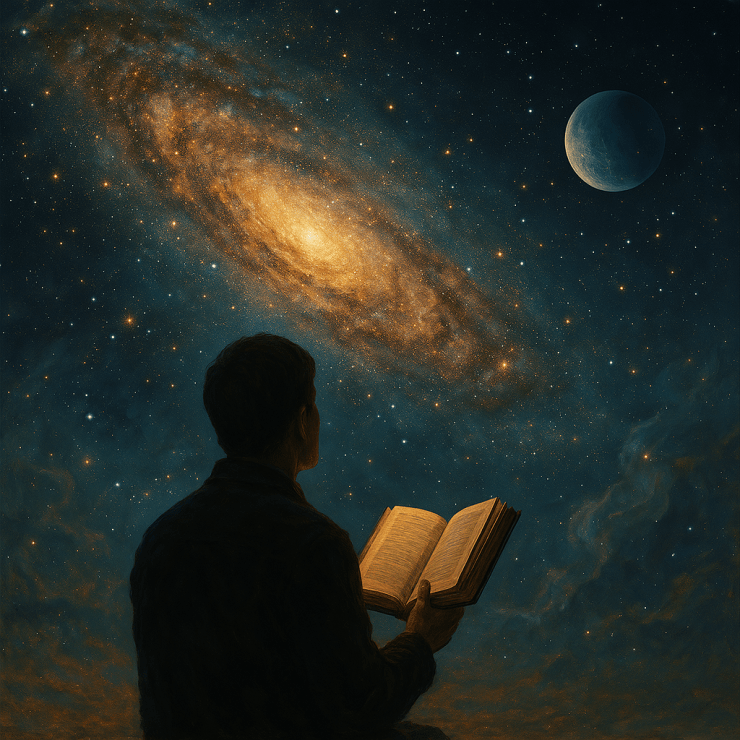
Science fiction evokes a sense of awe. Whether gazing at the spiral arms of a galaxy or watching humanity take its first steps on a distant planet, the genre awakens something ancient and sacred: wonder, marvel.
The Christian faith is not afraid of wonder. In fact, it begins in wonder: “When I consider Your heavens, the work of Your fingers, the moon and the stars, which You have ordained, what is man that You are mindful of him, and the son of man that You visit him?” (Psalm 8:3-4). And it ends in wonder: “Now I saw a new Heaven and new Earth, for the first Heaven and the first Earth had passed away… Then He who sat on the throne said, ‘Behold, I make all things new'” (Revelation 21:1, 5).
When a Christian reads science fiction and is overwhelmed by the vastness of the universe, that is not an argument against God. Rather, it is an invitation to worship. “The heavens declare the glory of God; and the firmament shows His handiwork” (Psalm 19:1).
Yes, some authors intend their speculative universes to deny the Creator. But often, they end up affirming it by accident. The very attempt to imagine a cosmos without God is a feckless endeavor; it often ends in the realization that something is missing—something only the Gospel can fill.
Reading with Discernment
Of course, not all science fiction is equally beneficial. Some stories are nihilistic, graphic, or hostile to the faith. Christians must read with discernment, guided by the Holy Spirit and informed by the Scriptures. But that is true of all reading, even theology.
We are not Gnostics who despise the physical world. Neither are we rationalists who need everything to conform to our meager categories. We are followers of Christ, who walked dusty roads, spoke in fantastical parables, and promised to return in power and glory. Our faith is incarnational—it belongs in the world. And it can stretch even to the stars.
As Paul says in 1 Thessalonians 5:21, “Test all things; hold fast what is good.” Science fiction must be tested. But much of it, when tested, proves to be good: rich in insight, honest in its questions, and fruitful for reflection. Here are some book suggestions to ease you into the genre if you’re unfamiliar with it:
- Fahrenheit 451 by Ray Bradbury (a sci-fi dystopian).
- Eruption by Michael Crichton and James Patterson.
- Starship Troopers by Robert A. Heinlein (a military sci-fi; nothing like the movie).
- Frankenstein by Mary Shelley (yes, it’s not a horror novel).
- Hyperion by Dan Simmons (book 1 of The Hyperion Cantos 4-part series).
- Ilium by Dan Simmons (the second book of the duology is Olympos).
- The Martian by Andy Weir.
- Project Hail Mary by Andy Weir.
Pilgrims in Space
The Christian is a stranger and a pilgrim on Earth (Hebrews 11:13). We look for a better country—the new Heaven and new Earth. In this way, every science fiction story that yearns for something more—every journey into the great unknown, every cry for justice, every glimpse of the transcendent—becomes a shadow of our true story.
Yes, the stars may be filled with silence. But even there, God speaks. And perhaps the more we learn to read science fiction well, the more we will long for the day when Christ returns with the new heavens and the new Earth.
So read boldly, think deeply, and see Christ even among the stars, which were created by Him and through Him (Colossians 1:15-17). The universe is not too big for grace, for it was made by it.
 The Lutheran Column
This was such a thoughtful and inspiring read—sci-fi really can reflect deep spiritual truths and stir our longing for something greater. I’ve read stories set in the future that echo these same themes of grace, redemption, and hope, and they’ve stayed with me long after the last page.
LikeLike
Thank you for your thoughtful comment! I appreciate the encouragement.
LikeLike