
“Indeed, any hope of overcoming him is false; shall one not be overwhelmed at the sight of him?” — Job 41:9
Leviathan: The Embodiment of Chaos
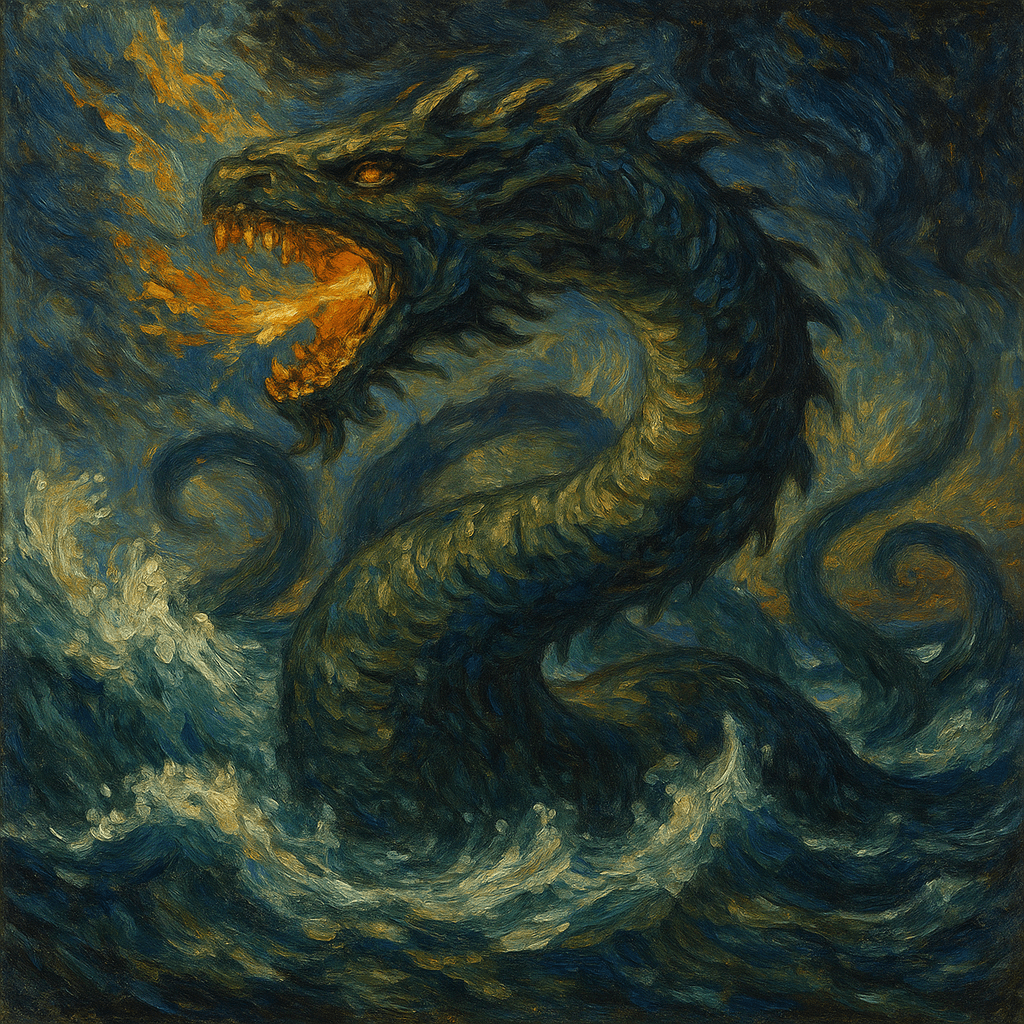
Similar to the behemoth before, God opens with another challenge: “Can you draw out Leviathan with a hook, or snare his tongue with a line which you lower?” (v. 1). The answer is obvious—no. No one can. Whatever it was, Leviathan is a force that mocks human strength, resists human weapons, and terrifies even the mightiest warriors. God describes him as untouchable, unconquerable, and fearsome: “No one is so fierce that he would dare stir him up. Who then is able to stand against Me?” (v. 10). Leviathan is not just a creature; it’s a metaphor for the forces of chaos and evil, the monsters of the deep that lie beyond human control.
Descriptions pile up with poetic fury: “His sneezings flash forth light, and his eyes are like the eyelids of the morning. Out of his mouth go burning lights; sparks of fire shoot out. Smoke goes out of his nostrils, as from a boiling pot and burning rushes. His breath kindles coals, and a flame goes out of his mouth. Strength dwells in his neck, and sorrow dances before him. The folds of his flesh are joined together; they are firm on him and cannot be moved. His heart is as hard as stone, even as hard as the lower millstone” (vv. 18-24).
Whether Leviathan refers to a literal creature like a crocodile or a mythical sea-dragon, again, like the behemoth, the point is not in the identification of this creature but that there are terrifying realities in creation man cannot manage—but God can. Leviathan is the final exclamation point in God’s sermon: even the most fearsome, unknowable powers are subject to Him.
If you’ve ever faced something in your life that felt too vast, too wild, or too terrifying to confront—like grief that won’t let go, trauma that won’t stop haunting you, fear that paralyzes, or even spiritual darkness that feels beyond naming—Leviathan is a symbol meant for you. It represents the chaos you cannot tame and the dread you cannot reason with. But God doesn’t show you Leviathan to frighten you; He shows you Leviathan to remind you that you are not in control, and that is grace. Because the One who created Leviathan is not threatened by it. The chaos that overwhelms you is not greater than the God who speaks from the chaotic whirlwind.
This means you can stop trying to fight the monsters alone. You can stop demanding explanations or wielding control as your shield. The untamable thing you fear, God already holds it in His hand. He knows where it lies; He drew its boundaries. In Christ, He has already declared it defeated—“It is finished.” Whatever chaos you’re facing, it is not sovereign. It may roar, but it does not reign. Your Redeemer does. And the same voice that summoned the stars and silenced Job’s storm still speaks today: “Fear not, for I am with you; be not dismayed, for I am your God. I will strengthen you, yes, I will help you, I will uphold you with My righteous right hand” (Isaiah 41:10).
The God Who is Not Threatened
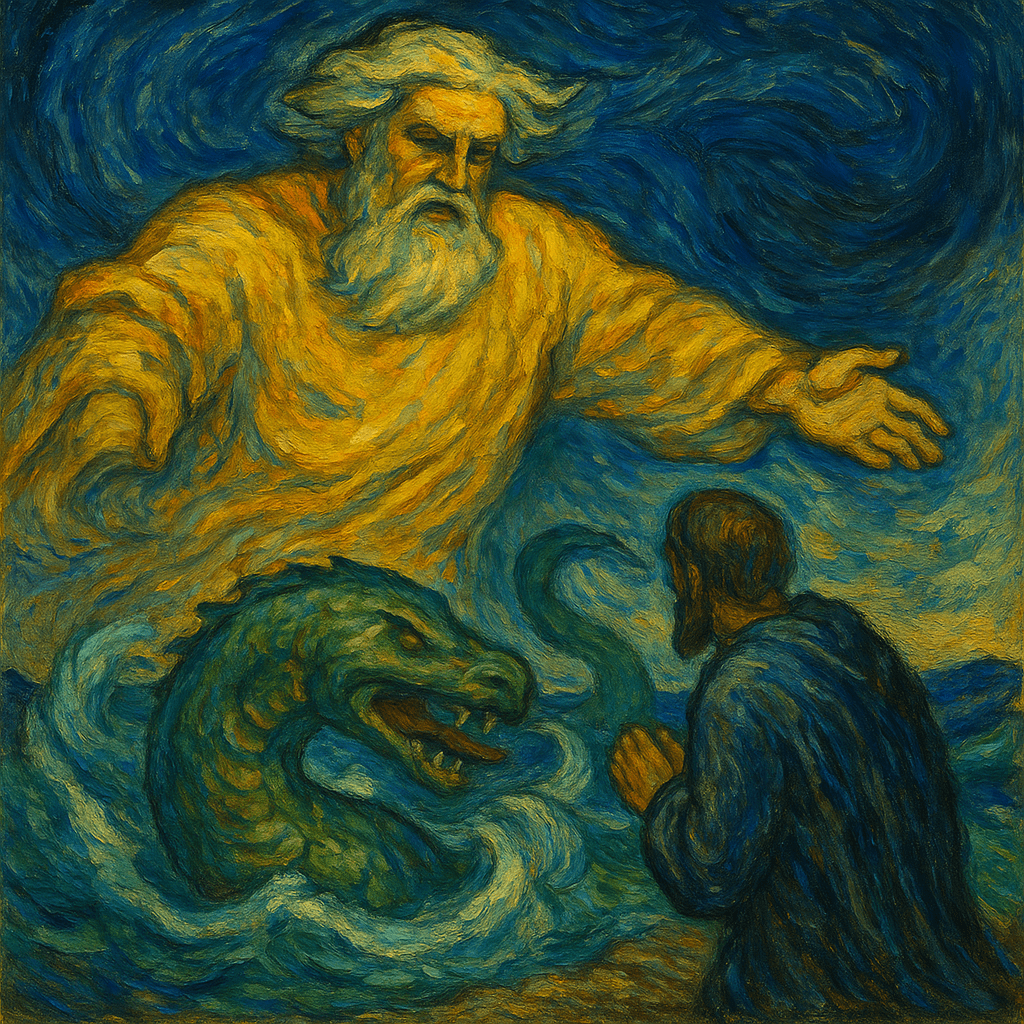
“Who has preceded Me, that I should pay him? Everything under Heaven is Mine” (v. 11). God’s speech makes a critical turn here. He’s not only the Creator of Leviathan—He is its Master. He owes no one an account. He’s not answering to Job’s pain as if on trial; He’s revealing His rule over the deepest, darkest forces of the world, as if to say: “That chaos that terrifies you? I’ve already put a leash on it. That power you fear? It cowers before Me.”
“When he raises himself up, the mighty are afraid; because of his crashings they are beside themselves. Though the sword reaches him, it cannot avail; nor does spear, dart, or javelin” (vv. 25-26). The futility of man’s weapons against Leviathan is part of the point: Job, like us, has tried to defend himself with knowledge, arguments, righteousness, and protest. But the Lord is showing him no human weapon can pierce the armor of suffering or chaos. Only God can rule this Leviathan of ours, and only God can ultimately crush it.
This chapter, therefore, is not meant to terrorize but to humble—and in humbling, to heal. Job has faced real suffering, and behind it the shadow of something larger than mere circumstance. Leviathan stands at the edge of Job’s comprehension like his own suffering: vast, deep, fiery, and utterly outside his control. But God says: “That belongs to Me.” Even the monster bows to the Maker. And Job, who has wrestled so long for understanding, is now given something greater: reverent silence before sovereign strength.
To reiterate, God never explains why Job has suffered. Instead, He shows who reigns over all things, including the things that are Leviathan and seem unjust and unconquerable. And that vision is what Job needed most. Not because it answers his questions, but because it settles his heart. Leviathan reminds Job—and us—that we are not gods, and we were never meant to be. We were only meant to be human, dependent on our gracious Creator who, in Christ, is both God and man so that the God-man now sits enthroned as the Almighty who is more powerful than the worst terrors we face.
The Monster is Not the Master
Job 41 ends with no speech from Job—only silence. The image of Leviathan, untouchable by human hands, stands as the final masterpiece in God’s gallery of sovereign power: “On Earth there is nothing like him, which is made without fear. He beholds every high thing; he is king over all the children of pride” (vv. 33-34). Yet for all his might, Leviathan is still just a creature. The monster is not the Master. God is. And He does not just conquer Leviathan—He uses it for His glory. The most frightening realities of your life are not outside God’s control. They may roar, but they cannot dethrone Him.
This chapter, therefore, is an invitation to release the illusion of control and rest in the arms of the Almighty. You don’t have to slay the monster. You don’t have to understand the storm. You don’t even have to escape the chaos. You only need to know this: the God who spoke to Job from the whirlwind is the same God who has crushed the head of the serpent on the cross. In Christ, not even the Leviathan of Death could have the final word, which now has no final word over you and me. The One who rules the deep is the One who raises the dead.
 The Lutheran Column