
“Shall the one who contends with the Almighty correct Him? He who rebukes God, let him answer it.” — Job 40:2
God’s Direct Challenge
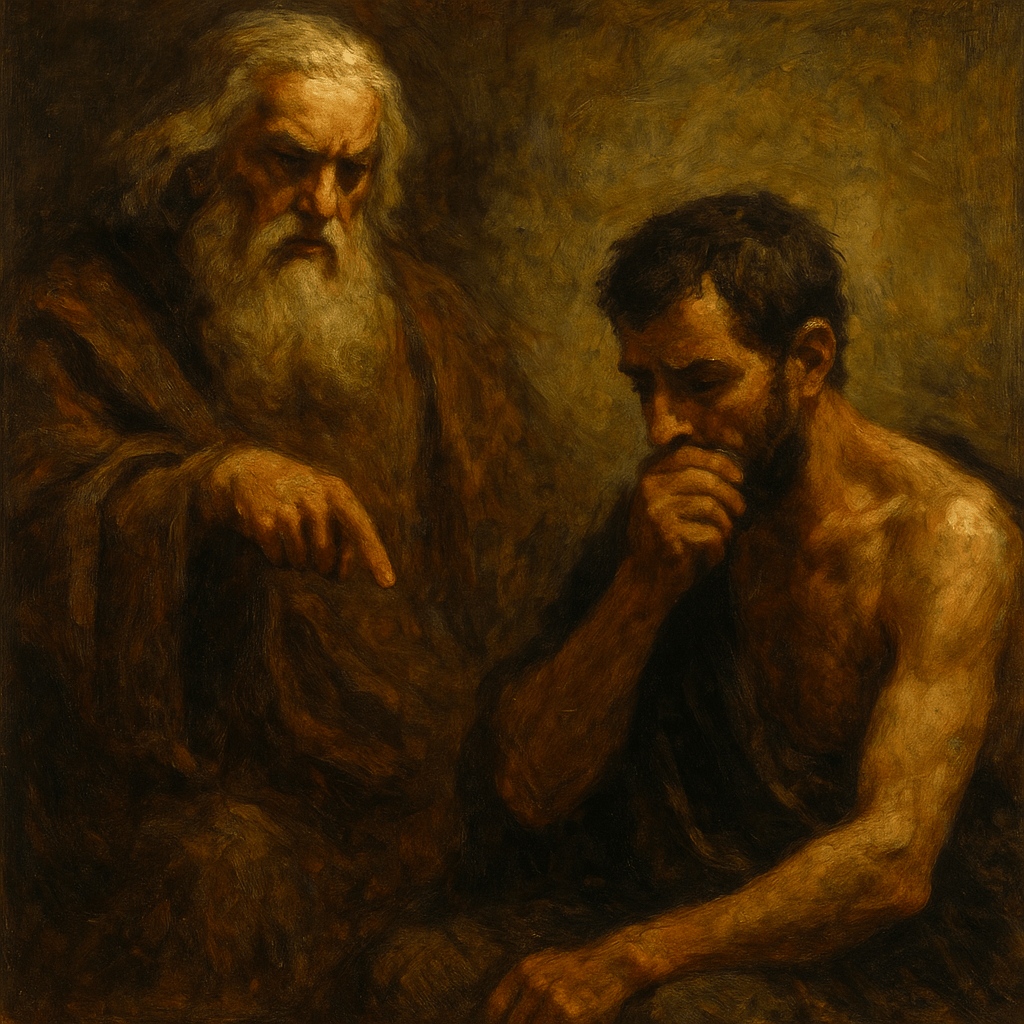
After unveiling the grandeur of creation in chapters 38 and 39, the Lord continues speaking directly to Job: “Shall the one who contends with the Almighty correct Him?” (v. 2). God is not asking for an apology; He’s inviting Job to reflect: Will you continue demanding answers from the One who holds the stars in His hand? God does not dismiss Job’s pain, but He will not be cross-examined. The courtroom has become a cathedral, and the proper response is reverent silence.
Then finally, Job is given room to speak, and he says, “Behold, I am vile; what shall I answer You? I lay my hand over my mouth” (v. 4). That is wise. But this is not Job groveling in shame, per se—he is understanding his place before God. He realizes that his suffering, though real, does not give him the vantage point to judge God’s justice. “Once I have spoken, but I will not answer; yes, twice, but I will proceed no further” (v. 5). Job does not repent of trusting God; he repents of demanding to understand God.
Perhaps in your own lamenting and grief, you’ve been tempted to put God on trial—to demand He answer for your suffering (or the suffering of another) or justify His silence. If so, Job’s encounter reminds you there is only One fit to judge, and it is not us. Again, God does not dismiss Job’s pain, but He challenges—with a tough love—the assumption that finite creatures can hold infinite wisdom accountable. We may feel the ache of injustice, but we must resist the temptation to declare ourselves more righteous or wiser than God. True healing begins not when we find all the answers but when we lay down the gavel and listen in reverent silence to the One who speaks from the whirlwind.
And yet, God’s challenge is not cruel but merciful. He doesn’t strike Job down for speaking so boldly, even if he did sin in doing so. Rather, He meets Job with questions that lead him out of despair. This is how God deals with us, too. He confronts us not to crush us but to correct us, and not to shame us but to restore us. If you find yourself standing at the edge of accusation, unsure whether to trust God’s justice, hear His voice: “Shall the one who contends with the Almighty correct Him?” That question is not meant to push you away but to draw you near—to remind you that the Judge of all the Earth will do right, even when His ways are hidden.
The Call to Clothe Yourself with Majesty
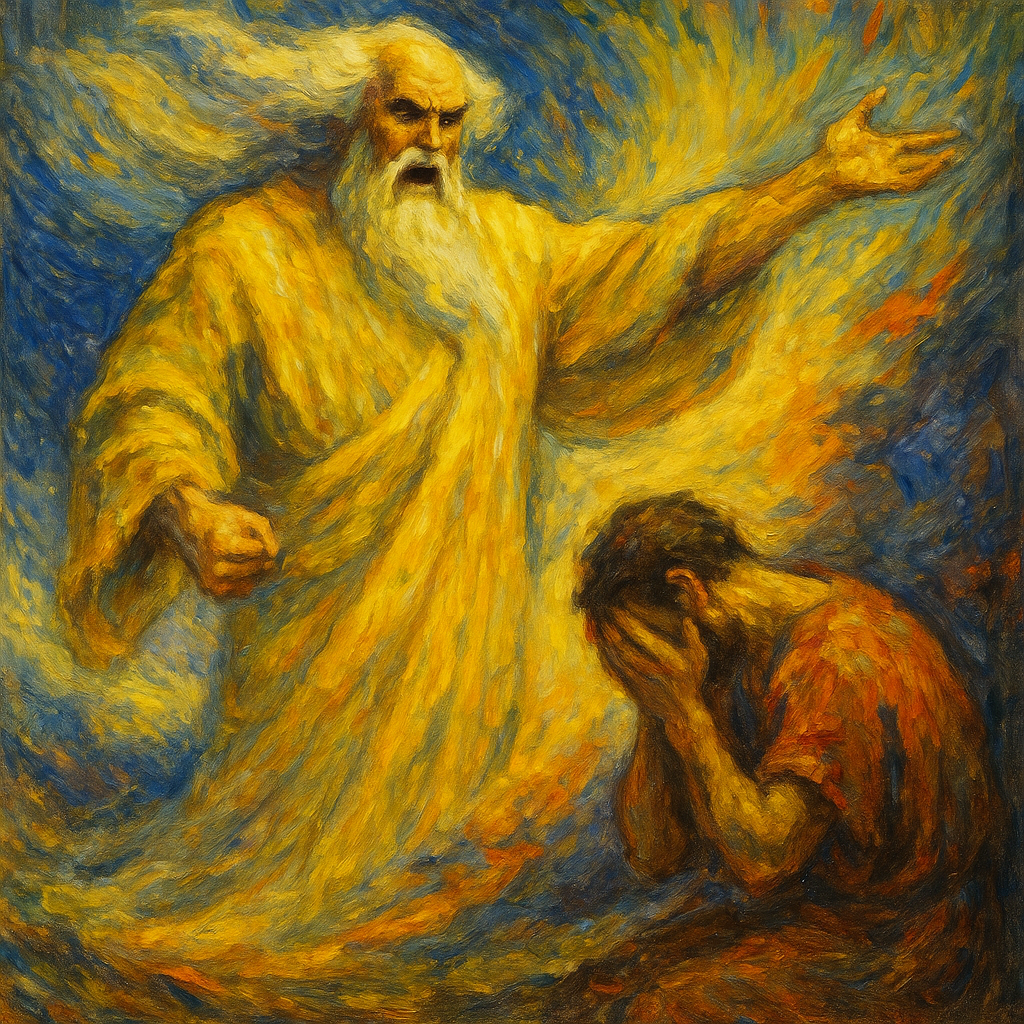
Job speaks briefly, but the Lord is not finished with him. With divine irony, He challenges Job: “Would you indeed annul My judgement? Would you condemn Me that you may be justified?” (v. 8). The danger Job now faces is not physical but theological. In his effort to defend his innocence and integrity, he has begun to accuse God of wrongdoing—but even then, this is not cursing God. So, the Lord asks, “Have you an arm like God? Or can you thunder with a voice like His?” (v. 9). If Job insists on judging God’s justice, he must possess God’s wisdom, power, and authority to do so.
If Job possesses such godlike attributes, God continues with a further challenge: “Then adorn yourself with majesty and splendor, and array yourself with glory and beauty. Disperse the rage of your wrath; look on everyone who is proud and humble him” (vv. 10-11). In essence, God is saying, “If you think you can run the universe and the laws of morality, then take My throne.” It’s not mockery; it’s an invitation to humility. Job cannot rule over prideful men or restrain evil with a glance. He cannot save himself, much less the Earth and the entire cosmos. Only God can judge with perfect justice and redeem with perfect mercy.
If you’ve ever tried to take God’s place by demanding full understanding, or by attempting to fix everything yourself, or by assuming judgement over how your life should unfold, God’s words to Job are a gentle but firm reminder for you as well: you were never meant to wear the crown. You cannot adorn yourself with majesty, command justice perfectly, or humble the proud with a glance. But the good news is that you don’t have to. God has never asked any of us to be sovereign over our suffering; He has only called us to trust the One who is.
This doesn’t mean your pain doesn’t matter; it means you are freed from the impossible burden of having to make sense of it all. Man tried this in the Garden by eating the fruit of knowledge, and look how that turned out! God alone is clothed in splendor and power. And in Christ, He has come not only to rule but to serve—to bear your weakness, to cover your shame, and to work justice not from afar but through a cross. So when life overwhelms you and injustice enrages you, remember you don’t need to seize control. You only need to kneel before the King who wears majesty like a robe, who has stooped low enough to wash your feet and walk alongside you in your suffering.
Behemoth: A Living Parable of Power

God then turns Job’s attention to the behemoth: “Look now at the behemoth, which I made along with you; he eats grass like an ox” (v. 15). The creature described is massive, untamable, and unthreatened. Its bones are like bronze, its limbs like bars of iron (v. 18). “He is the first of the ways of God; only He who made him can bring near His sword” (v. 19). The behemoth is a pinnacle of power in the created world. Yet, for all its strength, the behemoth is still a creature. It was made. It is known and governed by God.
Whether the behemoth is a poetic description of a hippopotamus or some other creature, a symbolic creature of chaos, or a now-extinct beast, the point remains: Job cannot overcome it. But God can. God possesses power that Job cannot contain or understand. In the behemoth, God gives Job a picture of how majesty and mystery coexist within His creation, and how even the most untamable forces of the Earth answer to His will.
If your life feels overrun by forces you can’t understand or control—grief that lingers, fear that won’t be mollified, suffering that defies explanation—God’s words about the behemoth provide comfort. Whatever this massive creature—or perhaps dinosaur—was, the point is not the identification of the creature but that the God who can tame this untamable creature can also tame the beast of your suffering. Choose whatever beast of this Earth—present or extinct—you think is mightiest. God has tamed that beast, and He can tame your suffering.
The behemoth is not a beast to be feared but a symbol of the truth that even the strongest, most uncontrollable forces in your life are still creatures, not gods. They have limits. They are known to the Lord. And the God who made them is not overwhelmed by them, and He will not let them destroy you.
In your weakness, it’s tempting to believe that unless you master the chaos, you’re at its mercy. But the behemoth teaches the opposite: your rest comes not from domination but from trust. You do not need to hold the reins of every mystery; you only need to know your Savior does. And in Him, we see the full picture—where the Creator not only governs the behemoth but has taken on flesh to conquer sin and death itself, the most untamable beasts of all. The untamable may roar, but it is not sovereign. Your God is. And He is not only mighty—He is merciful.
A Theology that Humbles and Heals
Job’s restoration begins with his posture before God transformed, not with his fortunes returned. Neither does God provide an answer to Job’s suffering in the form of a reason. Instead, He provides Himself. And in doing so, He invites Job to trade accusation for adoration, entitlement for reverence, and despair for trust. Job’s healing begins not in the reversal of his pain but in the re-centering of his worship.
Job 40 asks hard but holy questions: Are you willing to let God be God? Will you surrender your demand for control and your craving for explanation to the One whose ways and understanding are higher than yours? You may not understand your suffering, but the One who commands the whirlwind and created the behemoth understands you. And in Christ, that God has drawn near in mercy, not judgement.
This chapter is also a turning point. Again, Job does not receive an answer—he receives a revelation. God’s questions are not meant to shame him into silence but to shepherd him into a place of trust. The behemoth is not a threat; it’s a reminder that there are powers you cannot tame, mysteries you cannot unravel, and griefs you cannot solve, but there is a God who can. And that God, full of splendor and strength, still speaks.
For those who suffer, this chapter invites you to lay your hand over your mouth in faith, not fear. The world is not yours to carry. You do not preside over justice. And that’s good news, for every justice system we formulate is imperfect and becomes corrupt. The One who thunders from the whirlwind is also the Lamb who was slain. Justice met in His majesty on the cross, and there you find not condemnation but mercy that humbles and heals.
 The Lutheran Column
1 thought on “Job 40: The God Who Tames Behemoths”