
“Do you know the time when the wild mountain goats bear young? Or can you mark when the deer gives birth?” — Job 39:1
Creatures Beyond Human Control
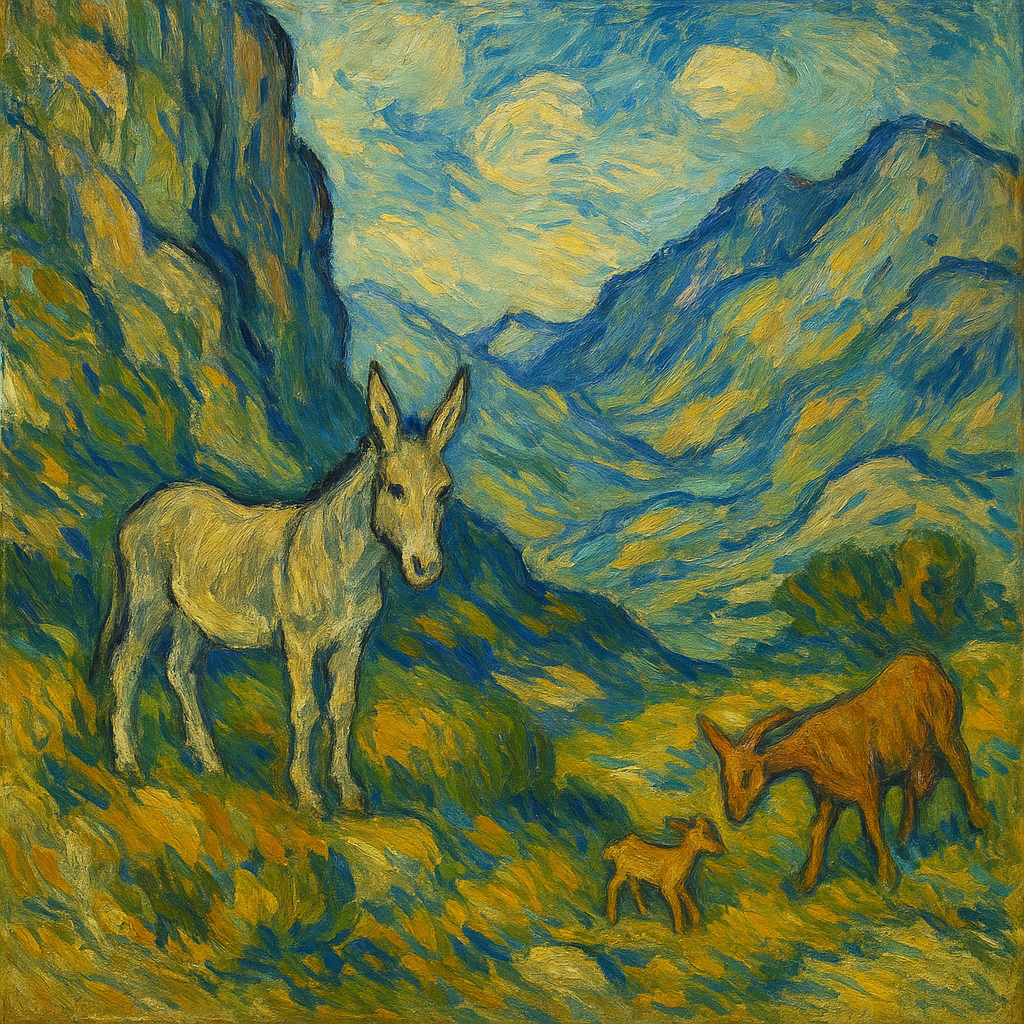
God continues His inquisition, now with a shift in tone—from the cosmic scale to the creaturely. It’s a tender, quiet mystery—life beginning in remote places Job has never seen, managed by hands he cannot guide. God knows every moment on Earth. His care is intimate, His knowledge exact. The world does not depend on Job’s insight, nor does it run by his wisdom. Creation is governed by a wisdom far greater, far wilder, and far more detailed than Job ever imagined.
The wild donkey and the onager (a kind of desert dwelling wild donkey) follow no human yoke: “Who set the wild donkey free? Who loosed the bonds of the onager, whose home I have made the wilderness, and the barren land his dwelling?” (vv. 5-6). These are creatures that resist domestication. They are not tamed by man, yet they flourish under God’s care. In highlighting them, God is reminding Job that the world is filled with life that thrives apart from human systems and understanding. The absence of control does not mean the absence of order; it simply means the order belongs to God.
If your life feels out of control—if grief, illness, or uncertainty have made you feel like the world no longer answers to reason—this chapter offers comfort because it assures divine care, not regained control. The wildness of creation is not a flaw; it’s a feature that testifies to a God who governs even what we cannot tame. You don’t need to see every hidden place or understand every process. The God who watches over mountain goats birthing in secret places is watching over you. He sees what you cannot. He sustains what you never knew needed sustaining. And He is never overwhelmed.
This means your security is not found in your ability to manage life but in trusting the One who governs what you cannot reach. If your prayers feel unanswered and your suffering feels invisible, take heart: you are not unseen. The same God who gives freedom to the wild donkey and guides the rain in barren places is present in your wilderness, too. His providence extends beyond the boundaries of your understanding, and that is good news. Because when your strength fails, your Shepherd still leads you to green pastures and beside still waters (Psalm 23:1-3). And the world, though untamed, is never outside His control.
God’s Strange Wisdom in Creation
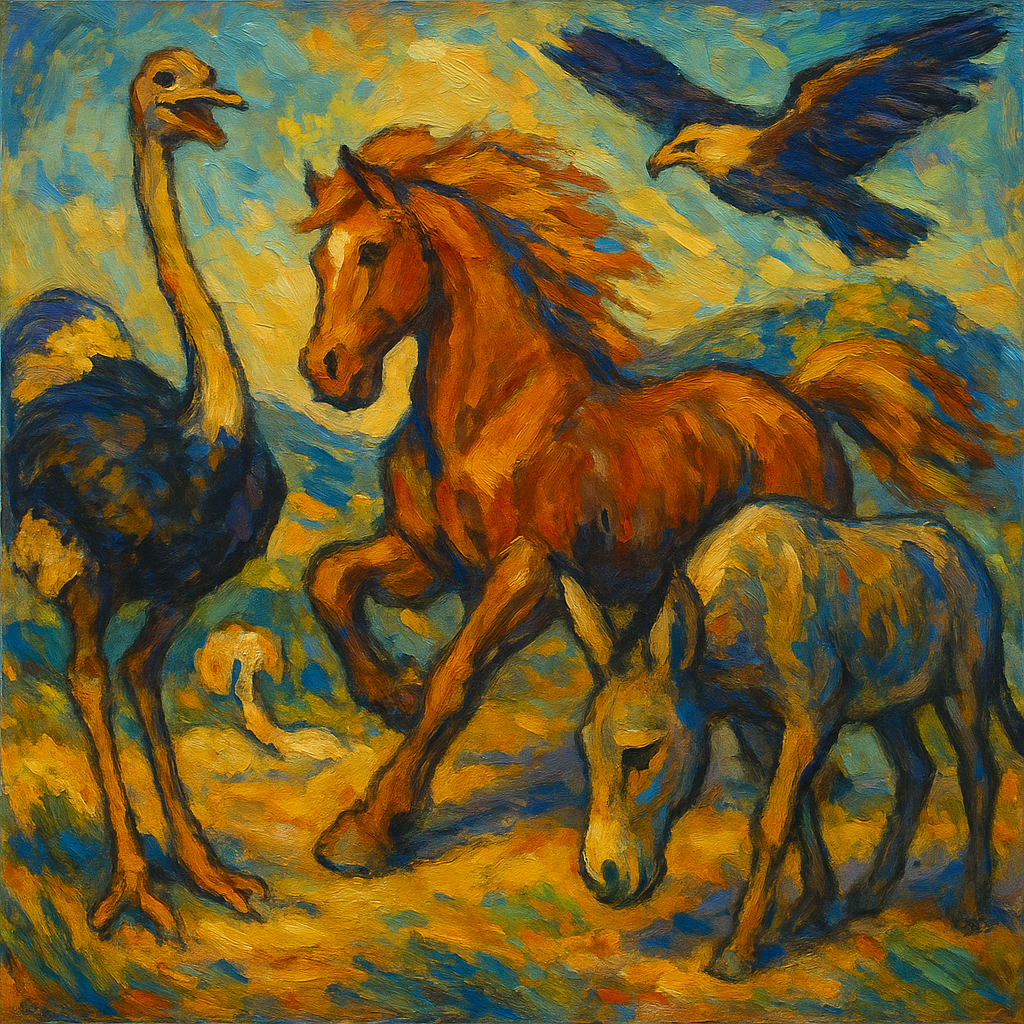
The ostrich is described with a bit of humor (vv. 13-17). She lacks wisdom and understanding. She leaves her eggs in the dust, forgets they may be crushed, yet runs faster than a horse. God delights even in the absurdities of creation. The point is not mockery; it’s a celebration of a wisdom that is not ours. God’s design accommodates creatures who are seemingly foolish yet are provided for and sustained. Even the “foolish” flourish under His hand.
Then God speaks of the horse: strong, majestic, fearless in battle. “He paws in the valley and rejoices in his strength; he gallops into the clash of arms. He mocks at fear and is not frightened; nor does he turn back from the sword… At the blast of the trumpet he says, ‘Aha!’ He smells the battle from afar, the thunder of captains and shouting” (vv. 21-22, 25). He’s speaking specifically of warhorses, of course, who are bred for battle, not your common stable horse.
And the haw and the eagle, who soar high above, seeing from heights Job cannot reach (vv. 26-30). God names each animal’s strength, limit, and glory. These are not just natural wonders; they are general revelations of God’s design. God is not offering a biology lesson; He’s showing Job that creation reflects a wisdom not bound by human logic or expectations.
If your life feels confusing—if you’ve done everything “right” and still suffer, or if you can’t make sense of how God is working—this may sound odd, but remember the ostrich. God calls her foolish, yet He has joy in her. She lacks wisdom but can even outrun a fierce warhorse. God is not only present in order and strength; He’s also at work in what seems absurd or weak. That means your limitations, quirks, and even your confounding situations are not outside the scope of His care. You may not understand why things are the way they are, but you are not forgotten. God sees you through the lens of grace, not through the lens of utility.
The ostrich, eagle, wild donkey, and horse remind us that God’s wisdom is often strange to us, but never wrong. He delights in the unexpected, the unexplainable, and the untamed. And if He can care for creatures with no obvious purpose, how much more will He care for those created in His image (cf. Matthew 6:25-34)? You don’t need to make sense of every detail. You only need to trust the One who formed the foolish and the majestic alike has not made a mistake with you. His strange wisdom is not something to be solved; it is to be trusted with open hands and an expectant heart.
The World is Not a Machine
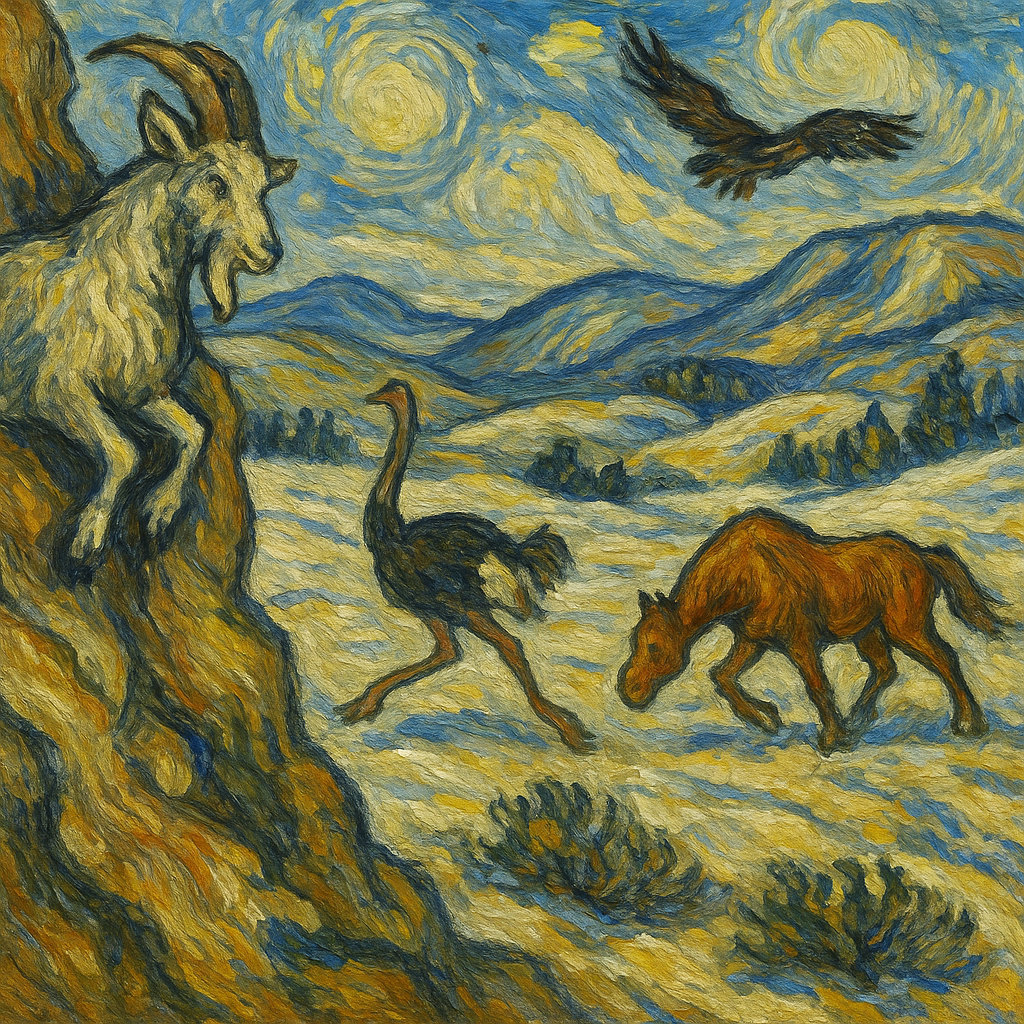
This chapter dismantles the idea that everything in life must be explainable, controllable, or useful in human terms. The mountain goat’s secret birth, the wild donkey’s freedom, the ostrich’s folly, and the eagle’s flight do not fit neatly into human categories of order. And yet, God delights in them and provides for them. He sustains them. The world is not a machine built for man’s benefit; it’s a stage for God’s glory. Further, Job 39 defies the deistic notion that God is like a watchmaker—that He set up creation to run its course and He sits back and watches, uninvolved.
God’s questions gently confront Job’s assumption that suffering must mean disorder and that pain must mean purposelessness. The world is wild, yet not lawless. It’s mysterious, but not meaningless. The God who tends to animals in the remotest cliffs and desert plains is not absent from the lives of His people. Job’s affliction is not proof of chaos but a summons to humility before divine wisdom.
Job 39 thus invites you to worship in a new way—by marveling that God understands everything rather than relying on human understanding. The mountain goat’s labor, the ostrich’s sprint, and the eagle’s flight all declare God’s ways are not our ways. And that is good news, because the same God who watches over the wild also watches over you, no matter how wild your situation. The same God who governs unsearchable mysteries is not perplexed by your pain.
Furthermore, this chapter is a call to lay down the burden to needing to understand everything and take up the joy of being known by the One who does. In Christ, we are not only watched—we are redeemed. And the voice that thunders from the whirlwind has also cooed from a manger and cried out from a cross. He knows the way of the eagle, and He knows your path, too.
 The Lutheran Column
1 thought on “Job 39: God’s Continued Inquisition”