
Date: July 27, 2025
Festival: 6th Sunday after Trinity
Text: Romans 6:1-11
Preaching Occasion: Calvary Lutheran Church, Carson City, MI, and Peace Lutheran Church, Alma, MI
Appointed Scriptures: Exodus 20:1-17; Romans 6:1-11; Matthew 5:17-26
Sermon Hymn: LSB #562 All Mankind in Adam’s Fall
In the name of the Father and of the Son and of the Holy Spirit. Amen.
“What shall we say then? Shall we continue in sin that grace may abound?” [Rom. 6:1]. Such a question ought to make us tremble. It speaks to a conscience so twisted that it uses God’s grace as a license to sin. In our sin and bitter rebellion, we think God’s goodness is something to be toyed with. We are so twisted that we think, “I can commit this sin because God will forgive me anyway!” We often see this depicted on television when someone walks into a confessional booth to confess a sin they’re about to commit. That’s not how grace works. Paul’s reply to such thinking is, “Certainly not! How shall we who died to sin live any longer in it?” [v. 2].
Paul goes on to reveal the mysterious paradox of Baptism: that in order to live, we must die; to be free, we must be buried; and that the path to true holiness is through a tomb. Baptism is not a mere bath. In Baptism, your old self—your old Adam—was drowned. You were plunged into Christ’s death—plunged into the grave where His body lay, limp and bloodied and breathless. Your old self is the part of you that clutches to your idols, excuses your rage, justifies your lusts, and defends your pride. They must be buried with Jesus so that a new self may rise, created after the likeness of Christ in true righteousness and holiness.
Do you remember what the Law demands? It began thunderously on Mt. Sinai: “I am the LORD your God, who brought you out of the land of Egypt, out of the house of bondage” [Ex. 20:2]. Notice what the Law begins with. It does not begin with your obedience but with God’s deliverance—with God’s salvation work. And yet, the Commandments that follow are like a mountain too high to climb: no other gods, no worshiping of images and misusing God’s name, no profaning the Sabbath, no dishonoring your parents and other authorities, no murder, no sexual immorality, no stealing, no false testimony, and no coveting of any kind. You memorized these Commandments in Confirmation; you would do well to keep them memorized and not slack in revering them, lest, as Jesus says, “you be thrown into prison,” which is Hell [Matt. 5:25].
The Law is not merciful. If you break “one of the least of these commandments,” Jesus says, you break all of them [v. 19]. The Law has no compassion. It is strict. It does not bend the rules. It does not lower the bar. “All good intentions lead to Hell” because the Law doesn’t care about your good intentions. It doesn’t matter what you intended—you broke the Law.
In fact, when Jesus preaches on the Law in His famous Sermon on the Mount, He intensifies the Law. In today’s reading, He intensifies the 5th Commandment. “You have heard that it was said to those of old, ‘You shall not murder, and whoever murders will be in danger of the judgement.’ But I say to you that whoever is angry with his brother without a cause shall be in danger of the judgement’” [vv. 21-22]. The Apostle John would teach more about Jesus’ words on this Commandment in his first epistle when he writes, “Whoever hates his brother is a murderer, and you know that no murderer has eternal life abiding in him” [1 John 3:15].
Jesus, the one who came in grace and truth [John 1:14], takes the Law even deeper. It’s not just the act; even unjustified anger is murder. Not just the blade or the gun, but the bitter word that kills. “Whoever insults his brother,” Jesus says. Or more literally, whoever says “Raca!” which is Aramaic for “fool.” In its original meaning, this word doesn’t mean someone who’s silly, and it’s not condemning the way we tease our friends either. It means someone who is empty-headed—a numbskull. This isn’t merely name-calling; this is dehumanizing a person to the extent that we view them as scum. This is the kind of thinking that leads to holocausts, genocides, euthanasia, eugenics programs, and infanticides like abortion.
What shall we say then? Can we, who were buried with Christ in Baptism, return to the sin that crucified Him? Can we stand at the foot of the cross and speak apathetically of sin, as though it were manageable and not a big deal? Can we, who have tasted His grace, presume that grace means we may go on using Christ’s name as a swear word, dishonoring our parents, provoking our children to wrath, hating strangers on the internet, lusting, and so on?
To think and speak this way is to fundamentally misunderstand grace. Grace does not tell the corpse to try harder; it speaks to the dead and raises them. Grace calls the captive not just forgiven, but free. “Or do you not know,” Paul writes, “that as many of us as were baptized into Christ Jesus were baptized into His death?” [Rom. 6:3]. If you’ve been baptized, you are no longer your own. The old Adam within you has been drowned, though he still clings to your flesh for dear life and continues to kick and gasp and try to climb back out.
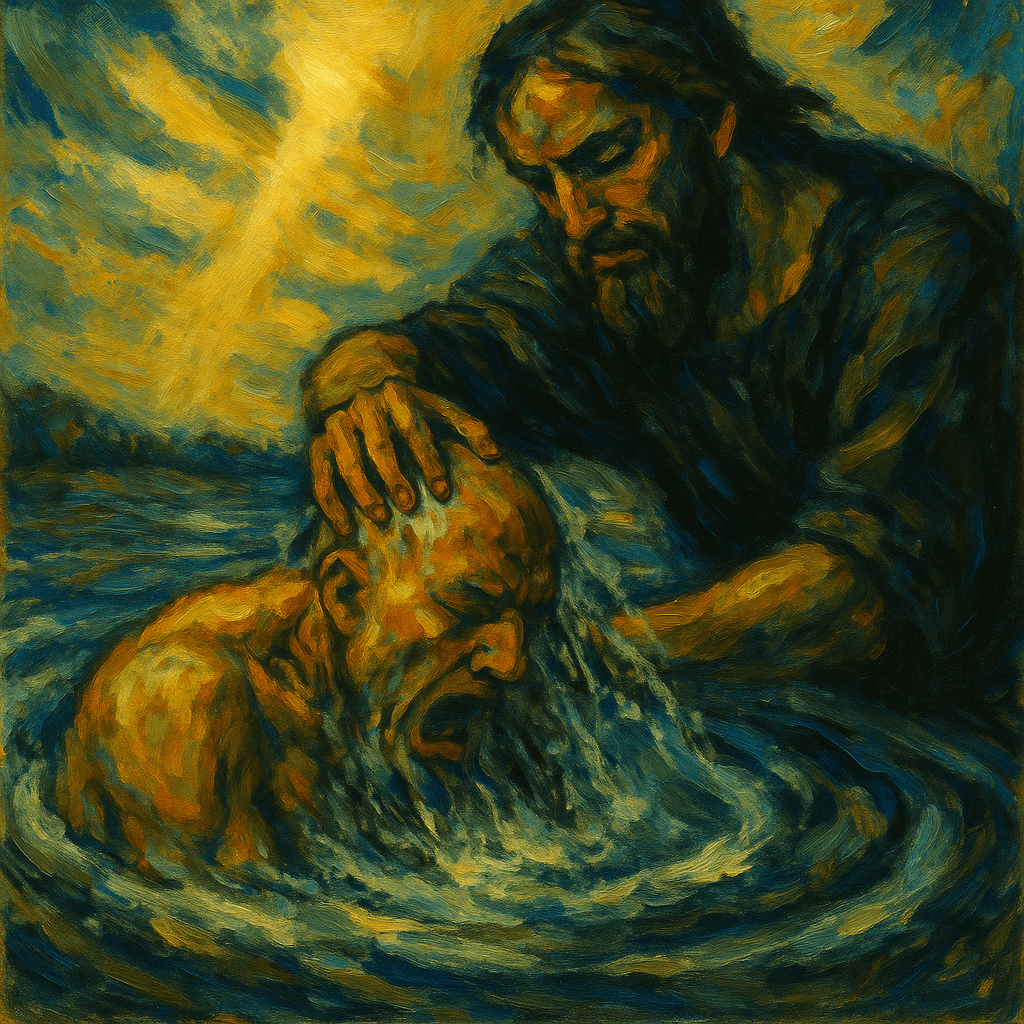
But Baptism’s flood is stronger. As the wicked fought for dear life, the Flood in Noah’s day consumed all flesh, and they drowned, and Noah and his family were saved in the ark. And now, Baptism is working to consume your flesh, keeping you safe in the ark of Christ’s Body, which is the Church. Just as God shut Noah in the ark, so He shuts you in the wound of Christ’s pierced side, from which flow the water and blood of His Sacraments. Thus, you have been sealed in the tomb with Christ, and you now stand as a new man or woman, dripping, breathing, and blinking into the light of Easter morning.
Christ did not die so that we could keep sinning with impunity. He died so that we could die with Him and live. “For if we have been united together in the likeness of His death, certainly we also shall be in the likeness of His resurrection” [v. 5]. We have a new rhythm now. Not the rhythm of slavery—of sin repeating itself like a cursed refrain. Not the rhythm of the Law thundering, “Do this or die,” but the rhythm of Baptism’s exodus, bringing you from death into life—daily dying and daily rising, drowning the old Adam every morning through repentance, with all his stubborn thoughts and bitter desires, and emerging anew as a child of the resurrection.
This death—this Baptism—is not symbolic. It is our spiritual reality. “Knowing this,” says Paul, “that our old man was crucified with Him, that the body of sin might be done away with, that we should no longer be slaves of sin” [v. 6]. This is why St. Peter writes, “Baptism now saves you” [1 Peter 3:21]. A lot of Christians have a problem with this, unfortunately. They think Baptism is our work, so when we say Baptism saves, they think we’re saying our work of Baptism saves us rather than Jesus. No, Baptism is God’s work. Just as God saved Noah through a flood and saved the Israelites through the Red Sea, which Paul calls a baptism into Moses [1 Cor. 10:2], so God saves through Baptism. God always uses means to save His people, be it blood, water, bronze serpents, bread and wine, or even simply His spoken Word.
These mistaken Christians also like to say, “What about the thief on the cross,” because they assume he wasn’t baptized. Not only do we not know this (for he definitely could have been baptized), but he was also fortunate enough to be literally crucified with Christ, to whom Jesus said, “Today you will be with Me in Paradise” [Luke 23:43]. You and I don’t have that luxury. The thief on the cross is not the exception but the rule. We can’t go back in time to be crucified with Jesus and receive the promise of being with Him in Paradise. Therefore, He instituted Baptism, through which we have been crucified with Him. On the cross, the power of sin has been broken, not because you finally got it together but because Jesus was nailed to a tree in your place.
If you search images of Baptism on Google, you’ll likely find images of people wearing a t-shirt that says, “I Decided!” But a dead person cannot decide anything. You were dead in your trespasses and sins, Paul writes in Ephesians [2:1]. A corpse cannot get up and decide to live. Lazarus did not come out of the tomb until Jesus commanded, “Come out!” Therefore, through water and the Word, you die with Christ on the cross, He commands you alive in Him, and you are now freed from sin.
Freed! Not just forgiven—your bonds have been released. Jesus, who has the key to Death and Hades, has removed sin’s handcuffs. The devil’s accusations are silenced. The Law’s demands—righteous and holy as they are—can no longer condemn you who have already died in Christ, the One who has fulfilled the Law [cf. Rom. 8:1]; for judgement has been rendered. The verdict has been spoken: “It is finished.”
Yet still, the struggle continues. The old Adam is a stubborn corpse. He floats. He resurfaces. He whispers. He tempts. And yet, you are not alone. You have been united to Christ. What is true of Him is now true of you. “Now if we died with Christ,” Paul continues, “we believe that we shall also live with Him” [Rom. 6:8]. Not just someday in the resurrection of the body, but even now, in the mystery of our daily baptism, which Luther calls repentance [LC IV, 74].
Jesus did not abolish the Law, for it still convicts our consciences to bring us to repentance. Again, He fulfilled it [Matt. 5:17]. Every demand, Commandment, and drop of justice the Law required has been satisfied in the life and death of Jesus. And now, clothed in His righteousness, baptized into His death and life, the Law no longer stands as a curse but as a guide. Not a ladder we climb to Heaven but as a lamp that guides our feet [Psalm 119:105] because Heaven has come down to us. We no longer have to keep the Law; now we get to keep the Law out of love for God and neighbor.
Dear saints, this changes everything. We no longer live to please the flesh. We no longer speak the way we used to speak, or desire what we used to crave. We do not make peace with sin—we put it to death when we confess it to our heavenly Father. And when it rears its ugly head again, we take it back to the waters through repentance—back to the cross, back to the tomb, because we are not our own. We were bought with a price—with the innocent blood of Jesus [1 Cor. 6:20].
Therefore, “reckon yourselves to be dead indeed to sin, but alive to God in Christ Jesus our Lord” [Rom. 6:11]. You are alive. Not surviving, not merely coping—but alive. With a new heart, a new mind, a new desire, a new Master—and one day soon, a new body on the Last Day.
So, as you approach the altar today, bury your sin again. Nail it to the cross. Drown it in the font. Speak it in confession. And then walk away from the grave, because the tomb is empty. Christ is risen. And you are no longer a slave, but a son. No longer bound, but free. No longer dead, but alive in the crucified and risen Lord.
In the name of the Father and of the Son and of the Holy Spirit. Amen.
 The Lutheran Column