
“For I know that my Redeemer lives, and He shall stand at last on the Earth; and after my skin is destroyed, this I know, that in my flesh I shall see God.” — Job 19:25-26
Shattered by Words

Job’s response to Bildad is not merely a rebuttal—it’s a cry of protest against cruelty masquerading as pious wisdom. “How long will you torment my soul and break me in pieces with words?” (v. 2). Job’s suffering has not only come from sores and loss, but also from his friends’ pontificating. He’s been cut down by both God’s silence and man’s misuse of God’s name.
“These ten times you have reproached me; you are not ashamed that you have wronged me” (v. 3). Job’s friends, instead of comforting him, have committed spiritual abuse. They’ve treated his wounds as evidence of wickedness. And their persistence in judgement has multiplied his agony.
Job continues, “Know then that God has wronged me, and has surrounded me with His net” (v. 6). These are painful words—Job still believes God is behind his suffering. Indeed, he believes Bildad’s previous words despite his rebuke of them! Yet despite these striking words, he does not call God his enemy; he cries to God as one who feels abandoned. His theology is not neat, but it is honest. He’s not trying to escape guilt—he’s trying to understand what appears to be divine hostility from the God he’s always feared and loved.
This section is not merely about Job’s pain—it’s about the devastating power of words when wielded without wisdom. To torment someone with the name of God is to do more than misunderstand them; it is to distort the face of the Almighty. The wounds inflicted by false friends often cut deeper than those inflicted by enemies, precisely because they come dressed in the garb of concern, cloaked in holy language. As David wrote, “For it is not an enemy who reproaches me; then I could bear it. Nor is it one who hates me who has exalted himself against me; then I could hide from him. But it was you, a man my equal, my companion and acquaintance. We took sweet counsel together and walked to the house of God in the throne” (Psalm 55:12-14).
Job’s words echo in the ears of all who’ve been shamed under the guise of help, who’ve been judged when they needed mercy, and silenced when they needed understanding. He does not just want their pity—he wants their repentance. And he names their wrong not out of bitterness but because love tells the truth. Their theology has broken him. Now he asks if they can see the shards.
Isolation in the Dust

In verses 7-20, Job recounts the total collapse of his life. “If I cry out concerning wrong, I am not heard. If I cry aloud, there is no justice” (v. 7). this is not an abstract complaint—it’s the grief of someone who once had a place in society, in family, and before God, and now finds himself erased.
“[God] has removed my brothers far from me, and my acquaintances are completely estranged from me… My breath is offensive to my wife, and I am repulsive to the children of my own body” (vv. 13, 17). Job’s losses are not just financial and physical—they’re also relational. He’s been abandoned by those closest to him. Suffering has not drawn others near; it has driven them away. This is the cruel irony of affliction: just when one needs comfort most, people recoil.
He adds, “My bone clings to my skin and to my flesh, and I have escaped by the skin of my teeth” (v. 20). His body is a shell, severely malnourished in his depression. His relationships are gone. And yet, he still speaks. His very speech is an act of faith—a meager refusal to allow suffering the final word. It’s in this bleakest moment that his greatest confession rises.
This kind of isolation compounds the suffering of the soul. Job does not merely feel forgotten—he feels forsaken. His body has become a source of revulsion, his name a byword, his presence a burden. Even the children—those least likely to be shaped by theological judgements—now mock him (v. 18). There’s nowhere he can go to be seen, heard, or touched without shame. This is not just loss—it is exile.
And yet, in this exile, Job continues to speak. Though shunned by men, he does not silence himself before God. His lament, far from evidence of doubt, becomes a manifestation of endurance. And that simple act—the voice of one abandoned—will one day echo in the mouth of Christ, who also was despised, rejected, and utterly alone, yet opened not His mouth in hatred but in hope.
A Cry for Pity and a Plea for Preservation
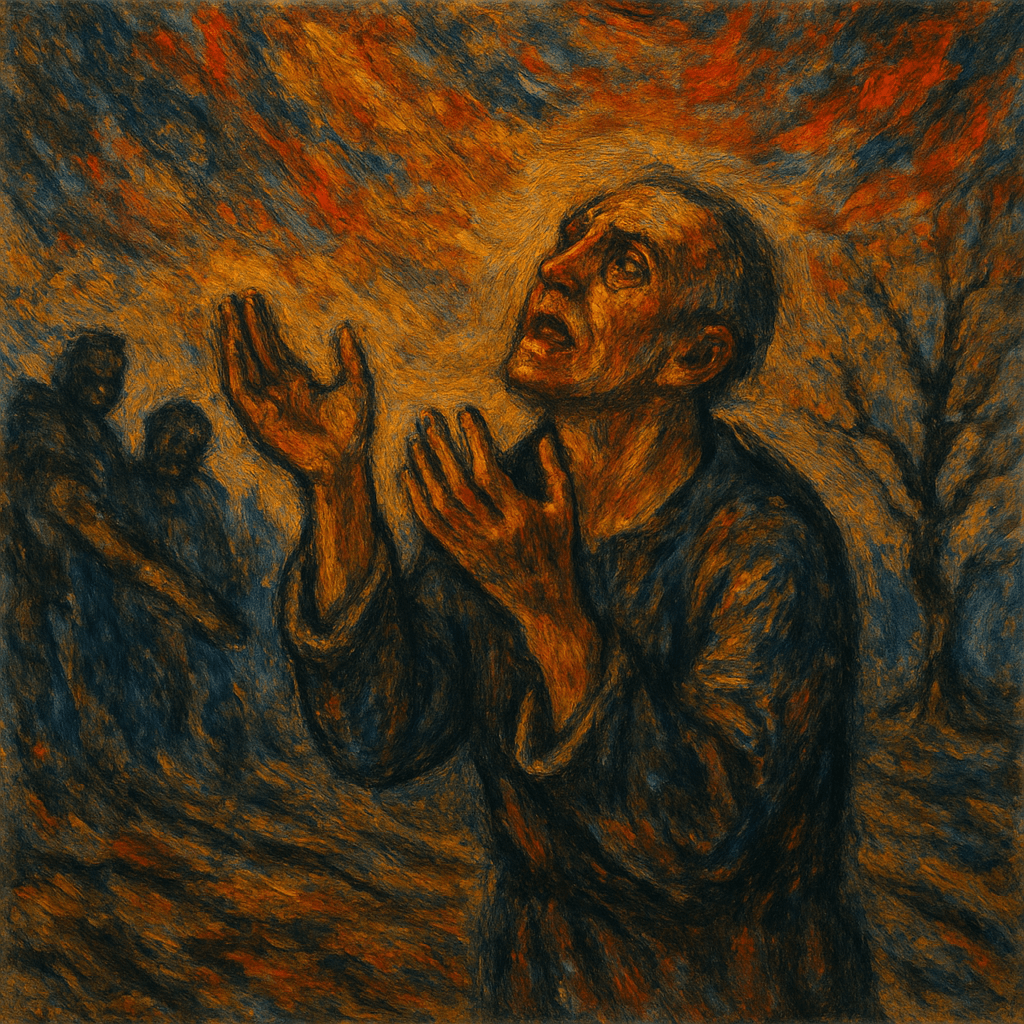
Before declaring his Redeemer lives, Job turns to those around him with one final appeal: “Have pity on me, have pity on me, O you my friends, for the hand of God has struck me!” (v. 21). Job is not asking them to change his circumstances—he knows they can’t. He’s asking them to recognize his humanity, to stop trying to explain his situation away, and to treat him not as a puzzle to solve but as a person to be loved.
“Why do you persecute me as God does, and are not satisfied with my flesh?” (v. 21). He knows God’s providence has allowed his suffering. (God did not cause his suffering, but He did permit it. There’s nothing that happens to us that does not pass through God’s good and gracious hands.) But his friends, in their theology of glory, have gone further—they’ve relished in his downfall. They’ve become cruel in the name of being correct. Job’s question to them is piercing: Why do you act as if it’s your job to finish what God has started?
Then he turns from them and looks upward—and forward. “Oh, that my words were written! Oh, that they were inscribed in a book!” (v. 23). Once again, there’s dramatic irony here—we the readers know something he doesn’t. His words have indeed been recorded in the very book we’re reading. Job wants his protest, his innocence, and his hope to outlive him. He wants his cry to echo beyond the dust. And without knowing it, he gets exactly what he asked for. His words are inscribed in our Bibles. His lament is preserved not only in parchment but in the canon of Scripture and the heart of God.
In these words, Job is not only confronting the poor theology of his friends but also their lack of compassion. Their attempts at theodicy have led them to abandon God’s mercy. Job asks for pity not because he’s innocent but because he’s simply human. He’s not demanding they vindicate him, only that they acknowledge his pain. He’s pleading for presence—for someone to remain with him in the ashes without trying to explain them away.
This plea echoes through every generation of the suffering faithful. The afflicted do not first need answers—they need solidarity. They do not need doctrine shouted from a distance—they need the nearness of those who believe God is still present despite the silence. Job’s friends had Scripture on their lips but not love in their hands. And Job, though stripped of all comfort, still offers us the way of true ministry: listen, weep, and do not try to play God. As one of my professors at seminary was famous for saying: “God is God; you are not. Don’t be a theologian of glory.”[1]
My Redeemer Lives

Then comes the climax of Job’s faith and the center of the entire book: “For I know that my Redeemer lives, and He shall stand at last on the Earth” (v. 25). The Hebrew word for “redeemer” here is גֹּאֵל (go’el), which refers to the kinsman-redeemer—the relative who takes up the cause of the helpless, pays their debt, restores their land, or avenges their blood (see the Book of Ruth). Job does not just hope God is just; he believes someone—God Himself—will take up his cause.
“And after my skin is destroyed, this I know, that in my flesh I shall see God” (v. 26). Job’s confession reaches beyond death. He believes in the bodily resurrection. Though his skin be devoured, though his name be forgotten, though his breath be gone, he will see God in his flesh upon the Earth. Not with another’s eyes. Not in spirit only. But with his own resurrected eyes in his own flesh.
This is no spiritual theory—it’s the cry of desperate certainty. Job does not base this on what he sees but on what he knows by faith. And this knowing is faith (again, Hebrews 11:1). This is what it means to believe without sight—to trust while still aching. His Redeemer lives, even while he wastes away.
This wondrous confession comes not from the mountaintop but from the pit. Job sees no outward reason to believe in the bodily resurrection—his pain is unrelieved, and God has not spoken—yet he still cries out with certainty: “I know that my Redeemer lives, and He shall stand at last on the Earth. And after my skin is destroyed, this I know, that in my flesh I shall see God, whom I shall see for myself, and my eyes shall behold, and not another. How my heart yearns within me!” (vv. 25-27). Again, this is not a theory for him. It is defiant faith in the middle of desolation. His Redeemer may be silent now, but He is alive. And one day He will rise to Job’s defense—not to explain Job’s suffering but to tend it with God’s true justice and mercy.
What Job declares here is more than hope—it is prophecy. He does not merely believe in resurrection—he proclaims God Himself will stand upon the dust, incarnate, present, and victorious. Job does not yet know the name of Jesus, but he knows the shape of His work. And in this confession, the Church finds her own voice: that even when we suffer, even when we decay, even when everything is lost, we also shall see God, and not as a stranger.
The Gospel in the Ashes
Job ends with a warning to his friends: “Be afraid of the sword for yourselves; for wrath brings the punishment of the sword, that you may know there is a judgement” (v. 29). If they continue to speak falsely for God, judgement awaits. But even in this warning, the focus remains on the Redeemer. Job is not asking for vengeance but for vindication. He’s not declaring himself perfect; he’s clinging to a God who will one day make him whole in body and soul in the new heavens and the new Earth.
In this chapter, suffering has not disappeared. Relationships remain shattered. God has not yet spoken. And yet, Job’s voice rises with more clarity than ever before. He no longer searches for God in the darkness—he proclaims God will come to him on the Last Day. The Redeemer lives, and that is enough.
This is the heart of faith for the afflicted: not certainty about the present but hope in the new creation; not answers to every question but the promise that the Redeemer lives—and they will stand before Him on the Last Day. And in the end, the God who seemed silent will be seen face to face (cf. 1 Corinthians 13:12).
[1] Rev. Dr. Joel Okamoto.
 The Lutheran Column
1 thought on “Job 19: I Know That My Redeemer Lives”