
For He shall give His angels charge over you, to keep you in all your ways. In their hands they shall bear you up, lest you dash your foot against a stone. — Psalm 91:11-12
Context in Psalm 91: God Our Refuge and Fortress
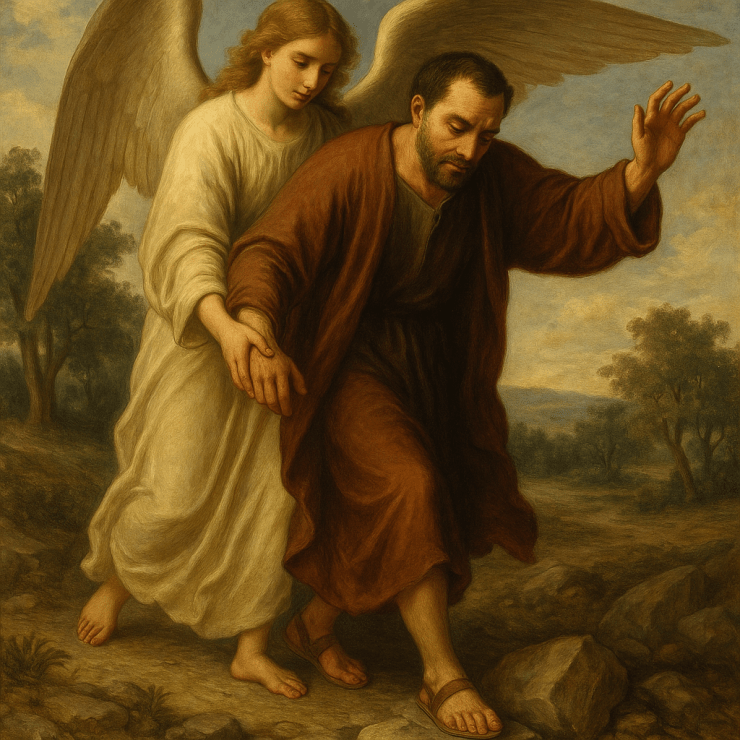
Psalm 91 is a psalm of divine protection and trust. The entire psalm flows as a confession of faith in God’s providence, emphasizing His sheltering presence amid dangers both seen and unseen. It begins, “He who dwells in the secret place of the Most High shall abide under the shadow of the Almighty” (v. 1). This psalm functions as both a comfort and a shield, reminding the believer that God’s watchful care is personal, constant, and sovereign. Verses 11-12 fit within a sequence of promises that include deliverance from plague, terror, and destruction (vv. 5-10), all of which culminate in God’s divine command: “For He shall give His angels charge over you.”
This psalm was likely used liturgically in the temple, possibly spoken by a priest or Levite as a blessing over a faithful worshiper who sought the Lord’s protection. The repetition and structure suggest a chanted or recited rhythm meant to strengthen the heart in the midst of threat. Just as Psalm 23 speaks of the valley of the shadow of death, so Psalm 91 sings of snares, pestilence, arrows, and stones—but also of deliverance, rescue, and angels. It’s the liturgy of the endangered saint, clinging to the faithfulness of God amidst overwhelming fear.
The psalm does not pretend danger is imaginary. It confesses danger is real, and yet the danger is not final. The promises of protection in Psalm 91 do not deny the existence of evil—they declare evil does not have the final word. This is key for the Christian reading the psalm today. The psalmist sees with clear eyes the threats of the world, but with even clearer faith the providence of God. These words are not for those who wish to escape the world but for those who dwell within it and need assurance that God is their dwelling place (v. 9).
Furthermore, Psalm 91 doesn’t offer protection from suffering as much as it promises the presence of the Protector within the sufferer. The promise is not that no stone will ever trip us up but that the fall will never be beyond the reach of God’s hand. “In their hands they shall bear you up,” the psalm says—but this lifting is often spiritual, emotional, and eternal rather than physical. The image is one of rescue, not removal; of accompaniment, not abandonment. For the believer, the reality of trouble is answered by the deeper reality of divine faithfulness.
Ultimately, the refuge spoken of in Psalm 91 is not just a place—it’s a Person. The “Most High” and the “Almighty” are not distant concepts but relational names of the covenant God. To dwell in His shelter is to be found in Christ, who is the true hiding place for sinners—the fortress that will not fail. From this safe dwelling, even when surrounded by trial or death, the faithful can say with confidence: “He is my refuge and my fortress; my God, in Him I will trust” (v. 2).
Angels and the Lord’s Charge

The Hebrew text emphasizes God Himself commands His angels to care for the one who takes refuge in Him. These are messengers (מַלְאָךְ, malak)—supernatural beings sent not of their own will but under divine command. The angels do not act independently but are given charge (צָוָה, tsavah)—a military term denoting orders from a commander. The image is clear: God’s angelic host moves at His word, and their mission is to guard (שָׁמַר, shamar) His people “in all [their] ways.”
This is not a guarantee of physical invulnerability but a promise that all things are under God’s good ordering. The angels act not to indulge our whims but to keep us “in all [our] ways”—that is, in the vocations and paths of life God appoints. The Confessions briefly address this: “Besides, we also grant that angels pray for us. For there is a passage in Zechariah 1[:12], where the angel prays, ‘O Lord of hosts, how long will you withhold mercy from Jerusalem…?'” (Ap XXI, 8). Luther similarly writes, “Although the angels in heaven pray for us (as Christ himself also does), and in the same way also the saints on earth and perhaps those in heaven pray for us, it does not follow from this that we ought to invoke angels and saints [or] pray to them” (SA II, 26).
This is why you hear your pastor pray the eucharistic prayer every Divine Service, “Therefore, with angels and archangels and all the company of Heaven…” Similarly, in Luther’s morning and evening prayers, we conclude: “Let Your holy angel be with me, that the evil foe may have no power over me.” These prayers are not mere poetry; they’re the confidence of faith rooted in Psalm 91. God sends His angels not to pamper us but to serve us for the sake of Christ. Even if their protection results in martyrdom, it’s because our death has become the gateway to eternal life in Him.
The Christian confession, then, is not merely that angels protect us but that they do so under the reign of Christ. As Paul says, all things “that are in Heaven and that are on Earth, visible and invisible, whether thrones or dominions or principalities or powers… were created through Him and for Him” (Colossians 1:16-17). Angels serve the Church because they serve Christ, who is “the head of the body, the church” (v. 18). Therefore, Psalm 91 is not a standalone promise of mystical guardianship but part of the broader promise that Christ has secured our lives in His own nail-pierced hands and feet.
Guardian Angels?
That being said, Psalm 91:11-12 is one of the most commonly cited biblical passages in support of the idea of guardian angels—those whom God personally assigns to protect individual believers. From this, many conclude each Christian has a dedicated angel who walks beside them. Is this true?
As seen in the Confessions above, as Lutherans, we affirm the ministry of angels, for Scripture itself asks rhetorically: “Are they not all ministering spirits sent forth to minister for those who will inherit salvation” (Hebrews 1:14). They rejoice at our repentance (Luke 15:10), watch the lives of believers (1 Corinthians 4:9), and are present with the Church (1 Timothy 5:21; Revelation 2-3). Psalm 91 explicitly says, “He shall give His angels charge over you,” which declares with strong language not only that angels are active in our lives but also that their activity comes by God’s command and purpose.
However, this does not mean angels serve as spiritual bodyguards. The verses speak more generally about angelic protection given to all in Christendom, while also strongly implying personal guardianship. While Scripture does not provide an airtight explanation of guardian angels, there are key texts that suggest this might indeed be the case:
- In Matthew 18:10, Jesus says of children: “Take heed that you do not despise one of these little ones, for I say to you that in Heaven their angels always see the face of My Father who is in Heaven.” This implies an ongoing relationship between children (or believers characterized as “little ones”) and particular angels.
- In Acts 12:15, after Peter is miraculously freed from prison and appears at the door, the disciples initially think it must be “his angel.” While this comment reflects a common Jewish belief, it shows the early Christians held the notion of individuals having angels assigned to them.
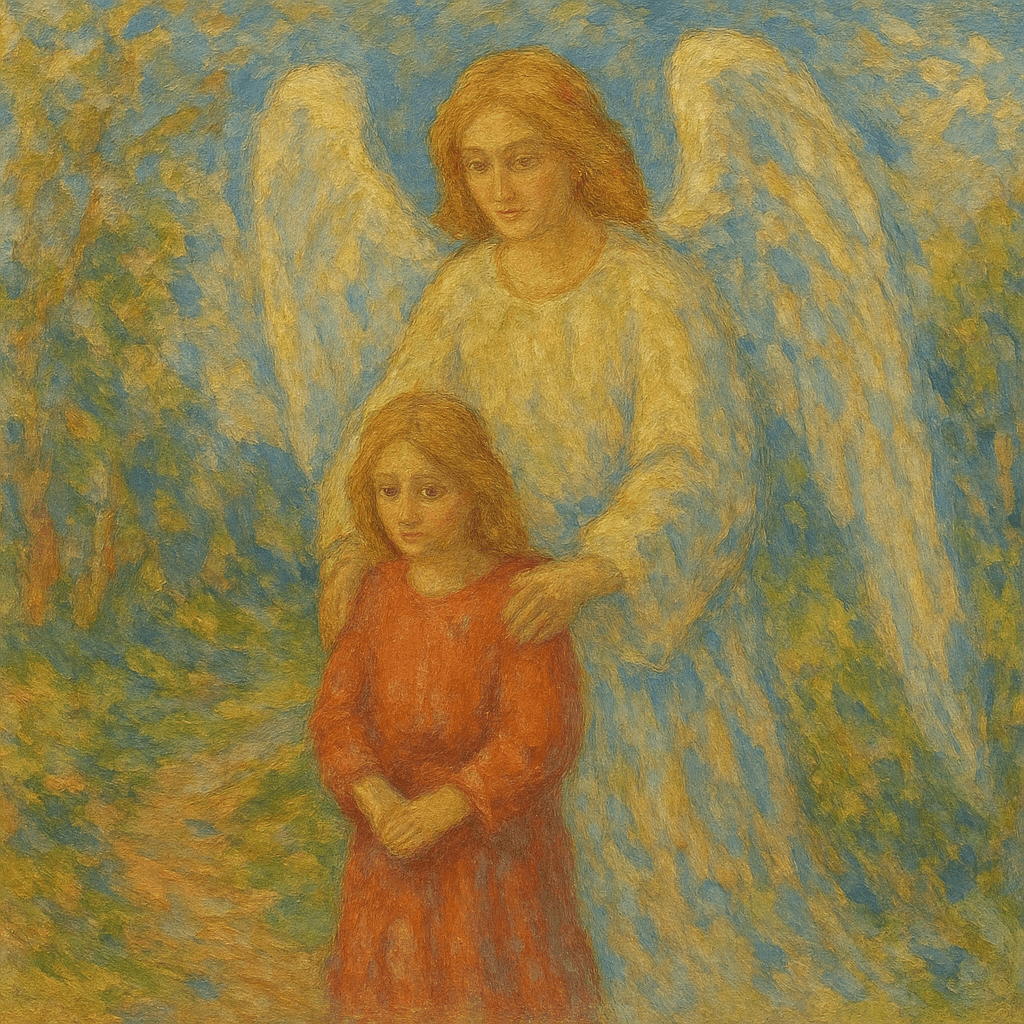
In fact, in a sermon on Matthew 18:1-10 Luther preached on The Day of St. Michael and all Angels in 1532, Luther said, “But there are distinctions among angels, as well as among the devils. Princes and lords hav great and special angels, as we see in Daniel 10. Children and common folk have ordinary angels. For there will always be a given angel who is greater, mightier, and wiser than the rest. The same is true, also, of the devils. That explains why, as Christ says, that they belong to a kingdom (Luke 11)” (Luther, 381).
Two years later in another sermon, he preached on the same feast day: “Also, we are to know for a certainty that every human being has his own appointed angel who looks after and watches over him. We are familiar with the common proverb that expresses people’s customary comment when someone is shielded from harm, ‘You had a good angel!’ or, ‘Your holy angel was with you and protected you.’ That is well said and, in fact, nicely reminds us of the benefaction God bestows on us through his beloved angels” (Luther, 387).
So, it seems rather clear that Lutheran tradition affirms guardian angels. However, it is vital to distinguish this understanding from folk religion or speculative theology. The angels do not act apart from God’s will, nor are they to be worshiped, prayed to, or treated as magical beings. The presence of angels is a sign of God’s care, not an end in itself.
Additionally, angelic protection is always subject to God’s higher purposes. Just as Jesus’ own angels did not prevent His crucifixion (Matthew 26:53-54), so too we should not assume the presence of a guardian angel guarantees a trouble-free life. The Lutheran confessors were careful to emphasize that the doctrine of angels is meant for consolation and encouragement, not for superstition.
In summary: yes, in my opinion Psalm 91:11-12 strongly supports the idea that a particular angel guards and protects each individual believer. There is credible biblical and theological support for the view that this guardianship may be personal, though the number or method of their assignment is not revealed. But regardless of whether God assigns one angel or many, the comfort remains: You are never alone. God commands His holy angels concerning you not because of your worthiness but because you are in Christ.
And if angels rejoice over your repentance, then surely they also keep watch over your tears.
Satan’s Misuse in the Wilderness (Matthew 4:5-7)
Ironically, these verses are most famously quoted by Satan, not a saint.
Then the devil took Him up into the holy city, set Him on the pinnacle of the temple, and said to Him, “If You are the Son of God, throw Yourself down. For it is written: ‘He shall give His angels charge over you,’ and, ‘In their hands they shall bear you up, lest you dash your foot against a stone.'”
Matthew 4:5-6
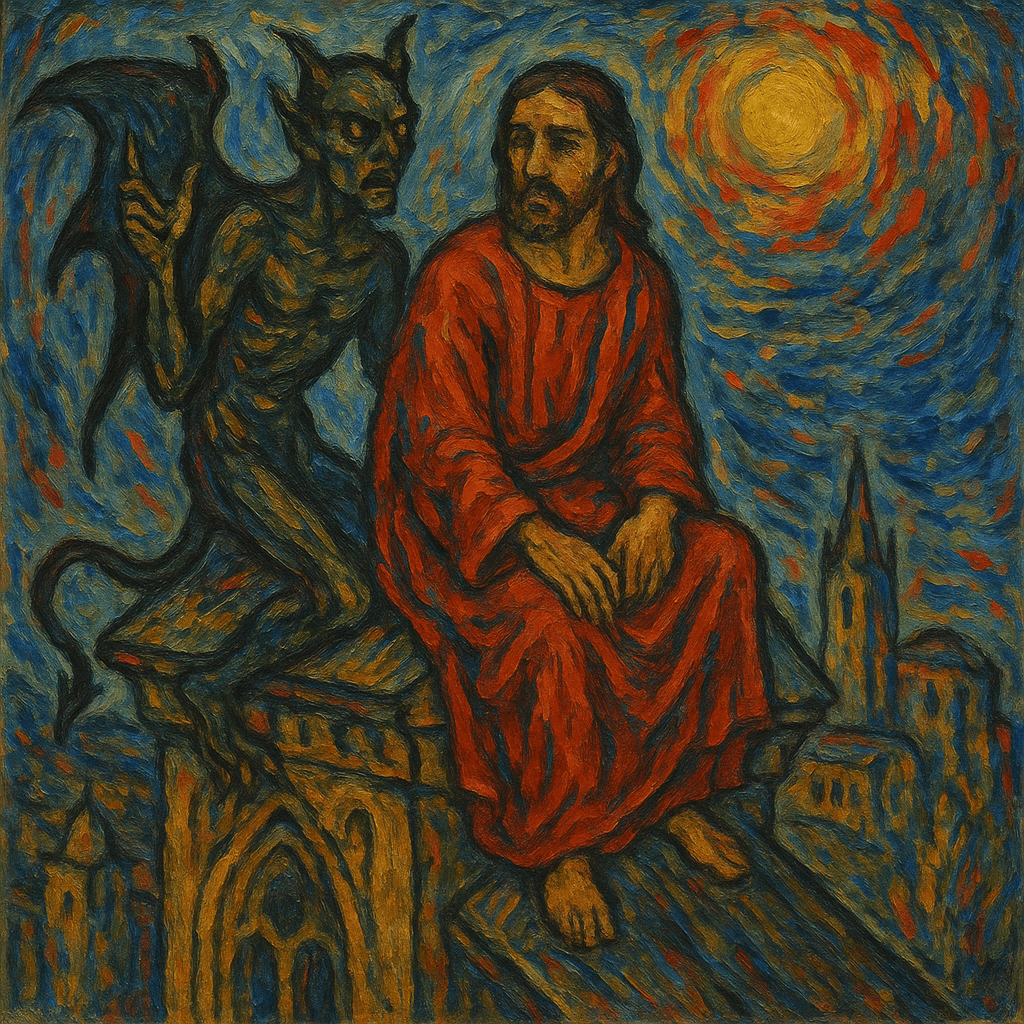
The devil quotes Psalm 91:11-12 but omits the phrase “to keep you in all your ways.” This omission is significant and purposeful. Satan isn’t stupid; he knows what he’s doing. He wants Jesus to test God by stepping outside the Father’s appointed path. In effect, Satan is tempting Jesus to invoke divine protection in an act of pride. But Jesus responds, “It is written again, ‘You shall not tempt the LORD your God'” (v. 7). In doing so, He upholds Psalm 91 not as a license for recklessness but as a promise within the bounds of faithful obedience.
This is instructive for every believer. The devil does not fight fair—he twists the Word of God. He’s an expert on Scripture, and he always quotes it with a subtle distortion that removes it from its Christ-centered purpose. For this reason, as Lutherans, we insist Scripture must be read through the lens of Christ and in the unity of the whole counsel of God. Misuse of Scripture is satanic, as it always results in the misuse of God’s promises. The temptation to “prove” God’s love through self-harm or spectacle is not faith but unbelief cloaked in piety.
Moreover, Jesus’ rejection of this temptation is not only a moral example but, even more, a substitutionary victory. Whereas Israel failed in the wilderness by testing God (and Adam and Eve failed to resist Satan in Eden), Jesus succeeds by trusting the Father’s plan and correctly applying God’s Word. In theological terms, to borrow from St. Augustine, we call this His recapitulation of Eden and Israel’s wilderness wandering. He does not leap from the temple; He walks the slow path to the cross. He does not demand a miraculous rescue; He receives betrayal and crucifixion. He walks through the valley of the shadow of death. In this, He undoes Satan’s deception and secures Psalm 91’s promises for all who are in Him—not because they’re strong but because He was faithful even unto death (Philippians 2:7-8).
Christ, the Fulfillment of Psalm 91
Christ is not only the One who resists the devil’s twisting of Psalm 91; He is also its final fulfillment. He’s the One whom angels serve (Matthew 4:11), who was preserved in His earthly ministry until His appointed hour (John 7:30), and yet who ultimately was not borne up but allowed Himself to be cast down—not by a stone but upon a Roman cross. He was not kept from harm so that we would be kept from eternal harm.
In His resurrection, we see Psalm 91’s promise fulfilled in its highest form: not in earthly safety but in victory over sin, death, and the devil. And now, in Him, the promise is extended to all believers—not as a mere shield from earthly danger but as a deeper security in God’s eternal care.
In this way, Psalm 91 is messianic. It anticipates not only the general faithfulness of God but the specific faithfulness displayed in the life and death of Jesus Christ. He is the true man who dwelt perfectly in the shelter of the Most High. He is the beloved Son to whom the Father gives angels to minister. And yet, He willingly enters the danger for our sake. He is crushed so that we might be cradled.
Thus, to read Psalm 91 apart from Christ is to misunderstand it. It’s not a spell for personal protection or a charm against misfortune. It’s the hymn of the Redeemer who makes His people safe—not by keeping them from death but by taking death into Himself and conquering it. The hands that bear us up are not only angelic—they are the pierced hands of the risen Lord.
What the Psalm Means for You Today
Psalm 91:11-12 continues to speak today, especially in times of danger, illness, and uncertainty.
- Angels still guard God’s people. God has not withdrawn His protection. His angels still serve those who’ll inherit salvation (Hebrews 1:14). We may not see them, but their presence is real, sent not to prevent every fall but to ensure God’s purposes are accomplished.
- We are kept in “all our ways,” not all our wishes. God’s protection does not mean exemption from suffering. Rather, we are preserved in our vocations, comforted in our trials, and guided in paths of righteousness—even when those paths lead through shadowed valleys.
- We do not test God. Psalm 91 is not an excuse for spiritual arrogance or reckless living. We do not test God’s faithfulness with foolish behavior. Instead, we receive His promises with faith, trusting He knows best how to care for us.
- We rest in Christ, our refuge. The ultimate promise of Psalm 91 is fulfilled in Christ, our shelter and fortress (v. 2; cf. Psalm 46). Because He was cast down, we are lifted up. Because He was unprotected at Calvary, we are eternally kept.
In practical terms, this means we can live with courage not because life is safe but because we are eternally safe in Christ. The world may threaten our bodies, reputations, or peace of mind, but it cannot sever us from the love of God in Christ Jesus our Lord (Romans 8:38-39). Angels may bear us up invisibly, but Christ has already borne us visibly through His cross and resurrection, and continues to bear us in grace in His ascension.
This also reframes how we approach suffering and danger. We don’t need to interpret every trial as a failure of God’s promises. Instead, we see our suffering as a participation in the cruciform life of Christ (Luke 9:23). Even when we stumble, He bears us up (cf. Isaiah 40:31). Even when we fall into death, He carries us through it (Psalm 23:4). Psalm 91 is not undone by hardship—it is fulfilled within it.
Finally, these verses train us to trust God in hidden ways. His help is not always spectacular, but it is always sufficient. The angels may not stop the car accident, but they carry the soul home. The foot may dash against a stone, but it will not dash against Hell. For in Christ, the final harm has already been borne; and what remains now, even in death, is resurrection (John 11:25).
Works Cited
Luther, Martin. The Complete Sermons of Martin Luther. Volume 7 (Grand Rapids: Baker Book House, 2007).
 The Lutheran Column