
Date: May 4, 2025
Festival: 3rd Sunday of Easter
Text: Revelation 5
Preaching Occasion: Beautiful Savior Lutheran Church, Wellston, MI
Appointed Scriptures: Acts 9:1-22; Revelation 5; John 21:1-19
Sermon Hymn: LSB #547 The Lamb
In the name of the Father and of the Son and of the Holy Spirit. Amen.
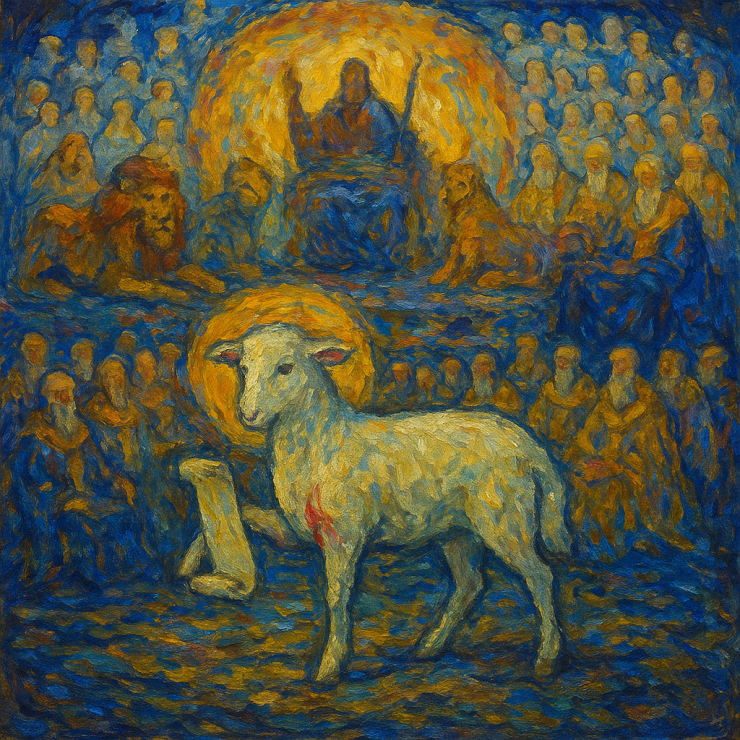
“So, I wept much, because no one was found worthy to open and read the scroll, or to look at it” [Rev. 5:4]. The Apostle John, exiled on Patmos, beholds Heaven opened—and yet his eyes fill with tears. What strange sorrow could inhabit the courts of God? He’s surrounded by angels, encircled by elders, drawn up into glory itself—and yet, he weeps. Not because of what is present, but because of what is absent. A scroll sits in the right hand of the One upon the throne, sealed shut with seven seals. It is the decree of history—the record of judgement and salvation, the script of creation’s redemption. But none in Heaven, none on Earth, and none beneath the Earth, are found worthy. No angel or archangel. No prophet or king. No priest or patriarch. No creature can touch or even look upon the scroll.
And so, John weeps. In that moment, his grief becomes our own. We too know what it is to face closed scrolls—questions without answers, wounds without healing, sins without absolution. We, too, see our world unravel and wonder, “Who can make sense of this? Who can fix what is broken?” The broken marriages, the cries of abused children, the trembling hands of the elderly, the silent screams of the depressed, the ache of guilt that won’t be silenced. These are the sealed scrolls of our lives. And like John, we weep.
But then, a voice breaks the sorrow: “ ‘Do not weep. Behold, the Lion of the tribe of Judah… has prevailed to open the scroll and to loose its seven seals’” [v. 5]. A Lion? Yes, that is what we expect: power, authority, and glory. The devourer of enemies. The conqueror of Death. And yet, when John turns, what he sees is not a Lion at all. He sees a Lamb. Not just any lamb, but one “as though it had been slain” [v. 6]. Torn open, bloodied, yet standing. Here is the great reversal: Victory has come not through the violence of man but through the self-giving of God. The throne of Heaven is claimed by a crucified King.
And the Lamb steps forward—not hesitantly, not fearfully, but in quiet majesty. And the scroll that no one could touch or even look at, He takes with ease. The cosmos holds its breath, and the seals begin to break. And Heaven erupts in a hymn: “ ‘You are worthy to take the scroll and to open its seals; for You were slain and have redeemed us to God by Your blood…’” [v. 9].
Beloved, take this to heart: the Lamb who was slain reigns. He rules not in spite of the cross, but through it. The wounds He bears are not hidden—they are His glory. His worthiness comes not from avoiding suffering, but from entering into it for your sake—and how this Lamb rewrites our stories.
Let us journey from Heaven’s throne to the road to Damascus. There walks a man named Saul. His heart burns with rage. His hands grip letters of arrest. He is a man of zeal, of pedigree, of knowledge—and of deep blindness. He believes he serves God, but in truth he serves his pride. With every step toward Damascus, he presses down on the Church, breathing out threats and murder. He is a closed scroll, sealed tight with arrogance and violence.
But then—light. Blinding, searing light. And a voice, “Saul, Saul, why are you persecuting Me?” [Acts 9:4]. Yes—Me, He says. Not, “Why are you persecuting My Church,” but “Why are you persecuting Me?” For as this man would later write to the Christians in Ephesus and Corinth, the Church is Christ’s Body [Eph. 1:22-23; 1 Cor. 12:12-27], so to persecute the Church is to persecute Christ Himself.
And Saul falls to the ground, trembling. The Lord’s cry is not the voice of vengeance. It is not the cry of a helpless victim. It is the call of the Lamb, speaking not to destroy but to redeem. “I am Jesus,” He says—not was, but am [Acts 9:5]. The crucified One yet lives. And Saul, who once walked in the certainty of the Law, now gropes in literal blindness—a physical manifestation of his spiritual blindness. He is then led by the hand, a broken man.
But the Lamb is opening his scroll. The Lord sends Ananias—fearful, hesitant, yet faithful. He lays hands on Saul, the scales fall from his eyes, and his eyes open. He’s baptized—cleansed and filled with the Holy Spirit. The persecutor becomes the preacher. The enemy becomes Christ’s instrument of grace. So thoroughly does the Lamb rewrite Saul’s story that he becomes Paul, the Apostle to the Gentiles. The one who stood by as Stephen died will now lay down his own life for Christ, to be beheaded in Rome. What Saul wrote, the Lamb rewrote in mercy.
And now, let us journey to Galilee at the Sea of Tiberias, also known as the Sea of Galilee. The sea laps against the shore, and Simon Peter with other disciples drag their empty net through the water. Peter returns to fishing—not out of joy, but from failure. Just days ago, he had sworn loyalty unto death. But when the moment came to prove his allegiance to Jesus, he denied Him—not once, but thrice. He did not merely fall as if by accident; he abandoned his Lord, warming himself by a charcoal fire [John 18:18]
But then, on the shore, they see Jesus standing, though they do not yet realize it is Him. Just like when they first met Jesus, they are having difficulty catching fish. And just like before, He tells them to cast their net into the water, and it was so full that they could not draw it up to the boat. And that’s when they recognize Him—“It is the Lord!” [21:7]. And even though they’re not very far from the shore, Peter can’t wait—he jumps in and swims to his Lord.
And on the shore, they see a charcoal fire, just like the fire by which Peter had once betrayed his Lord. Standing there is the Lamb, risen and alive, preparing breakfast for the ones who fled. So, Peter drags the net of 153 fish, and Jesus invites them to eat breakfast with Him.
Then He turns specifically to Peter. “Simon, son of Jonah,” He says, “do you love Me?” [v. 15]. Three times for each time Peter betrayed Him—not to shame him, but to restore him. “Feed My lambs. Tend My sheep. Feed My sheep.” He doesn’t say, “Are you sorry?” He doesn’t ask, “Will you do better?” He doesn’t rehearse Peter’s failures—He rewrites them.
Peter the denier becomes Peter the shepherd. And when the Lamb reveals the end of his scroll, Peter sees a cross waiting for him as well. And he does not flee. When the time comes for his martyrdom, legend says he would not consider himself to be killed in the same manner as his Lord, so he demands he be crucified upside down. Perhaps because he had denied his crucified Savior, so he felt he would somehow dishonor Him by being crucified exactly as He was. Whatever his thinking, the same man who once trembled at a servant girl now embraces the cost of God’s love. What Peter wrote in shame, the Lamb rewrote in grace.
Dear saints, are these not your story? How often have your sins closed you off from hope? How many scrolls lie unread in your life—prayers you fear to speak, regrets you dare not revisit, wounds you try to ignore? You think no one sees. You fear nothing can heal you.
But the Lamb sees. The Lamb knows. The Lamb bore it. He takes your scroll—yes, yours—with all its jagged chapters and redacted regrets. He does not cast it away—He reads it. He redeems it. He sheds His blood on its pages. He writes, in crimson grace, a new ending to your story: “There is therefore now no condemnation to [you] who are in Christ Jesus” [Rom. 8:1].
He does not merely forgive your past—He gives you a future. An eternal one. He calls you by name. He grants you forgiveness—like Paul and Peter—not because you are worthy, but because He is worthy. Therefore, do not weep. Behold, the Lamb who was slain stands to feed you the breakfast of restoration.
So, let your tears be turned into a hymn. Let your shame be turned to service. Let your fear be turned to praise. Join with every creature in Heaven and on Earth and under the Earth and sing the hymn of the slain who is risen and reigns forever: “Worthy is the Lamb who was slain to receive power and riches and wisdom, and strength and honor and glory and blessing!” [Rev. 5:12]. † In the name of the Father and of the Son and of the Holy Spirit. Amen.
 The Lutheran Column