
In John Steinbeck’s Of Mice and Men, we encounter a sad and beautiful story of two itinerant laborers—George Milton and Lennie Small—who cling to each other in a world that does not welcome weakness. The novella, first published in 1937, is concise and stark, yet its moral weight and emotional resonance are immense. Lennie, a large man with a childlike mind, is the center of the novel’s moral conflict. He is gentle and affectionate, yet immensely strong and prone to unintended harm. George, his protector and friend, shoulders the arduous task of keeping them both alive—dream intact—in a system designed to crush people like Lennie.
Of Mice and Men is not just a tragedy. It is also a parable of sin and mercy, of vocation and sacrifice, and of the haunting question: What does the world do with those who cannot defend themselves? In Lennie, we may glimpse not only the vulnerability of our neighbors, but also the wounded Christ who bears our infirmities (Isaiah 53:2-5). And in George, we find not a flawless moral compass, but a man burdened with a fallen world’s impossible choices.
This is your spoiler warning.
“The Best-Laid Schemes”: On the Meaning of the Title
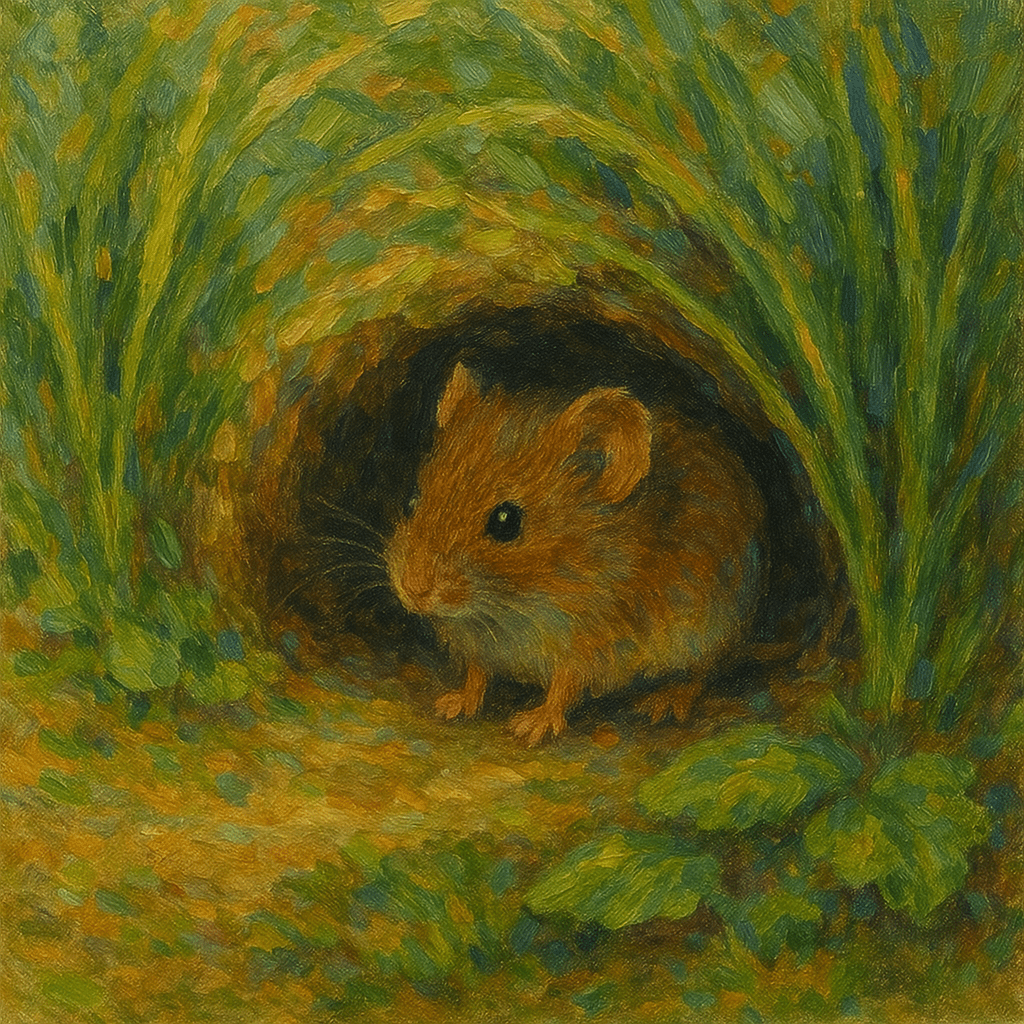
The title is taken from the Scottish poet Robert Burns’ 1785 poem: To a Mouse, on Turning Her Up in Her Nest with the Plough. In it, Burns reflects on the sudden destruction of a field mouse’s home by the blade of his plow and recognizes a shared fragility between mouse and man: “The best-laid schemes o’ Mice an’ Men / Gang aft agley. An’ lea’e us nought but grief an’ pain, / For promis’d joy!” Steinbeck does not merely borrow a poetic title; he signals his novel’s central theological tension: that in a fallen world, even the most innocent hopes and tender intentions are vulnerable to destruction, grief, and unintended consequences.
In the opening pages of the novella, George and Lennie’s dream of “livin’ off the fatta the lan'” becomes a recurring refrain—a liturgy of hope against the backdrop of economic ruin, social exclusion, and fragile mental health. Their plan is modest, good, and rooted in mutual care. But it is destroyed—not by malice, but by misunderstanding, fear, and the cruel weight of an unmerciful world.
This, in Lutheran theology, is the inescapable reality of sin (cor incurvatus in se—the heart curved inward on itself). Even our best intentions are entangled in brokenness. As St. Paul writes, “For the good that I will to do, I do not; but the evil I will not to do, that I practice” (Romans 7:19). George and Lennie do not fail because they’re wicked. Their plans fail because they’re human—vulnerable to fear, to accident, to the weight of a society that offers no grace to the weak.
From a theological standpoint, the title, Of Mice and Men, also reminds us that God alone makes plans that do not fail. As the psalmist proclaims, “The counsel of the LORD stands forever, the plans of His heart to all generations” (Psalm 33:11). In contrast to human schemes, the Gospel is the promise that will not collapse, even when every worldly hope crumbles. George and Lennie’s dream may perish in a barn, but the Christian’s hope—secured in the death and resurrection of Christ—endures through every heartbreak.
The tragedy of Steinbeck’s title is not that plans go wrong; it’s that they go wrong despite the purity of desire and goodness of heart. In this, the novel becomes not merely a cautionary tale, but a lament. And lament, in the Scriptures, is not the absence of faith; it is the voice of those who still believe God hears.
“He’s Jes’ Like a Kid”: Lennie and the Theology of the Marginalized
Though Steinbeck never diagnoses Lennie, some readers—including yours truly—recognize in him some characteristics commonly associated with Autism Spectrum Disorder (ASD): a limited ability to process social cues, repetitive behaviors (such as petting soft things), anxiety in response to change or unfamiliar situations, and a deep emotional dependence on routine and reassurance. George describes Lennie’s mind early in the novel: “He’s jes’ like a kid… If you don’t want me I can go off in the hills an’ find a cave. I can go away any time.”

George’s words capture both Lennie’s cognitive limitations and one of the many stereotypes of autistic individuals being childish. As a psychologist and autism expert observes, “Being too passionate about a video game, comic book, or wild animal species [and other things] is often viewed in society as childish or limited, and so Autistic children [and adults] are expected to hide their enthusiasm. Interestingly, adults are only shamed for having an obsessive interest if that interest is a bit too ‘strange,’ and doesn’t come with the opportunity to rack up a lot of achievements or make a lot of money” (Price, 152; emphasis mine).
Lennie is not a moral agent in the traditional sense—he does not fully understand cause and effect, nor does he act out of malice. In theological terms, Lennie represents human vulnerability after the Fall: he bears the image of God, but in a marred and fragile form.
To be clear, autism is not a sin, nor a flaw to be pitied. From a Lutheran pastoral view, Lennie–whether autistic or not—is a person who challenges our culture’s idolatry of competence, speed, and independence. Our culture has long measured worth by one’s level of productivity. Lennie reminds us human worth is not based on utility. As we confess about the 5th Commandment (“You shall not murder”) in the Small Catechism, “We should fear and love God so that we do not hurt or harm our neighbor in his body, but help and support him in every physical need.”
In other words, we are called not simply to refrain from violence but also to actively protect the vulnerable. Lennie exists in a world where almost no one does that. And as an autistic person myself, I have experienced firsthand being discriminated against for my disability, even by the Church.
The World’s Judgement and the Hidden God
Steinbeck’s 1930s California is not overtly religious, but it is soaked in the Law—not God’s perfect Law, but the harsh, utilitarian law of economic survival. The weak do not inherit the Earth here. They are exploited, discarded, or killed. Curley’s wife, herself marginalized and unnamed, recognizes Lennie’s difference immediately: “He ain’t mean. I can tell a mean guy from a mile off.”
Her words are tragically true. Lennie is not cruel; he is incapable of guile. Yet the world sees only the danger of his difference (neurodivergence), not the meekness of his intent. When he accidentally kills her while trying to silence her screams—panicked, confused, and terrified—he becomes a hunted animal. His death is not due to justice, but fear.
As Lutherans, we speak of the Deus absconditus—the hidden God. In Lennie’s story, we encounter this theological mystery. God seems absent in the moment of crisis. The world’s judgement falls quickly. There is no trial, no appeal, and no intercession. Yet for the Christian, God is never more present than in the suffering of the innocent. Christ, too, was misunderstood, condemned without cause, and crucified as a threat to the social order.
As Luther writes in his Heidelberg Disputation, “The visible and manifest things of God are seen through suffering and the cross” (LW 31:40). We find God not in power, but in the afflicted. Lennie is one of these. In his death, we are meant not to condemn, but to grieve.
George’s Choice and the Theology of the Cross
The climax of the novel—George’s decision to shoot Lennie himself before the mob arrives—is one of the most heart-wrenching moments in American literature. George sits beside Lennie, asking him to imagine their dream one last time: the rabbits, the land, the freedom.
Then he shoots him in the back of the head.
It’s a “mercy” killing (there’s no such thing). It’s an execution. An “act of love.” An act of desperation. It cannot be justified, and it cannot be dismissed.
The Lutheran tradition is uniquely equipped to handle such moral ambiguity. We believe in vocation amid brokenness—that Christians are called to serve their neighbor even when no perfect solution exists. George’s act is not righteous. Nevertheless, it is born of love in a fallen world, a world where the systems of protection have failed, where the law has no mercy, and where grace must sometimes appear as grief. He genuinely believed he was doing this for the good of Lennie, but murder is never the solution to misunderstanding and inconvenience.
Luther speaks of the Christian being simul iustus et peccator—simultaneously saint and sinner. George, in this moment, is both. He bears the cross and enacts death because he refuses to let the mob do it, but he still pulls the trigger. I don’t think he can be viewed as a villain or a hero in this moment. Rather, he should be seen as a man crushed by the weight of a sin-sick world.
The Dream Deferred: Eden and the Kingdom of God
George and Lennie’s dream—to live off the “fatta the lan’,” to own a small farm, to be safe and free—is more than economic. It’s a longing for Eden—for home, peace, and security in a world that offers none. This is why their dream is repeated like a liturgy: “An’ have rabbits. Go on, George! Tell about what we’re gonna have in the garden…”
Lennie’s litany is not delusion. It is eschatological hope. It is the language of a childlike soul yearning for the kingdom of God. As Christians, we know this hope will not be fulfilled by political systems or economic freedom. But the desire itself is holy. The promise of a home, of work with dignity, of bodies and minds healed—this is precisely what Christ has secured for His people. “Nevertheless we, according to His promise, look for new heavens and a new Earth in which righteousness dwells” (2 Peter 3:13).
Lennie dies before that promise is fulfilled. But he dies believing it.
In This Man, Christ Also Suffers
Lennie is not a Christ-figure in the traditional literary sense. He does not save others, and he is not sacrificed for their survival; but for the Christian, he is someone in whom Christ suffers. He is a man despised and rejected, slow of speech, gentle of hand, who harms no one on purpose and is destroyed for what he cannot help. In the way society treats Lennie, we see the truth of Jesus’ words, “Inasmuch as you did it to one of the least of these My brethren, you did it to Me” (Matthew 25:40).
Of Mice and Men is not a comforting book, but it is a cruciform one. It holds up a mirror to our fallen world and asks: Who is your neighbor? It forces us to confront our response to those who do not fit in (like the autistic), who need care, and who frighten us by being different (or neurodivergent). It reminds us that Christ did not come as the strong, the competent, or the admired. He came as a man acquainted with grief, a friend to sinners, and a brother to the broken.
And He died for Lennie, too.
Works Cited
Price, Devon. Unmasking Autism: The Power of Embracing Our Hidden Neurodiversity. Great Britain: Monoray, 2022.
 The Lutheran Column