
Most people think they know Frankenstein—a Halloween monster, a mad scientist, a stitched-together, mindless brute with bolts in his neck. But the cultural caricature is far removed from Mary Shelley’s 1818 novel. Shelley’s work is not a horror story in the modern sense; it is a haunting theological and anthropological meditation on what it means to be human, to create, to sin, and to long for redemption. In fact, I’m of the strong opinion that Frankenstein is the progenitor of sci-fi novels. It is a story not of monsters in the horror sense, but of men—and the tragic consequences of abandoning love and responsibility.
For the Christian reader, especially the Lutheran, Frankenstein offers profound insights into the doctrine of creation, the reality of sin, the hunger for grace, the dangers of ignoring grief, and the dangers of human pride. It exposes the consequences of a world that wants the power of God without the love of God. And it gives voice to one of the most urgent questions in human history: If I’m a monster, can I still be loved?
This is your spoiler warning.
The Creator Who Abandons His Creation
Victor Frankenstein, the novel’s central figure, is not a villain in the traditional sense. He is a brilliant young man who, through indefatigable scientific study, discovers how to reanimate lifeless matter instead of properly grieving the death of his beloved sister. As he reflects quite profoundly, “I need not describe the feelings of those whose dearest ties are rent by that most irreparable evil [death]… It is so long before the mind can persuade itself that she, whom we saw every day, and whose very existence appeared a part of our own, can have departed forever—that the brightness of a beloved eye can have been extinguished, and the sound of a voice so familiar and dear to the ear can be hushed, never more to be heard.”
But once he succeeds in “creating” life—fashioning a being from dead human parts—he is immediately horrified by what he’s done. He abandons his creation, leaving the creature to fend for himself in a world that sees ugliness as a threat.
From a Lutheran perspective, Frankenstein’s sin is not that he created life—though this is certainly a moral question—but that he refused to love what he had made. He played God without reflecting God’s heart. He fashioned a man in his own image but refused to claim him as his son.
In stark contrast, the God of Scripture does not abandon His creation, even when it falls into ugliness. He seeks Adam and Eve in the Garden, He clothes them in their shame, and He promises a Savior. Frankenstein presents us with a “god” who flees from responsibility—who mirrors the worst tendencies in humanity rather than the mercy of the Father.
The creature is not “Frankenstein”—that’s Victor. The creature has no name. This alone is a theological crisis. Naming, in Scripture, is an act of intimacy, identity, and care. God names His people. Jesus calls His sheep by name. But Frankenstein’s creation is cast off, rejected, and denied even the dignity of identity. Here are two melancholy quotes from “the monster” that reflect this:
- ” ‘Hateful day when I received life!’ I exclaimed in agony. ‘Accursed creator! Why did you form a monster so hideous that even you turned from me in disgust? God, in pity, made man beautiful and alluring, after his own image; but my form is a filthy type of yours, more horrid even from the very resemblance. Satan had his companions, fellow-devils, to admire and encourage him; but I am solitary and abhorred.'”
- “I remembered Adam’s supplication to his Creator. But where was mine? He had abandoned me, and in the bitterness of my heart I cursed him.”
This is what sin does—it dehumanizes. Not just the other, but also the self. God saying to Adam in the Garden, “Where are you,” was a blessing; for instead of abandoning His creatures to their ugly rebellion, God sought them out to make them His again. Failing to do this for his creation was Victor Frankenstein’s colossal failure.
The Creature: A Figure of the Law
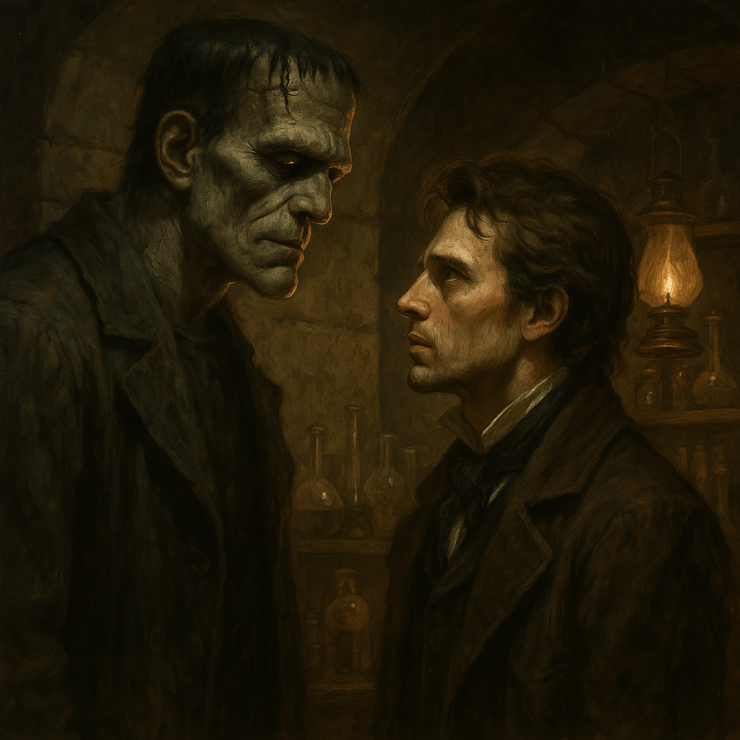
Frankenstein’s creature is no mindless beast. He is surprisingly eloquent, sensitive, intelligent, and deeply philosophical, even theological. His narration of his early life is one of the most moving parts of the entire novel. He hides in the shadows of a small cottage and observes a loving family. He teaches himself to read and speak. He longs for belonging.
But when he attempts to reveal himself, he is met with screams, blows, and horror. As the creature reflects, “When I looked around I saw and heard of none like me. Was I, then, a monster, a blot upon the earth from which all men fled and whom all men disowned? I cannot describe to you the agony that these reflections inflicted upon me: I tried to dispel them, but sorrow only increased with knowledge.” And then later, “For the first time the feelings of revenge and hatred fill my bosom, and I did not strive to control them… I beat my mind towards injury and death.”
He did not begin with violence. He began with longing—for acceptance, community, and someone to look upon him with love. But every person he dares open himself up to meets him only with disgust and terror. He begins as every child begins: reaching out for a face that will not recoil. But without love, he descends into total despair and a seething hatred. His every attempt at friendship is met with rejection. And so, he turns to vengeance.
Theologically, this is the voice of the Law. The creature has no Gospel. He knows he is unwanted, and he cannot un-know it. No one speaks redemption to him. No one embraces him. No one offers grace. Therefore, he becomes the very monster the world already believes him to be. This is what happens when the Law reigns without the Gospel: condemnation without hope, rejection without redemption, and justice without mercy.
The Monster in the Mirror: Sin and Empathy
One of the most powerful aspects of Shelley’s novel is that it forces the reader to empathize with the creature, which is totally unexpected when all you “know” is the caricatures of him in film adaptations… and then the horror of sympathizing with him. That is the true horror—not the “monster,” but our empathy for the monster. He murders Frankenstein’s family: William (his younger brother) and Elizabeth (his wife), as well as his closest friend, Henry. The creature lies, manipulates, and murders, becoming the evil he hates.
And yet… we understand him. It’s really hard to blame him. In fact, we want to justify his actions.
When we read Frankenstein, we are not reading about an alien being, a mad scientist, or some paranormal creature. We are reading about ourselves. We are Frankenstein, seeking power and control. We are Frankenstein’s “monster,” longing to be loved and growing cold with despair—and for some of us, even to the point that we take the law into our own hands and get the “justice” we deserve. We are both creator and created. As parents, we are creator, sometimes denying our children the love they need (some more horrifically than others). As creatures, we are broken and afraid, perhaps even neglected of the love we need and deserve from our creator parents.
And that is precisely where the Gospel must enter.
Grace Rejected, Grace Desired
Unlike most Christian novels, Frankenstein does not end with redemption, but sorrow. Frankenstein dies consumed by obsession and guilt. The creature, finding his creator dead, weeps over his body—not in triumph, but in anguish. He declares his intention to die—to vanish into the icy wastes of the north. There is no reconciliation or restoration, just judgement and regret.
But in that final scene, there is also a flicker of something deeper: remorse, lament, and the recognition of a lost relationship that might have been saved. “I should have been thy Adam,” the creature tells his creator earlier in the novel. “But I am rather the fallen angel.” The creature sees himself as cast out—not because he rebelled first, but because he was never loved.
For the Christian, this final cry is not the end of the story—it is the beginning of the Gospel. We believe in a Creator who does not abandon His creation, even when it becomes monstrous (in fact, this is the point I made in a funeral sermon, which turned out to be one of the best sermons I’ve ever preached based on others’ extremely positive reactions after the service). We believe in a God who enters the story—not to punish His creature, but to redeem him.
Where Frankenstein refused to name, Christ names us. Where the world sees monsters, Christ sees His brothers and sisters. Where the Law accuses, the Gospel forgives.
Why Christians Should Read Frankenstein
- To reflect on the dignity of life. Frankenstein forces us to confront how easily we dehumanize. Whether through appearance, ability, or origin, we judge—and in doing so, we forget that every person is a creature of God, despite the circumstances of their conception and/or birth.
- To see the cost of abandoned responsibility. Frankenstein’s failure is not in creating life, but in refusing to care for it. Christians, especially those in positions of authority, must be reminded that power without love is a curse, not a gift.
- To wrestle with the ache for grace. The creature’s story is a sad parable of what happens when mercy is withheld. He becomes what the Law declares him to be (specifically the 5th Commandment—a murderer). The Christian is called to be a voice of the Gospel, especially to those the world calls monsters without cause.
- To remember that salvation does not come from science or intellect. Frankenstein believed knowledge would conquer death. As he reflects early in the novel, “It was the secrets of heaven and earth that I desired to learn; and whether it was the outward substance of things, or the inner spirit of nature and the mysterious soul of man that occupied me, still my enquiries were directed to the metaphysical, or in its highest sense, the physical secrets of the world.” He was wrong, which he fortunately realizes later. “Learn from me, if not by my precepts, at least by my example, how dangerous is the acquirement of knowledge and how much happier that man is who believes his native town to be the world, than he who aspires to become greater than his nature will allow… I thought, that if I could bestow animation upon lifeless matter, I might in process of time (although I now found it impossible) renew life where death had apparently devoted the body to corruption.” Only Christ has overcome the grave—not through discovery and knowledge, but through dying and rising.
- To see our need for our true Creator. The juxtaposed protagonists in Frankenstein is searching for meaning. The Christian knows where meaning is found—not in our achievements, but in the God who makes, redeems, and names us.
The Creator Who Does Not Flee
Mary Shelley wrote Frankenstein when she was 18, in the shadow of grief, philosophy, and revolution. She created a story that is far more than science fiction—it is a cry from the heart for love, justice, and grace. Christians should read this book not because it affirms our faith, but because it exposes the world’s ache for it. It shows what happens when the Gospel is absent. It paints the tragedy of a creator who flees his creation. And it makes us long all the more for the true Creator, who did not flee, but came down, took on flesh, and bore our sin upon Himself.
In the end, we are all the creature. But in Christ, we are no longer nameless creatures. He knows us by name. Using a metaphor to speak of Himself in His famous Good Shepherd discourse, Jesus says, “To him the doorkeeper opens, and the sheep hear his voice; and he calls his own sheep by name and leads them out” (John 10:3).
 The Lutheran Column