
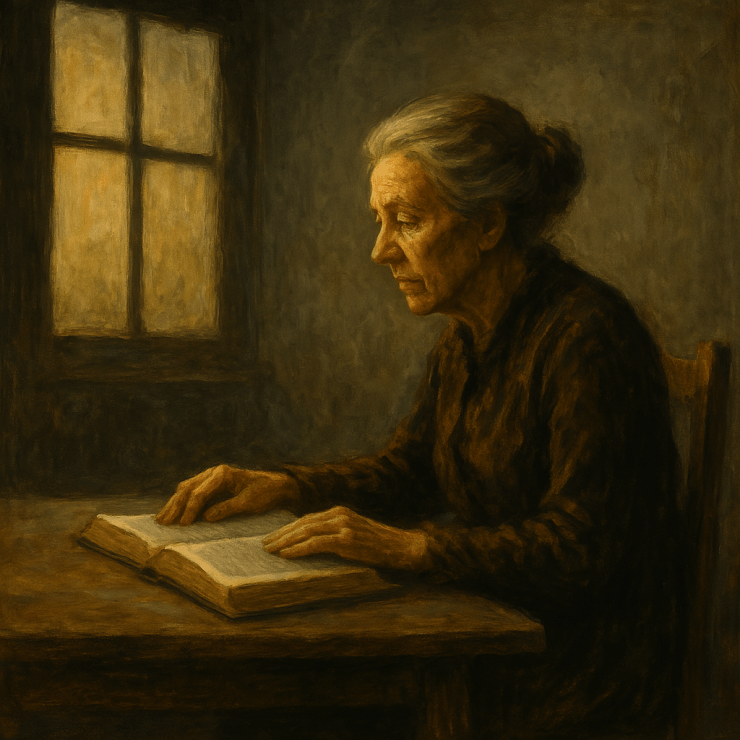
There are books that entertain, books that inform, and books that endure. Then there are books that transform—books that pierce the soul, shake our assumptions, and leave us weeping with gratitude and aching for Heaven. The Hiding Place by Corrie ten Boom is one of those books.
Set against the bleak backdrop of Nazi-occupied Holland and the Ravensbrück concentration camp, Corrie’s autobiography tells the true story of herself, her sister Betsie, and their family—a family of Dutch Reformed Christians who risked their lives to hide Jews during the Holocaust. But far from being a mere historical memoir, the book is a radiant testimony to the Gospel in the midst of unimaginable suffering.
Every Christian, young or old, should encounter it. Why? Because it immerses us in the reality of sin, grace, vocation, suffering, forgiveness, and the incomprehensible power of Christ’s resurrection hope, even in the shadow of the crematorium.
This is your spoiler warning.
The Law is Not Abstract: The Reality of Evil
Lutheran theology understands the Law of God not merely as a list of rules but as the holy will of God that confronts our sin, restrains evil, and prepares our hearts to receive the Gospel in Confession. The Hiding Place plunges the reader into a world where evil is not theoretical. It is embodied in swastikas, betrayal, gas chambers, and the cruelty of man toward his neighbor.
Corrie recounts the arrest of her family, the betrayal by a man they tried to help, and the systematic cruelty of the Nazi regime. Her father, Casper ten Boom—a watchmaker and devout Christian—dies shortly after their arrest. Her beloved sister, Betsie, suffers and ultimately dies in Ravensbrück, her frail body no match for the labor, the starvation, and the cold.
This is not a sanitized Christian story; it is Good Friday in narrative form—a brutal exposure of human depravity. And yet, even here, God is not absent. As Luther taught, God is hidden in suffering, and it is often when the Law shows us death that the Gospel breaks through.
Christ Hidden in Vocation
The ten Boom family are a living witness to the Lutheran doctrine of vocation—that God places each Christian in their daily station in life (home, work, nation, family) to serve their neighbor in love. As a watchmaker, Corrie served her community with quiet diligence. As a daughter, she honored her aging father. As a Christian, she answered the call to shelter the Jews, knowing it could cost her life.
They did not do this as political activists or moral idealists but as disciples of Jesus, seeking to love their neighbor as themselves. As Corrie once said, “There is no pit so deep that God’s love is not deeper still.” Their story reminds us that vocation is not glamorous. It is often costly. But it is where Christ is present, and where the Christian bears the cross.
Betsie: A Portrait of the Gospel in Flesh
Of all the characters in The Hiding Place, Betsie ten Boom shines most clearly with the light of Christ. Her body grows weak, but her faith is radiant. She prays for her enemies (yes, her Nazi enemies!). She gives thanks for fleas because they keep the guards out of their barracks, allowing them to lead worship and read Scripture with the other prisoners (they smuggled a Bible). Her love is not naïve—it is divine.
In one of the most powerful moments, Betsie says, “In darkness, God’s truth shines most clearly.” This is resurrection theology. Betsie knows she may die, but she also knows Christ has conquered death, and so she smiles through hunger, sings hymns in filth, and forgives her captors even as they beat her. She is a living sermon—a vessel of grace poured out in a world of wrath.
Forgiveness that Scandalizes
Corrie survives. After Betsie’s death, she is released by a clerical error one week before the women her age were all sent to the gas chamber. She returns to Holland, broken and grieving—but alive.
What follows is perhaps the most remarkable part of her autobiography: Corrie’s ministry of reconciliation (cf. 2 Corinthians 5:18-21). She speaks of Christ’s love to churches and survivors. And then, in a moment of supreme Gospel power, she recounts seeing a former Ravensbrück guard—one of the cruelest—approach her after a speaking event. He reaches out his hand and says he has become a Christian and asks her forgiveness.
Corrie is frozen. Rage swells up. She cannot do it. She prays, and God moves her arm, she takes his hand, and in that moment, she writes, she felt God’s love flood her whole being. This is not sentimentality but justification by grace through faith—a murderer and abuser forgiven, and a victim turned minister of mercy. This is the scandal of the cross.
The Theology of the Cross Made Visible
Luther taught that God is most clearly revealed not in glory, but in the suffering and weakness of the cross (see 1 Corinthians 1:21-25). The Hiding Place is a modern witness to that truth. There is no prosperity gospel here. No false comfort. No pretending that faith makes life easy.
What we do see is Christ crucified, hidden in the barracks, shining through the pages of Scripture smuggled into the camp, present in the whispered prayers, and victorious in the final chapter. Corrie’s story is not about her strength; it is about Christ’s strength made perfect in weakness. “My grace is sufficient for you, for My power is made perfect in weakness” (2 Corinthians 12:9).
Why Every Christian Should Read It
The Hiding Place is not just for those interested in World War II. It is not just for women, or for fans of memoirs. It is for every Christian because:
- It teaches sound theology through lived experience.
- It shows how vocation, suffering, and faith converge in real life.
- It confronts us with evil and drives us to the only source of hope—the cross of Jesus.
- It reminds us that forgiveness is not deserved or a feeling, but a gift of the Holy Spirit.
- It strengthens our faith by showing us what the Church looks like under the cross.
Christ, Our Hiding Place
Psalm 32:7, “You are my hiding place; You shall preserve me from trouble; You shall surround me with songs of deliverance.”
Isaiah 32:1-2, “Behold, a king will reign in righteousness, and princes will rule with justice. A man will be as a hiding place from the wind, and a cover from the tempest, as rivers of water in a dry place, as the shadow of a great rock in a weary land.”
Corrie ten Boom found her hiding place not in secret walls or false strength, but in Jesus Christ, who walked with her through the camps, who received her sister and father into glory, and who gave her the strength to forgive what seemed unforgivable.
Let every Christian read her story. Let every reader be brought low by the Law and lifted up by the Gospel. And let us never forget that in the deepest darkness, the light of Christ shines all the brighter.
 The Lutheran Column