
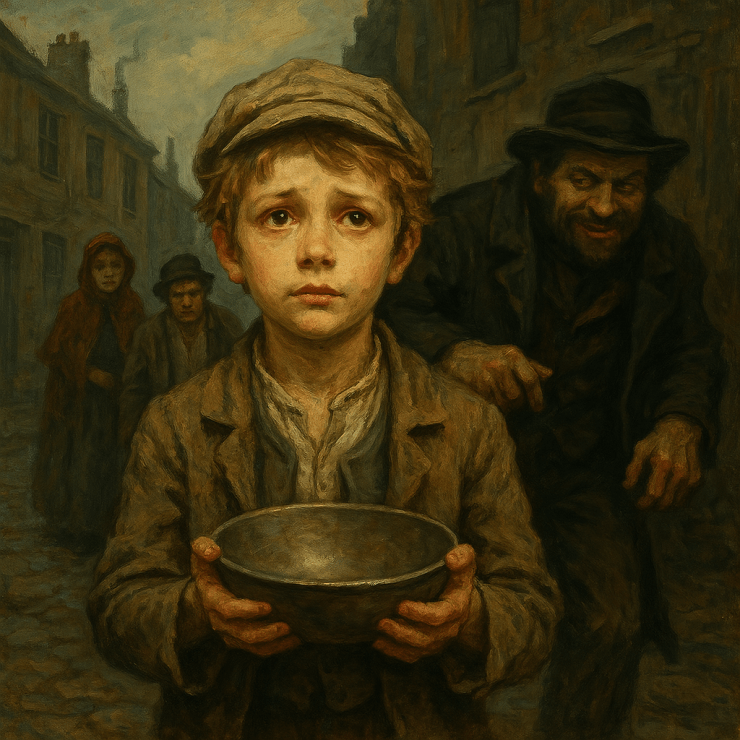
In an age when many Christians are drawn to bite-sized devotions and self-help interpretations of Scripture, the Church must not neglect the moral and theological treasures buried within the great works of literature. Among these, Charles Dickens’ Oliver Twist stands tall as a rich and haunting tale of sin, suffering, redemption, and grace. Dickens, though not a theologian in any formal sense, nevertheless writes with a profoundly biblical imagination. His novels, and Oliver Twist in particular, provide fertile ground for the Christian reader to meditate on the human condition, the corruption of institutions, the need for mercy, and the mysterious workings of God’s providence. Oliver Twist is not merely a moral story, but a parable of the Gospel veiled in the grime and fog of 19th-century London.
This is your spoiler warning.
The Depth of Human Depravity
From the very first page, Oliver Twist plunges the reader into a world of institutional cruelty and systemic oppression of the poor, including orphans. Oliver is born in a workhouse, an orphan with no name, status, or rights. Even his first cries at his birth are a nuisance to the overseers who view him not as a human created in God’s image, but as a burden to be minimized—or, in Dietrich Bonhoeffer’s words, “an object to be manipulated” (Bonhoeffer, 100-101). The workhouse system, which Dickens so viciously satirizes, is a grotesque manifestation of what Luther called the homo incurvatus in se—man curved in upon himself. The officials of the parish board serve not the neighbor, but themselves, their pride, their pocketbooks, and their perverse desire for control.
Christians ought to read this not simply as a social critique but also as a theological diagnosis. Sin is not only personal but structural. The corruption of man infects institutions, laws, and customs. God’s Law shows us not only that we are sinful, but also that our entire world groans under the weight of sin. When Mr. Bumble, the parish beadle, declares indignantly that “the law is a ass,” he unwittingly echoes the Pauline insight that the Law, though good and holy in itself, cannot justify or make righteous. Instead, it exposes the wretchedness of fallen man and his futile attempts to justify himself by his works.
The Innocence of Oliver and the Image of Christ
Oliver himself is a peculiar figure. Unlike most Dickensian characters, he is not formed by experience or growth; he enters the story almost supernaturally innocent, and remains so throughout. Critics have sometimes faulted this as unrealistic. But viewed through a theological lens, Oliver is not meant to be realistic. He is a Christ-figure.
He is born under the curse of poverty, misunderstood and despised, subjected to every form of temptation and suffering, yet without sin. He is dragged into the dens of iniquity but does not partake of the iniquity (at least by choice; all analogies break down at some point). Like Christ, he is “despised and rejected by men, a Man of sorrows and acquainted with grief” (Isaiah 53:3). His very presence among thieves, cutthroats, and swindlers becomes a judgement on their corruption.
Yet, unlike Christ, Oliver is not the Redeemer but the Redeemed. He is the helpless child—like the one Jesus placed in the midst of His disciples when He said, “Whoever receives one little child like this in My name receives Me” (Matthew 18:5). Through Oliver, Dickens challenges the reader to see Christ in the least, the lost, the orphan, and the abused. As Lutherans who confess the Real Presence of Christ in the humble elements of bread and wine in the Lord’s Supper, we are trained to recognize that God delights to dwell in the lowly and the forsaken.
Fagin, Sikes, and the Bondage of the Will
No essay on Oliver Twist would be complete without mention of Fagin and Bill Sikes—the twin terrors of Oliver’s childhood. Fagin, the manipulative mastermind who grooms young boys into a life of theft, represents the seductive power of sin. He offers acceptance and belonging, but only at the cost of the soul. Sikes, the brutal enforcer, is the logical end of such a life—a man consumed by rage, suspicion, and the lust for domination.
These characters illustrate the bondage of the will, a central Lutheran doctrine. Like all human beings, Fagin and Sikes are not free agents choosing between good and evil; they are slaves to sin. The Confessions state that “human beings were so corrupted through the fall of our first parents that in spiritual matters concerning our conversion and the salvation of our soul they are by nature blind, and that when God’s Word is preached they do not and cannot understand it. Instead, they regard it as foolishness and cannot use it to bring themselves nearer to God. On the contrary, they remain God’s enemy until by His grace alone, without any contribution of their own, they are converted, made believers, reborn, and renewed by the power of the Holy Spirit through the Word as it is preached and heard [1 Cor. 2:4, 12-13]” (FC SD II, 7).
Or as Luther wrote in his treatise The Bondage of the Will, the unregenerate man “does not do evil against his will, under pressure, as though he were taken by the scruff of the neck… but he does it spontaneously and voluntarily” (Luther, 101). Fagin’s manipulation and Sikes’ violence are not anomalies but natural outgrowths of their hearts, corrupted by original sin and hardened by habit.
And yet, there is no peace for them. Fagin is haunted in his final days, reduced to a pitiful figure awaiting execution. Sikes meets a horrific end, undone by his own guilt and terror. Their deaths are not simply narrative punishments but eschatological warnings. “The wages of sin is death” (Romans 6:23a). Every Christian who reads their stories should hear the Law thunder: “This is where sin leads.”
Providence and Adoption
Yet Oliver Twist is not a tragedy. It is a story of divine providence—of God’s mysterious and merciful intervention. At every turn, when Oliver seems lost, a door opens. Mr. Brownlow, the benevolent gentleman who takes Oliver in, acts as a Christ-like figure of unconditional love and protection. The Maylies, too, provide shelter and care, not because Oliver has earned it, but because they see in him a soul worth saving. This is grace.
Oliver’s final adoption into a loving family is the climactic Gospel note of the novel. He is no longer an orphan but a son. “You did not receive the spirit of bondage again to fear,” writes Paul, “but you received the Spirit of adoption by whom we cry out, ‘Abba, Father!'” (Romans 8:15). Furthermore, it leads us to remember our Baptism, wherein we receive this adoption by the Holy Spirit. Oliver’s happy ending is not the result of his virtue or striving; it is the fruit of mercy, freely given.
A Call to Mercy
Finally, Oliver Twist serves as a summons to mercy. Christians cannot read it without being confronted by the suffering of the poor, the abuse of children, the cruelty of self-righteousness, and the silent cries of the oppressed. Dickens does not allow us to look away. And in doing so, he compels us to remember Christ’s words: “Inasmuch as you did it to the least of these My brethren, you did it to Me” (Matthew 25:40).
As Lutherans, we confess that good works flow necessarily and naturally from faith—that the forgiven Christian becomes a little Christ to his neighbor. Reading Oliver Twist stirs the heart toward compassion and justice. It reminds us that theology must not remain abstract. It must move our hands to give, our feet to go, and our hearts to love.
Literature as Means of Reflection
Dickens was not a Lutheran. He was not even, perhaps, a fully orthodox Christian in his doctrinal statements. But he was a master of moral imagination, and Oliver Twist is saturated with the kind of realism Lutheran tradition cherishes—the seriousness of sin, the blessedness of grace, and the mystery of divine mercy working in the most unlikely of places.
Every Christian should read Oliver Twist not because it will teach them doctrine, but because it will awaken their hearts. It will teach them to see Christ in the child, to abhor the power of sin, to long for the mercy of God, and to hope in His redeeming love. It is a dark story, yes, but only so that the light of grace may shine all the brighter.
Works Cited
Bonhoeffer, Dietrich. Life Together. Translated by John W. Doberstein. New York: HarperOne, 1954.
Luther, Martin. The Bondage of the Will. Translated by J.I. Packer and O.R. Johnston (Revell edition, 1957).
 The Lutheran Column