
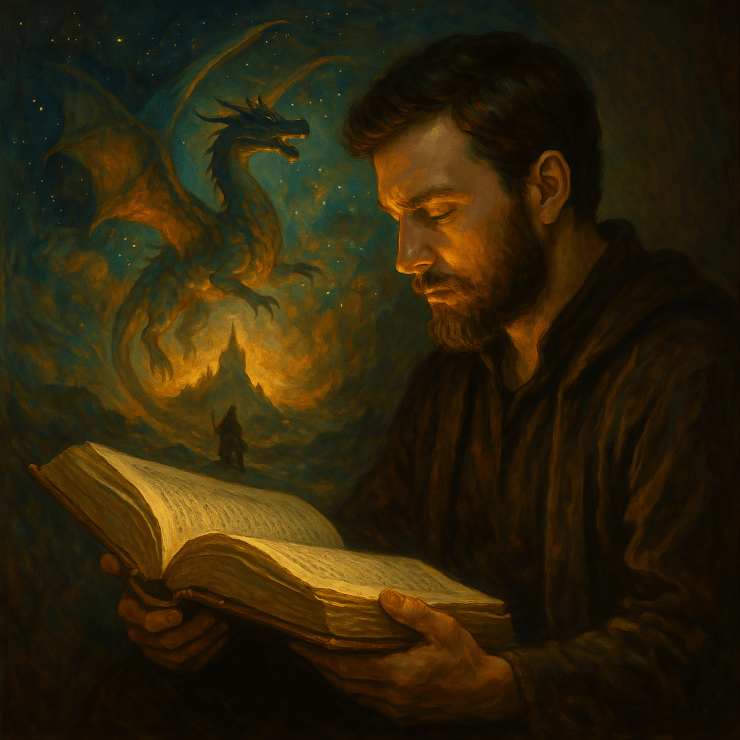
In an era marked by scientific rationalism and biblical illiteracy, many Christians feel unequipped—or even uncomfortable—when confronted by the stranger portions of Holy Scripture: wheels within wheels, beasts with multiple heads, dragons waiting to devour a child, or a valley full of dry bones clicking back to life. These are not straightforward didactic teachings but strange, otherworldly, and symbolic realities. And yet, they are inspired—breathed out by God for the building up of the Church (2 Timothy 3:16).
Too often, however, modern readers treat these biblical texts as either embarrassing relics of pre-modern superstitions or puzzles to be solved by charts and end-times speculations. But what if our imaginations, not just our intellects, need training to read such texts rightly? What if part of growing in biblical literacy is also growing in literary imagination?
This is where fantasy literature, often dismissed by the Church as dabbling in the occult, becomes a potent and pastoral tool. Fantasy literature offers a unique gift: it stretches the imagination so that we can better hear, see, and believe the living Word of God, especially when that Word comes robed in mystery.
The Word Is Not Tame
Catholic fantasy author J.R.R. Tolkien called fantasy the “recovery of wonder” (Tolkien, 77). Similarly, as he reflected on The Chronicles of Narnia, C.S. Lewis wrote:
I thought I saw how stories of this kind could steal past a certain inhibition which had paralysed much of my own religion in childhood. Why did one find it so hard to feel as one was told one ought to feel about God or the sufferings of Christ? I thought the chief reason was that one was told one ought to. An obligation to feel can freeze feelings… But supposing that by casting all these things into an imaginary world, stripping them of their stained-glass and Sunday school associations, one could make them for the first time appear in their real potency?
Lewis, 45-46
Scripture is a wonder-filled book, but many modern Christians have lost the eyes to see it.
The Bible does not merely convey doctrine—it tells a cosmic story. In Genesis, we find talking snakes and flaming swords. In Exodus, a burning bush speaks but is not consumed, plagues turn rivers to blood, and darkness chokes the land. In Daniel, empires are portrayed as monstrous beasts rising from the sea. In Revelation, the entire universe trembles at the coming of the Lamb who was slain. These are not tame images—they are quite fantastical. Yet they are true, not in spite of their strangeness, but because of it.
Fantasy books, when done well, prepare the Christian to receive these parts of Scripture not with skepticism or simplistic literalism, but with a reverent imagination trained to perceive deeper truths beneath symbolic veils. When we read of a great lion who is good but not safe (Aslan), or a king who returns at the end of a long darkness (Aragorn), or a humble child who turns out to be the savior of the world (Harry Potter), we are not turning from truth—we are being trained to long for it.
Training the Eyes of Faith
As Lutherans, we confess faith is not only knowledge of doctrinal facts but also trust in God’s promises—often unseen, yet no less real. Hebrews 11:1 reminds us, “Now faith is the substance of things hoped for, the evidence of things not seen.” That is, the Christian life is an imaginative one. Not imaginary, but imaginative—rooted in what we do not yet see but firmly believe. After all, we all enjoy imagining what Heaven and the new creation look like. Artists have painted their own imaginations of them.
Fantasy books train this kind of seeing. In fantasy, we follow characters who must believe in prophecies they do not yet understand, who fight enemies they cannot see, who hope for lands they have never visited. Sound familiar?
Abraham left his homeland for a place he did not know. Ezekiel prophesied to bones. John was shown things that “must shortly take place” through visions of lampstands, scrolls, gargantuan beasts, and trumpets. We hope for the Promised Land of the new creation we do not yet see. “For we live by faith, not by sight” (2 Corinthians 5:7). These are not abstractions—they are stories. And they require imagination to receive.
By reading fantasy, the Christian learns to suspend disbelief not to enter unreality, but to begin recognizing that reality is far deeper, stranger, and more enchanted than we often assume. And this prepares us to hear Scripture not just with our ears, but also with our hearts illumined by wonder.
Prophecy and Apocalypse are Fantasy with Authority
In books like Daniel and Revelation, God chooses to speak through visions that, on the surface, resemble fantasy more than they do systematic theology or eschatology. There are beasts with horns, dragons, numbers with symbolic meanings, and cosmic battles. These are not merely eccentric literary choices, utilizing symbols to elucidate eschatological truths. They are also prophetic. They are apocalyptic (from the Greek “revelation” [ἀποκάλυψις, apokalupsis]). They pull back the veil—reveal (apokalupto [ἀποκαλύπτω])—and show what’s really going on in the spiritual realm that will soon meet the physical.
But how can the average Christian read these texts without reducing them to secret codes or ignoring them altogether? This is where fantasy becomes a form of apprenticeship. When one has spent time with symbolic worlds—whether Tolkien’s mytopoeic legendarium or Lewis’ Space Trilogy—one is better prepared to hear the strange music of Scripture’s visions without panic or confusion.
You begin to see that the woman clothed with the sun is not nonsense (Revelation 12), but poetry indicative of the Greek apocalyptic genre (which the entire book was written in). That the dragon who persecutes the Church is not a literal monster, but representative of Satan’s real and terrifying evil. That the wedding feast of the Lamb is not mere metaphor, but our future made corporeal.
Fantasy doesn’t give us the keys to decode these visions, but it does open the heart to receive them, the same way a parable must be received—not dissected, but believed.
Sacramental Imagination
One of the most beautiful insights of the Lutheran tradition is its robust sacramental theology. We believe that in, with, and under the humble elements of bread and wine, Christ is truly present; that in the water of Baptism, Christ truly saves us (1 Peter 3:21); and in Absolution, forgiveness of sins is truly delivered to us as from Christ Himself. We believe the eternal breaks into the ordinary. That’s not magic—that’s miracle. That’s fantasy fulfilled.
Fantasy literature forms what might be called a sacramental imagination. It invites the reader to believe that behind the veil of what is visible, something more and real is happening—that swords can be more than steel (Ephesians 6:17; Hebrews 4:12), that words spoken by God can shape the entire universe (Genesis 1), that the weak can shame the strong (1 Corinthians 1:27), that the body and blood of Christ truly is present in the bread and wine (Matthew 26:26-28; 1 Corinthians 11:23-29), and that light shines in the darkness and the darkness has not overcome it (John 1:5).
In short, fantasy primes us to see how God works—hidden, humble, and yet triumphant. That is the essence of Lutheran theology: God hidden in suffering. Glory veiled in a cross. The Risen One appearing first to weeping women. Fantasy helps us not only affirm this theologically, but also to know it and to believe it.
Fantasy as Consolation and Critique
Fantasy also consoles. In times of despair, reading the long defeat endured by Sam and Frodo can speak comfort in a way few sermons can. When Christians suffer under oppression, the knowledge that the White Witch’s winter will not last forever—or that Aslan is on the move—gives strength.
But fantasy also critiques. It unmasks the idols of power, control, and self-certainty. The One Ring corrupts. The Dark Lord deceives. Kaladin Stormblessed must stop depending on his strength alone. The systems of men are always twisted and corrupt. Fantasy, like the prophets of old, proclaim judgement on the kingdoms of this world and offers a vision of something better: a true kingdom, whose King is just and merciful.
In this way, fantasy is not escapist—it is eschatological. It points us forward. It makes us homesick for the New Jerusalem—the new heavens and the new Earth when Christ returns to inaugurate His kingdom that is not of this world, but will nevertheless transform it into a New Eden.
Practical Encouragement for Christians
For those who fear that reading fantasy may lead them away from Scripture, or if you just think it’s boring, I offer this pastoral word: let it lead you back to Scripture with new eyes.
- After reading The Last Battle by C.S. Lewis and/or The Lord of the Rings: The Return of the King, read Revelation again.
- After reading The Silmarillion, read Genesis 1-11 with fresh awe.
- After reading The Chronicles of Narnia, read the Gospel of John again with a renewed imagination.
- After reading Till We Have Faces by C.S. Lewis, revisit the Psalms.
- After reading about dragons and kings and unseen wars, pay closer attention to our liturgy in the Divine Service—where we hear God claims us as His children and makes us citizens of His kingdom.
We are called to be people of the Word, and that Word includes its own stories, songs, symbols, and visions. Our God is not embarrassed by the imagination. He made it, and He uses it.
Here are a few suggestions to ease you into fantasy if you’re unfamiliar with the genre:
- The Neverending Story by Michael Ende (don’t substitute it with the movie; it’s terrible).
- The Hobbit by J.R.R. Tolkien.
- The Lord of the Rings trilogy by J.R.R. Tokien (but read The Hobbit first if you’re new to fantasy).
- Hyperion by Dan Simmons (book 1 of They Hyperion Cantos, which is a blend of sci-fi and fantasy).
- Ilium by Dan Simmons (book 2 is Olympos, a duology that is also a blend of sci-fi and fantasy).
- The Way of Kings by Brandon Sanderson (then decide if you want to continue with the rest of The Stormlight Archive. This is a very long book, which is why I put it last. Most fantasy books are quite long).
Recovering the Wonder of the Word
To be a Christian is to believe that what is unseen is just as real as what is seen. To read the Bible rightly is to recognize that it is not a modern textbook; it is a divine drama filled with poetry, prophecy, vision, and truth (and yes, historical narratives; the Gospels are their own genre).
Fantasy literature—when received with discernment and humility—can serve as a gift to the Church. It helps us recover wonder. It helps us read strange texts without fear. It helps us become like children again—the very posture our Lord commends when He says, “Unless you become like little children, you will by no means enter the kingdom of Heaven” (Matthew 18:3).
Therefore, let us ready fantasy—not to escape reality, but to see it more clearly. Not to flee Scripture, but to re-enter it with eyes wide open. Not to find Christ in fiction, but to let fiction teach us how to behold Him more faithfully in His Word.
After all, the greatest fantasy ever told is true: the Word of God became flesh and dwelt among us! And He is coming again—not in myth, but in majesty.
Works Cited
Lewis, C.S. “Sometimes Fairy Stories May Say Best What’s To Be Said.” In On Stories: And Other Essays on Literature (HarperOne, 2002).
Tolkien, J.R.R. On Fairy-Stories. In Tree and Leaf (HarperCollins, 2001).
 The Lutheran Column