
Every pastor’s bookshelves brim with theological tomes, commentaries, dogmatics, and ecclesiastical treatises. A pastor’s reading list is often weighed down with heavy doctrine, church history, and exegetical minutiae. These are good and necessary tools for the Office of Holy Ministry in the proper administration of Word and Sacrament. But if the only texts a pastor consumes are technical, theological, or explicitly Christian, they risk becoming less effective at what they are called to do every Sunday: preach Christ crucified in a way that breaks hearts, stirs souls, and opens ears.
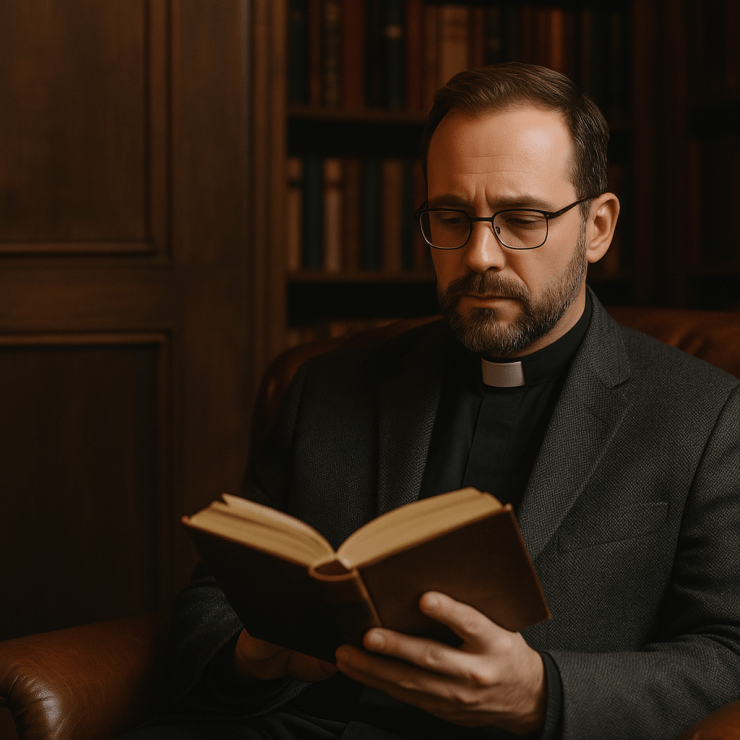
This is why pastors—especially Lutheran pastors who understand the gravity of preaching as God’s living address to His people—should read fiction. Not just allegorical fiction or “Christian novels,” but fiction in all its rich and varied forms: classic, fantasy, science fiction, horror, and others. Not because fiction is equal to Scripture—God forbid!—but because fiction, when received rightly, trains the imagination to proclaim the Gospel more vividly, more concretely, and more incarnationally.
Fiction Forms the Imagination
As Lutherans, we are not Gnostics. We do not despise the body or the material world. We confess the Word made flesh (John 1:14), Sacraments that wash over our bodies and physically consume and hear with our physical ears (Baptism, Lord’s Supper, and Absolution respectively), and a faith that is lived out in vocation, suffering, and community. And yet, far too often our sermons become disembodied abstractions—doctrinally accurate but experientially distant.
Fiction, by contrast, trains us to think in story, imagery, and particularity. A novelist does not describe love as a concept but shows it in action—a character who waits, who suffers, who gives, who fails and forgives (which is exactly why Jesus’ parables are so powerful). A good novel is incarnational in the way it presses emotion into scenes, pain into characters, and hope into dialogue. These narrative instincts, formed through the reading of fiction, are transferable to preaching.
If theology is faith seeking understanding, then fiction is faith seeking embodiment. It does not replace theology, but it does help us imagine what it looks like when theology meets real life. When a preacher has soaked in novels that bleed and breathe, he learns how to paint a world into his sermon—not for the sake of sentimentality, but to reach the hearer where they actually live: in bodies, in stories, in the mess and beauty of daily life.
Fiction Deepens Empathy
One of the greatest challenges in pastoral ministry is learning to love those you do not understand: the alcoholic, the shut-in who hoards, the teenager who self-harms, the man with no interest in faith, the woman who’s angry with God. A pastor who has only studied theology but never entered into the wounds and hopes of fictional characters may lack the muscle memory of empathy.
Fictional characters are not simply made-up people. They are sacramental in their own way—visible signs of invisible truths about the human condition. To read Dostoevksy is to be haunted by the psychological torment of sin and the yearning for redemption. To read R.F. Kuang is to be drawn into the griefs of a people long silenced. To read Marilynne Robinson is to hear grace echo in ordinary things. Even high fantasy like Tolkien’s The Lord of the Rings or horror like Stephen King’s Christine awaken our sense of courage, loss, and longing.
And when the pastor has been steeped in these worlds, his heart stretches. He becomes less quick to judge, more able to listen, more patient with pain, and more fluent in the language of the brokenhearted. This is no small thing in the pulpit.
Fiction Sharpens Language
God has chosen to communicate not through image or code but through words. Preaching, at its most fundamental level, is the art of speaking God’s Word clearly, faithfully, and beautifully. Fiction teaches us how to use language—not just what to say, but also how to say it.
Too many sermons are clunky with theological jargon, or padded with clichés and moral platitudes, or dulled by laziness. A good novel cuts through this. It shows how rhythm, metaphor, silence, and diction matter. It shows how to build tension, how to turn a phrase, and how to end a scene with weight. In other words, it shows how to preach not only to the mind but also to the imagination and the heart.
When Luther preached, he was not dry—he was vivid. He painted sin in monstrous colors. He made grace feel like sunlight after a storm. He used barnyard analogies, Scripture, song, and storytelling. Fictional reading helps recover this texture in a preacher’s voice. Not so that sermons become performances, but that sermons become memorable. Not because fiction makes a preacher clever, but because it makes him human.
Fiction Illuminates Law and Gospel
One of the central distinctions in Lutheran theology, preaching, and pastoral care is the proper distinction between Law and Gospel. The law accuses, reveals sin, and kills. The Gospel delivers the forgiveness of sins and comforts the conscience. But preachers often struggle to make the distinction vivid and existential, or forget to let the Gospel predominate. It can remain an abstract formula unless it is made flesh in narrative.
Fiction helps the preacher feel the Law—when reading Crime and Punishment, one feels Raskolnikov’s torment. In Les Misérables, we see the Law in Javert’s rigid justice and the Gospel in Valjean’s mercy. We see this paradigm even in horror novels, such as Stephen King’s Misery being a caution against obsession, or the desire for redemption in IT.
When the preacher has seen Law and Gospel unfold in story, he becomes more skilled at unveiling it in the sermon. He learns how to preach not only what it means but also what it looks like. He can say, “You are the man” (2 Samuel 12:7), and then, “You are forgiven,” and hearers will know both the wound and the balm.
Fiction Prepares for the Unexpected
Pastoral ministry is full of strange and unplanned moments: a suicide call at midnight or crisis phone call at 3 a.m., a widow’s trembling question at the graveside, a child asking why her friend died. The lectionary, as wonderful as it is, cannot anticipate all these things. But the pastor who has walked the many emotional corridors of fiction is better prepared to enter others’ stories with grace and a deep empathy for suffering.
Whether through science fiction or gothic horror, through magical realism or medieval legend, fiction primes the pastor for a world where not everything fits into a tidy system. It reminds him that people do not always speak in theological categories, but they still long for God, even when they don’t know it.
To paraphrase from Luther in his commentary on Galatians, if you want to understand the Gospel, you must go to the brokenhearted, for they are the ones it is meant for (see LW 26:115, 127).
Fiction helps the preacher find them.
Let the Word Dwell Richly—in All Words
The Apostle Paul commands, “Let the Word of Christ dwell in you richly” (Colossians 3:16). This is not only a call to meditate on Scripture but also a call to saturation—to live in the fullness of God’s truth and beauty so that it overflows in teaching, preaching, and living. Reading fiction, then, is not a waste of time. It is soul-work, craft-work, and pastoral care for the imagination.
As it is often paraphrased of Luther, “Next to the Word of God, music deserves the highest praise” (Leaver, 2006). I would humbly add: so does story. For an example of what all this looks like in a sermon, see my funeral sermon, “Jesus Confounds Death,” where Mary Shelley’s Frankenstein led me to preaching one of my best sermons as a pastor. (Yes, I used Frankenstein’s monster as a method of development in a funeral sermon, and I do not exaggerate when I say it was one of my best sermons I ever preached. The hearers—both Lutheran and non-Lutheran—could not stop talking about how great of a sermon it was and thanking me for providing them such comfort, especially the husband of the deceased.)
So, my brother pastors, pick up the novel. Step into another world. Learn again how to see, to feel, to speak. And then return to your pulpit—your people—with the Gospel burning on your tongue and stories in your bones.
Works Cited
Leaver, Robin A. “Luther on Music.” Lutheran Quarterly XX (2006).
 The Lutheran Column