
A Funeral Without Christ
In recent decades, a dramatic shift has taken place in how our culture handles death. Increasingly, funerals are being replaced with events called “celebrations of life.” Instead of solemn hymns and Scripture readings, people gather to share memories, play upbeat music, wear bright colors, and speak only of the good deeds and personality traits of the deceased. There is often laughter, stories, videos, and applause. Grief is discouraged—joy is prescribed. While there is certainly a time to venerate our dearly departed saints and reminisce about happy memories, the funeral service is not the time for it.
And while such practices may be well-intentioned—an attempt to “honor the person” or “remember the good times”—they are theologically misguided, pastorally harmful, and spiritually dangerous. For the Christian, a funeral is not a celebration of the deceased’s life; it is a proclamation of Christ’s death and resurrection, and it is an invitation to mourn with hope. Anything else is not Christian worship, but sentimental humanism clothed in religious language.
“Celebration of Life” Focuses on the Person, Not the Savior
The most immediate problem with a “celebration of life” is that it replaces the Gospel of Jesus Christ with a eulogy of the individual. The service becomes a time to talk about the person, to praise their works, and to relive their memory as people plaster false smiles on their faces. Even if a pastor is present, Christ is often an afterthought—an accessory added at the end of the party.
This is not the purpose of Christian worship. “And I, if I am lifted up from the earth, will draw all peoples to Myself” (John 12:32). Worship, including a funeral service, is about lifting up Christ crucified, not ourselves or our loved ones. In focusing on the life of the deceased, we implicitly teach people that eternal life is about what we have done and how we are remembered, rather than what Christ has done and what He remembers. “Therefore, we conclude that a man is justified by faith apart from the deeds of the Law” (Romans 3:28).
If we spend the service praising the person’s kindness, generosity, sense of humor, or hobbies, we are preaching works-righteousness, no matter how unintentionally. Again, there is a time to reminisce about our deceased loved one, but the funeral service is not the time for it. In my own pastoral practice, I’ve found that the luncheon that often follows the service is the perfect time for such reminiscing, and even the visitation before the service.
True Christian hope is not in a good life but in a crucified Savior. The only comfort we can give the grieving is not, “Your loved one lived a good life,” but “Your loved one died in Christ, and Christ is risen.” 1 Corinthians 15:14, “And if Christ is not risen, then our preaching is empty and your faith is also empty.” 1 Thessalonians 4:13-14, 16c-18, “But I do not want you to be ignorant, brethren, concerning those who have fallen asleep, lest you sorrow as others who have no hope. For if we believe that Jesus died and rose again, even so God will bring with Him those who sleep in Jesus… And the dead in Christ will rise first. Then we who are alive and remain shall be caught up together with them in the clouds to meet the Lord in the air. And thus we shall always be with the Lord. Therefore, comfort one another with these words.”
“Celebration of Life” Replaces Grief with Denial
The second major problem is that “celebration of life” language suppresses grief. Mourners are subtly—or even explicitly—told not to cry, not to feel sorrow, not to lament. They are told, “This is not a funeral. This is a celebration of life! Don’t be sad—celebrate!” And so, they fake-smile through their pain, fake-laugh through their sorrow, and bottle up the grief that God Himself has given us space to express.
Grief is not faithlessness; it is human and godly. “Jesus wept” (John 11:35). Jesus, who knew He was about to raise Lazarus from the dead, still stood at the tomb and grieved. Why? Because death is evil, unnatural, and the enemy. “The last enemy that will be destroyed is death” (1 Corinthians 15:26). He did not tell Martha and Mary to celebrate Lazarus’ life. Instead, He joined them in mourning.
“[There is] a time to weep and a time to laugh; a time to mourn, and a time to dance” (Ecclesiastes 3:4). Once again, I reiterate: there is a time to reminisce, but the funeral service is not it. God has created time for mourning. The Psalms are filled with laments. The Church does not run from sorrow; she sanctifies it by placing it at the foot of the cross.
Suppressing grief creates long-term harm. When a funeral becomes a celebration, we implicitly teach the grieving that their tears are inappropriate and misplaced. But this is emotional dishonesty, not Christian maturity. Even though we know they will be risen on the Last Day, it is still okay to grieve because death is a terrible evil. We were created for life with God, and death is a violent disruption of that order. Christians grieve, but we grieve with hope (1 Thessalonians 4:13).
“Celebration of Life” is Not a Christian Category—It is Pagan
The very concept of a funeral as a “celebration of life” has its roots not in the Church but in secularism and paganism. Modern “celebrations of life” reflect the secular belief that death is natural, that people are inherently good, and that legacy is more important than salvation. This mindset flows from Enlightenment humanism, not the Word of God. It teaches that what matters is the person’s impact, not their salvation in Christ.
Conversely, the Christian confesses, “For the wages of sin is death, but the gift of God is eternal life in Christ Jesus our Lord” (Romans 6:23). Death is not natural; it is the curse of sin. We don’t “celebrate” it. We mourn it, but not without hope.
Ancient pagans—Greeks, Romans, Egyptians—often held grand memorial feasts and rites meant to honor the life of the dead and appease the spirits. In Eastern religions like Hinduism and Buddhism, death is merely a transition in a cycle of rebirth, and funerals often center around the person’s deeds or good karma.
This is exactly what modern funerals have become: a ritualized remembrance of the person, often without any meaningful reference to the one true God. In this way, even Christian funerals can become pagan in practice if Christ is not preached (indeed, He is often left unmentioned at such “celebrations”).
The True Christian Funeral: A Liturgy of Christ’s Victory
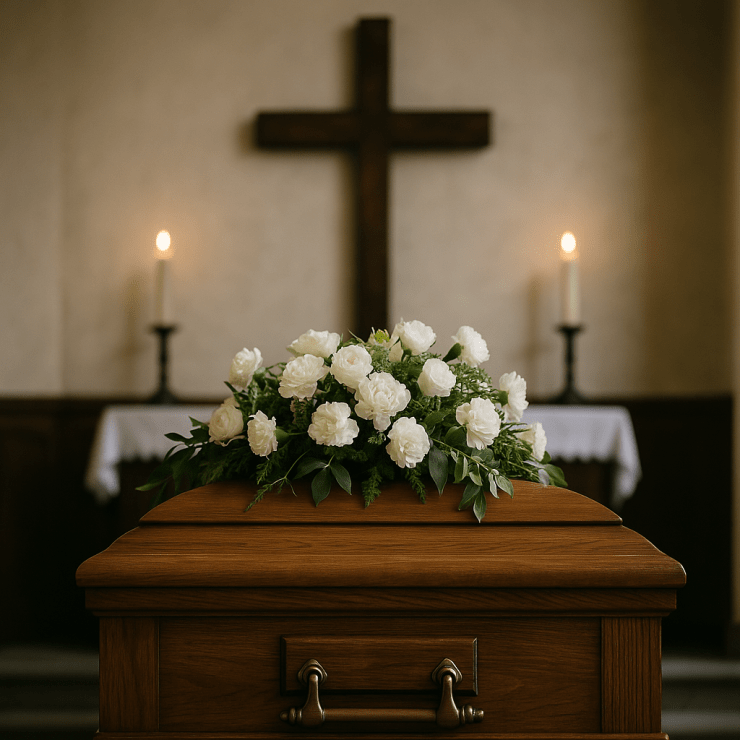
The funeral service is about the Gospel. In the Lutheran Church, a funeral is not a celebration of a person’s life. Rather, it is a service of the Word, grounded in the promises of Holy Baptism, the resurrection of the body, and the hope of eternal life in Jesus Christ. The focus is not the goodness of the deceased but the goodness of God who justifies sinners.
“Precious in the sight of the LORD is the death of His saints” (Psalm 116:15). This verse is not about sentimentality but about how God regards the death of those united to Christ. The funeral, then, becomes a proclamation of Christ’s victory over death.
Thus, the funeral service is a confession of the resurrection. Every Christian funeral is a declaration: “Christ is risen!” and “So shall we rise!” As is often read at a Lutheran funeral service, “For I know that my Redeemer lives, and He shall stand at last on the Earth; and after my skin is destroyed, this I know, that in my flesh I shall see God, whom I shall see for myself, and my eyes shall behold, and not another. How my heart yearns within me!” (Job 19:25-27). This is not wishful thinking or abstract spirituality; it is flesh-and-blood hope grounded in the historical resurrection of Jesus.
A Call to Pastors and Families: Proclaim Christ, Not the Deceased
Pastors must resist the pressure from the well-meaning bereaved to turn funerals into personality-driven events. They must gently teach the faithful that true comfort is not found in remembering earthly accomplishments but in being clothed in Christ’s righteousness. And Christian families must prepare their loved ones with clear instructions: “At my funeral, preach Christ. Do not celebrate my life. Proclaim my Savior.”
“But God forbid that I should boast except in the cross of our Lord Jesus Christ” (Galatians 6:14).
Christ is Our Celebration
We are not saved by our stories, our smiles, or our legacy. We are saved by Christ incarnated, crucified, risen, ascended, and returning. A Christian funeral does not celebrate the life of the deceased; it confesses the death and resurrection of Jesus Christ. To “celebrate life” is to point backward at fading memory. To preach Christ is to point forward—to the resurrection, to the life of the world to come, the new heavens and the new Earth.
Therefore, let the Church bury her dead in hope, not in denial. Let her mourn with tears, not with faux applause. And let her lift high the cross—not the accomplishments of men, but the mercies of God in Jesus Christ. “Blessed are the dead who die in the Lord… that they may rest from their labors, and their works follow them” (Revelation 14:13).
Amen.
 The Lutheran Column
This is a deeply insightful and thought-provoking piece that beautifully emphasizes the true essence of Christian funerals — focusing on Christ’s victory over death rather than worldly celebration. Your reflections bring powerful spiritual clarity and comfort. For more heartfelt perspectives on honoring loved ones, visit https://celebratelifeideas.com/.
LikeLike