
In moments of grief, especially after the death of a loved one, people often seek comfort in images and signs—whether a butterfly at the window, a bird landing nearby, or a gentle breeze that seems too perfectly timed to be a coincidence. Many sincerely believe these signs mean their departed loved one is visiting or watching over them, even Christians! Sometimes, people go further and say things like, “Grandpa visited me as a cardinal” just because that was his favorite bird, or “She came back as a butterfly to say goodbye.”
While these thoughts may bring momentary peace, they are not consistent with the teachings of Holy Scripture and the true hope they give us. In fact, they stem from pagan religious systems and non-Christian worldviews that contradict the clear and comforting truths given to us in God’s Word. As Christians, and especially as Lutherans who confess the authority of Scripture alone, we must gently but firmly reject such ideas and cling instead to the promises of Christ.
What Happens When We Die?
To understand why the soul of a person does not return as a creature, we must begin with what Scripture teaches about the state of the soul after death:
- Ecclesiastes 12:7, “Then the dust will return to the earth as it was, and the spirit will return to God who gave it.”
- Hebrews 9:27, “It is appointed for men to die once, but after this the judgement.
- Luke 16:22-26, In Jesus’ Parable of the Rich Man and Lazarus, both men die, and their souls are immediately taken to their eternal destinations—one to comfort in Abraham’s bosom, the other to torment. There is no mention of returning, reincarnation, or occupying other creatures.
These passages—and others—make it unmistakably clear: at death, the soul departs from the body and goes either to be with the Lord or to await final judgement apart from Him. There is no scriptural support for the idea that a soul hovers on Earth, becomes a butterfly, or takes on any new form.
Why Do People Believe in Reincarnation and Signs in Nature?
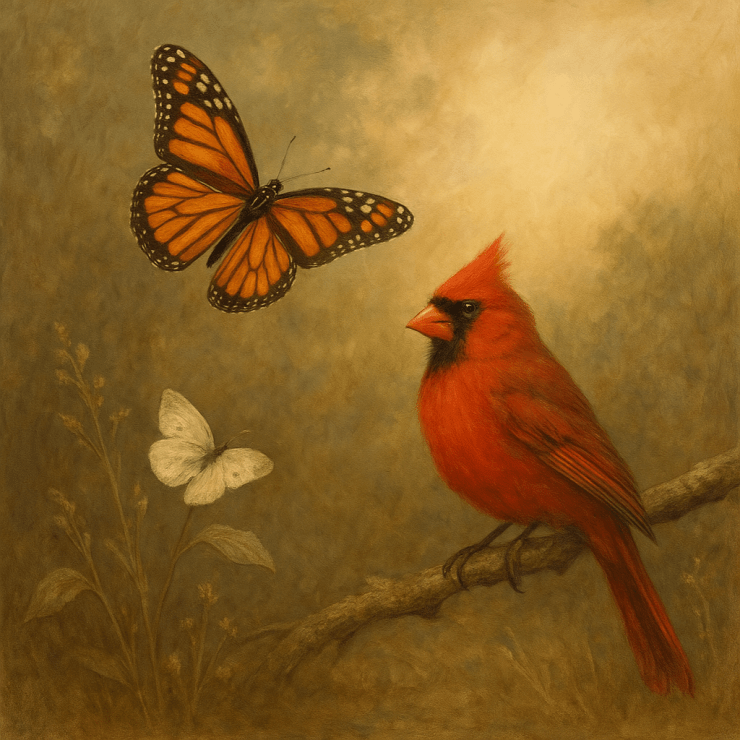
The belief that a human soul can return as an animal or another human is not Christian; it is pagan, and it originates from Eastern religious systems and animistic worldviews.
One of the oldest religions that teaches reincarnation is Hinduism, which holds that the soul (atman) is reborn repeatedly in a cycle called samsara. The form one takes in the next life—animal, human, or even god-like—depends on one’s actions (karma) in this life. The ultimate goal is to escape this cycle and merge with the divine (moksha).
In this view, a person might be reborn as a butterfly or a dog or a cow depending on past behavior. This belief, however, is incompatible with Christianity, which teaches salvation is by grace through faith in Jesus Christ, not by karma or endless rebirths. “For by grace you have been saved through faith, and that not of yourselves; it is the gift of God, not of works, lest anyone should boast” (Ephesians 2:8-9).
Buddhism, while philosophically distinct from Hinduism, shares the concept of reincarnation and karma. It too teaches the impermanence of the self and the goal of enlightenment, where the cycle of rebirth ceases (nirvana). In this system, there is no permanent soul, and the self is dissolved into a greater cosmic reality. This stands in contradiction to the biblical teaching of the individual soul that is known, loved, and redeemed by God in Christ.
In many tribal religions (animism) and New Age movements, people believe in spirit animals, nature deities, and the idea that souls can inhabit trees, rivers, or animals. They might see a butterfly or a bird as an actual manifestation of a deceased person. These beliefs are common in Native American spirituality, African traditional religions, Wicca, and modern spiritual-but-not-religious circles (which often pose as a counterfeit Christianity).
Such views are not simply harmless cultural practices. Scripture warns us that idolatry, even when veiled in emotion or nature imagery, is spiritual deception. “Professing to be wise, they became fools, and changed the glory of the incorruptible God into an image made like corruptible man—and birds and four-footed animals and creeping things” (Romans 1:22-23).
What Does Scripture Say about “Signs” from the Dead?
Scripture strictly forbids seeking signs from the dead or interpreting nature as a means of communication from them:
- Deuteronomy 18:10-12, “There shall not be found among you… a medium, or a spiritist, or one who calls up the dead. For all who do these things are an abomination to the LORD.”
- Job 14:12, “So man lies down and does not rise. Till the heavens are no more, they will not awake nor be roused from their sleep.”
The Bible never once tells us to look for signs in butterflies, birds, or any other thing of creation to connect with our dead loved ones. Rather, we are told to remember them, to grieve with hope, and to look to Christ for comfort in the bodily resurrection. “But I do not want you to be ignorant, brethren, concerning those who have fallen asleep, lest you sorrow as others who have no hope. For if we believe that Jesus died and rose again, even so God will bring with Him those who sleep in Jesus” (1 Thessalonians 4:13-14).
The Danger of Sentimental Falsehoods
It may seem gentle or poetic to say, “He became a cardinal to visit me,” but such sentiments are actually lies of the devil and they rob us of true comfort. Why? Because they focus on something uncertain and not grounded in God’s Word rather than on the solid rock of Christ’s resurrection.
To believe that the soul returns as a bird or some other animal is to believe a lie, no matter how sweet. These ideas are rooted in manmade religions, not the living Word of God. “For the time will come when they will not endure sound doctrine… and they will turn their ears away from the truth, and be turned aside to fables” (2 Timothy 4:3-4).
True Christian hope lies not in an animal that will also die, but in the empty tomb—our Lord who will never die again (Romans 6:8-9).
The Resurrection of the Body: Our True Hope
The belief that our loved one has come back as an inconsequential bird or insect is a failure to confess the Third Article of the Apostles’ Creed: “I believe in the resurrection of the body and the life everlasting.” We are not destined to become birds, thank God! What a downgrade that would be! We are not recycled souls floating in the cosmos. We are redeemed bodies and souls, awaiting the resurrection on the Last Day:
- John 5:28-29, “…for the hour is coming in which all who are in the graves will hear His voice and come forth…”
- Philippians 3:20-21, “[Christ] will transform our lowly body that it may be conformed to His glorious body…”
This is the comfort we hold out to the grieving: not that their loved one visits them in the form of a cardinal, but that their loved one rests in Christ, and that we will see them again in glorified bodies at the resurrection.
Speak the Truth in Love
As Christians, we are called to speak the truth in love (Ephesians 4:15), which is difficult to do when seeing someone deceived by the lies of the devil. When comforting the grieving, we do so not with folklore or pagan imagery, but with the pure promises of the Gospel.
Tell them, “Your loved one is not a butterfly. They are not a whisper in the wind. These are worse than what Jesus actually promises. If they died in faith, they are with Jesus, awaiting the day when He will raise them in glory, and you will see them again—not in the form of a bird, but face-to-face, body and soul, perfected in Christ.”
Let us not settle for shadows and superstitions when we have the sure and certain hope of the resurrection. And let us hold fast to the truth that while nature may reflect God’s beauty, it is not a vessel for departed souls. “For I know that my Redeemer lives, and He shall stand at last on the Earth; and after my skin is destroyed, this I know, that in my flesh I shall see God” (Job 19:25-27).
Amen.
 The Lutheran Column