
To argue that LGBTQIA+ identities and communities constitute a religion, we need to explore the idea that their perspectives involve metaphysical assumptions and practices similar to those found in traditional religions. This approach involves examining whether the LGBTQIA+ movement encompasses elements such as a belief system, rituals, a community of believers, and a framework for understanding life that can be seen as religious in nature.
First, let’s consider the definition of religion. Many have offered various definitions, but broadly speaking, religion can be defined as a system of beliefs and practices often centered around questions of existence, purpose, and moral conduct, usually involving a relationship with the divine or the supernatural/metaphysics.
Belief System and Metaphysical Assumptions
At its core, the LGBTQIA+ movement involves metaphysical assumptions about the nature of gender and sexual orientation. These assumptions challenge traditional, binary understandings of gender and advocate for a more fluid, spectrum-based understanding. This perspective is metaphysical in nature because it deals with the fundamental nature of reality and human existence, questioning deeply held beliefs about identity and the self. In this sense, the LGBTQIA+ movement shares a trait with religion: it offers a framework for understanding aspects of human existence.

Their metaphysical assumptions are the kernel of their doctrine, utilizing Plato’s philosophy and, furthermore, is the ancient heresy of Gnosticism subtly revisited. Plato taught that the spiritual world is superior to the material world, which he explains in his writing called The Republic through a story called the “allegory of the cave.”
Imagine people living in a cave. They have never ventured outside because they were chained to the walls. All they can see are shadows cast on the wall of the cave as things pass in front of a fire that’s behind them. They eventually give names to these shadows and assume they’re the full experience of reality. If it were possible for them to be released from the chains, then they would quickly realize what they understood as reality was nothing more than shadows. Plato’s story illustrates how people “wrongfully” assume the material world is reality when it is merely a shadow of reality. For example, in the spiritual realm there exists only perfect circles, whereas in the material realm every circle are just imperfect shadows of the ideal circle. Therefore, what is material is inferior to what is spiritual.
As Gnosticism later developed in the 2nd century, the Gnostic Christians essentially adopted Plato’s philosophy. The Gnostics varied in belief, but the common denominator among them is that they believed the world was created and ruled by a lesser deity, called the demiurge, and that Christ was an emissary of the remote supreme deity in the spiritual realm. Only through esoteric knowledge (gnosis) can the human spirit be truly redeemed to leave behind the evil, material body (the “cave”).
Thus, with Platonism and Gnosticism coupled together, the LGBTQIA+ believer claims people wrongfully assume there are two genders, as nature patently testifies (instead of gender, they call it one’s “sex”). This binary way of thinking is a mere shadow of reality: gender is now a spectrum. Your true gender and/or sexuality—your true self—is not what you are in your body. Your true self is “somewhere out there,” whatever you believe or feel yourself to be.
The goal of their doctrine—of their gnosis—is to convince people (especially teenagers and young children) that their spirit (their true self) can only be released from the evil, material sex they were “assigned at birth” through a rejection of the body given to them and the acceptance of whatever they imagine themselves to be, thereby necessitating gender reassignment surgery and/or hormone therapy. Here is a question that remains to be answered: If sex and gender are not the same, then why must one undergo gender reassignment surgery—the alteration of their sexual organs and hormones—in order to match their perceived gender?
Rituals and Practices
Religions often have rituals that reaffirm the beliefs and community bonds of their believers. For example, in the Lutheran Church—Missouri Synod, we have the liturgy of the Divine Service, Matins, Confirmation, different types of prayer services, and others, as well as other meaningful rituals unique to the local congregation like Oktoberfest, an annual spaghetti dinner, and so on. In the context of the LGBTQIA+ community, events like Pride parades (especially in June), coming-out ceremonies, and various forms of activism can be viewed as analogous to religious rituals. If you are a true believer, you engage in and/or approve of these rituals since these events celebrate LGBTQIA+ identities, foster a sense of community, and promote visibility and acceptance. They serve to reinforce the shared beliefs and values of the community, much like religious rituals do for their believers.
Community of Believers
The LGBTQIA+ community undeniably forms a distinct group with shared experiences, values, and goals. This community provides support, solidarity, and a sense of belonging to its members. Like religious communities, LGBTQIA+ groups offer a network where individuals find identity and purpose. The strong sense of community and shared mission within the LGBTQIA+ movement can be likened to the communal aspects of traditional religions, such as Christian churches, Mormon temples, Muslim mosques, and others.
Framework for Understanding Life
Religions provide frameworks for understanding the world, one’s relationship to the world, and guiding moral conduct. The LGBTQIA+ movement advocates for particular ethical perspectives, emphasizing equality, acceptance, and human rights (trans rights, gay rights). These principles shape how the believers understand human relationships and social structures. By offering a comprehensive worldview that informs both personal identity and societal norms, the LGBTQIA+ movement functions similarly to a religion in providing a moral, philosophical, and ethical framework for its followers. If one does not adhere to their beliefs, then that person is wicked, similar to other traditional religions.
Proselytization
Proselytization, or the act of attempting to convert others to a belief system, is a common aspect of many religions. LGBTQIA+ activists seek to convert others by promoting acceptance of LGBTQIA+ identities and challenging traditional views on gender and sexuality. This promotion can be seen in public school curriculums and libraries, media representation, legal advocacy, and even extremes of social ostracization and/or job loss for refusing to convert. These efforts are akin to religious proselytization in that they aim to spread a particular set of beliefs and values to a broader audience.

LGBTQIA+ Is A False Religion
As we have seen, LGBTQIA+ is indubitably a religion with its metaphysical presuppositions that guide its believers to formulate a system of doctrines centered around these believers, to reaffirm these beliefs through their various rituals, and to convert others into their beliefs through concerted proselytization efforts. As Christians who have fundamentally different beliefs, this makes it a false religion, for they serve an entirely different god—the self, pride. Rather than giving a lengthy argument about this, I’m going to assume that most of my readers are Christians. With that in mind, I want to take a different approach: how we as Christians can love the people within the LGBTQIA+ community without sacrificing our own beliefs, beginning first with gay people and then trans people.
How to Love Gay People
Lutheran content creator, Paladin Actual, has an excellent video on this, which you can watch below. I’d like to emphasize some major points he makes.
First, there are two major ways in which we don’t want to err as Christians. On the one hand, we ought not to become antinomians in which we attempt to rewrite God’s Word to be more accepting because we don’t like what God’s Law says about the sin of homosexuality (e.g., Leviticus 18:22; 20:13; Romans 1:26-28). I like what Paladin Actual said, “God doesn’t need you to rewrite the Bible. He wrote what He wrote and He meant what He wrote and He sticks to it.” One would be more intellectually honest to either accept what it says or to reject it entirely rather than approaching it like a buffet by taking out the parts we don’t like.
On the other hand, we ought not to become legalists and think our goal is to get them to stop sinning. Yes, people shouldn’t sin, but ceasing from sin is not what saves us and it is not what will save them. St. Paul was not able to stop sinning (Romans 7), and that’s why he wrote the next chapter. I encourage you to stop reading here, go and read Romans 7-8, and return here…
We are Romans 7 Christians with a Romans 8 God. That is, as Christians, we are people who have a heightened awareness of our sins because we have the Holy Spirit; it disgusts us, and we want to stop, but we can’t. So, we run to Christ for refuge, hence the beginning of chapter 8, “There is therefore now no condemnation to those who are in Christ Jesus.” Galatians 2:16 accentuates this, “a man is not justified by works of the law but by faith in Jesus Christ, even we have believed in Christ Jesus, that we might be justified by faith in Christ and not by the works of the law; for by works of the law no flesh shall be justified.” Jesus saves, not the cessation of sin by our own efforts.
We can’t love them by telling them to stop sinning because it’s too late. They’re deep in the throes of their sin already, and unless the grace of God moves them, they will not be moved. In fact, it’s already too late by the time we’re conceived since we’re conceived in sin (Psalm 51:5)! Our goal is not to bring them to stop sinning but to bring them to repentance and forgiveness. This doesn’t mean they stop sinning! For how often have you and I repented and then relapsed into that very sin?
As Paladin Actual says, we must preach the Gospel to them, which we cannot do without the Law, “but you must preach the Law in such a way that it leads to the Gospel… You have to present the Law in such a way that it is not diminishing the Law but that it leads to the Gospel because the Gospel—faith in Christ, forgiveness of sins—that’s what saves, not obedience to the Law.”
And that is how we love the gay person—preaching the Law so that they’re aware of their sin but in such a way that it leads them to the Gospel for the forgiveness of sins. 1 Corinthians 6:9-11 is our guide on how to do this, “Do you not know that the unrighteous will not inherit the kingdom of God? Do not be deceived. Neither fornicators, nor idolaters, nor adulterers, nor homosexuals, nor sodomites, nor thieves, nor covetous, nor drunkards, nor revilers, nor extortioners will inherit the kingdom of God. And such were some of you, but you were washed, but you were sanctified, but you were justified in the name of the Lord Jesus and by the Spirit of our God.“
It does not say you stop sinning; it points the sinner to Baptism and justification by faith. Now, it is not rational persuasion that gives faith in Christ, but the Holy Spirit when and where He wills. This is what we confess about the 3rd Article of the Apostles’ Creed, “I believe that I cannot by my own reason or strength believe in Jesus Christ, my Lord, or come to Him; but the Holy Spirit has called me by the Gospel, enlightened me with His gifts, sanctified, and kept me in the true faith” (Small Catechism).
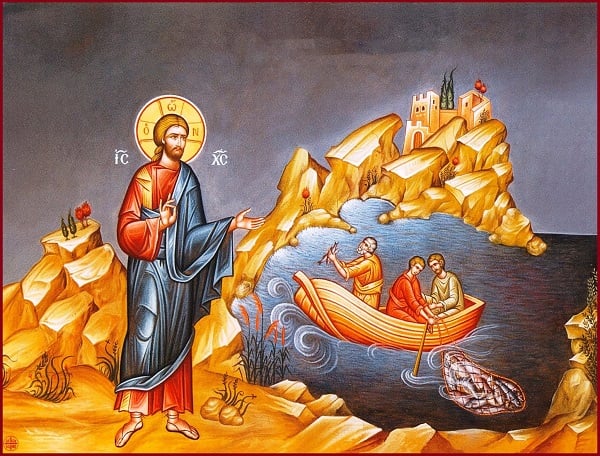
We do not take them to jail for their sin; we take them to Jesus. There is no better way to emphasize this than Luke 5:8-11, “When Simon Peter saw it, he fell down at Jesus’ knees, saying, ‘Depart from me, for I am a sinful man, O Lord!’ For he and all who were with him were astonished at the catch of fish which they had taken; and so also were James and John, the sons of Zebedee, who were partners with Simon. And Jesus said to Simon, ‘Do not be afraid. From now on you will catch men.’ So when they had brought their boats to land, they forsook all and followed Him.”
When Peter’s reason told him to run from the Lord, his faith drew him near Him. Nevertheless, he was still afraid, but Jesus is the end of all fear. Jesus draws sinners to Himself. The Law—the fear of God—is not meant to draw us away from Christ but to Christ. The fear of the Lord is perfected not when we run away from Him but when we run to Him for refuge (see Psalm 46). And when Jesus delivered the Gospel to them (“Fear not”) and subsequently called them to preach the Gospel, they did not depart from His presence, returning to their trivial lives, never to think of Him again. Rather, they remained in His presence—they followed Him.
So it is for us when Christ draws us near to Him in conversion. The Word of God, when properly preached, brings us to Christ through the Law so that we might receive His Gospel. Then we do not return to the way our lives once were. Rather, we remain in Him (John 15:5) and follow Him, for He has transformed our lives with His holy Gospel. When we encounter Christ, we are not the same anymore—we are a new creation, for the old has passed and the new has come (2 Corinthians 5:17). Therefore, we return not to the old things before Christ claimed us, but we look toward the new things in Him throughout our journey of sanctification. This does not mean we stop sinning, for that is impossible, but that we now no longer see our sin as having a claim on us since now Christ has made us His own.
Hence what we confess about the 2nd Article of the Creed in the Small Catechism, “I believe that Jesus Christ, true God, begotten of the Father from eternity, and also true man, born of the Virgin Mary, is my Lord, who has redeemed me, a lost and condemned person, purchased and won me from all sins, from death, and from the power of the devil; not with gold or silver, but with His holy, precious blood and with His innocent suffering and death, that I may be His own and live under Him in His kingdom and serve Him in everlasting righteousness, innocence, and blessedness, just as He is risen from the dead, lives, and reigns to all eternity. This is most certainly true.”
How to Love Trans People
Exactly the same way as just delineated above. What I want to discuss here, however, is how to confess why we believe transgenderism is wrong and why we cannot abandon what we believe for theirs.
Through my experience, I have learned that memorizing the Catechism is a powerful tool for practicing apologetics—better than memorizing logical soliloquies. It offers a simple framework for understanding and articulating our beliefs, providing us with the necessary vocabulary to confidently defend our faith. To illustrate this point, I will share a personal anecdote.
When my sister came out as non-binary and told us to refer to her as “they/them,” her new name (which ironically is not non-binary), and that my brother and I not refer to her as our sister, the first thing I told her was that I love her. Then I explained to her why I cannot meet her demands because as a Christian, and especially a pastor (future pastor at the time), I would be forsaking my basic Christian confession about who God is, specifically God the Father according to the 1st Article of the Creed.
She doesn’t know what this means, so I explained to her that in the Creed, I confess that God the Father “has given me my body and soul, eyes, ears, and all my members, my reason and all my senses, and still takes care of them.” I explained that to acquiesce to her demands would be admitting God made a mistake when He created her, and as a Christian I cannot in good conscience abandon my confession for her own. Then I told her I love her again.
Unfortunately, she became apoplectic and blocked me on all forms of communication with her. It hurt, of course, because I love my sister. I pray for her regularly and I miss her a lot. But I am constantly reminded by Jesus’ words, “He who loves father or mother more than Me is not worthy of Me. And he who loves son or daughter more than Me is not worthy of Me. And he who does not take his cross and follow after Me is not worthy of Me. He who finds his life will lose it, and he who loses his life for My sake will find it” (Matthew 10:37-39).
Verse 37: “He who loves father or mother more than Me is not worthy of Me. And he who loves son or daughter more than Me is not worthy of Me.” In context, Jesus is instructing His twelve chosen Apostles just as He’s sending them out to expand His ministry. He tells them of the necessity of prioritizing one’s relationship with Him above all other relationships, including the closest family ties. In a culture where family loyalty was paramount, Jesus’ statement would have been profoundly challenging, just as it is today.
Many members of my family have fallen into the camp of antinomianism in order to capitulate to my sister’s demands. This is unsurprising, seeing as the call to follow Jesus demands supreme allegiance. People are more ready to pledge allegiance to some human ideal, even if it means shunning you, but when it comes to pledging allegiance to God, we’d sooner forsake that vow when His Word—especially His Law—makes us feel uncomfortable. It’s not about neglecting or disrespecting family, but it is about understanding that commitment to Christ as His disciple is prioritized over everything else, even if it means your family rejects you.
Verse 38: “And he who does not take his cross and follow after Me is not worthy of Me.” In the Roman world, crucifixion was a brutal method of execution reserved for the worst criminals. To “take up one’s cross” symbolizes a path of suffering, shame, and death that mirrors Christ’s own. True discipleship involves a willingness to sacrifice one’s comfort, desires, and even life in pursuit of following Jesus.
Verse 39: “He who finds his life will lose it, and he who loses his life for My sake will find it.” This paradoxical statement challenges conventional wisdom about self-preservation and fulfillment. To “find” one’s life means to prioritize one’s own desires, beliefs, and goals above all else. Conversely, to “lose” one’s life means to surrender one’s personal ambitions, beliefs, and desires for the sake of Christ and the Gospel. Those who cling to their own life and seek to save it on their own terms will ultimately lose it. However, those who give up their life—symbolically or literally—for the sake of Jesus will find true, eternal life.
Jesus’ words here collectively emphasize the radical and transformative nature of being His disciple. Discipleship requires a profound reordering of priorities, placing Jesus above even the most cherished human relationships, otherwise that person—mother, father, son, daughter, sister, brother, wife, husband—become our god instead. It involves a willingness to endure hardship and persecution and to embrace the paradox that true life is found through self-sacrifice for the sake of Christ, who sacrificed Himself for us, rather than our own selfish desires and/or the selfish desires of others. His words challenge us to examine our own lives and commitments, calling us to a deeper, more sacrificial form of discipleship.
 The Lutheran Column