
Date: October 29, 2023
Festival: Reformation Day (Observed)
Text: Psalm 46
Preaching Occasion: Zion Lutheran Church, Mt. Pleasant, MI, and CTKLC
Appointed Scriptures: Revelation 14:6-7; Romans 3:19-28; John 8:31-36
Sermon Hymn: LSB #656 A Mighty Fortress Is Our God
Grace and peace to you from God our Father and the Lord Jesus Christ. Amen.
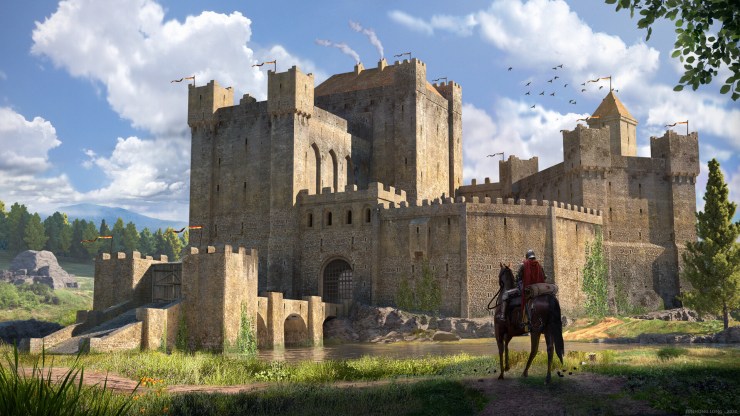
We’re going to do something a little different today. Please open the Bibles in front of you to Psalm 46. You can also find it in the front pages of the hymnal… We just finished the hymn that begins, “A mighty fortress is our God, / A trust shield and weapon.” Luther wrote this hymn when the Black Plague struck Wittenberg, Germany in August of 1527. While many fled, Luther and his wife, Katharina, remained in Wittenberg to treat the infected. It wasn’t that Luther thought it was wrong for someone to flee the plague, but his conscience would not allow him to leave; he wanted to continue providing medical and pastoral care to the sick and dying. Somewhere between 1527 and 1529, he wrote our beloved hymn. He based it on Psalm 46, which reads as follows, “God is our refuge and strength, a very present help in trouble. Therefore, we will not fear though the Earth gives way, though the mountains be moved into the heart of the sea, though its waters roar and foam, though the mountains tremble at its swelling.
“There is a river whose streams make glad the city of God, the holy habitation of the Most High. God is in the midst of her; she shall not be moved; God will help her when morning dawns. The nations rage, the kingdoms totter; He utters His voice, the Earth melts. The LORD of hosts is with us; the God of Jacob is our fortress.
“Come, behold the works of the LORD, how He has brought desolations on the Earth. He makes wars cease to the end of the Earth; He breaks the bow and shatters the spear; He burns the chariots with fire. ‘Be still, and know that I am God. I will be exalted among the nations, I will be exalted in the Earth!’ The LORD of hosts is with us; the God of Jacob is our fortress.”
The psalm begins with a similar anchor to our hymn, “God is our refuge and strength, a very present help in trouble.” Then it depicts what we might call a mighty storm, and there are two sides of this storm—all of creation is in an uproar, both the Earth itself and the nations. But there’s a very important word as the psalmist depicts this tempest. It’s not a word we normally pay particular attention to. The word is “therefore.” This word tells us the anchor—God—is still present amidst the storm. “God is our refuge and strength, a very present help in trouble. Therefore–[because of this]—we will not fear though the Earth gives way.” And there’s another word in there taken for granted; it’s the word “though.” “We will not fear though the Earth gives way, though the mountains be moved into the heart of the sea, though its waters roar and foam, though the mountains tremble at its swelling.” This is one side of the storm. On the other side, nations are raging and tottering, but God merely utters His voice and causes the nations to collapse as easy as fire melts wax.
When we pray this psalm, or sing the hymn it inspired, we are saying, “Even though the world around me rages like a wild tempest, I will not fear, because God is my anchor in this storm—He is my refuge and strength, my mighty fortress.” The world cannot even put a dent in God’s walls.
We love this psalm and the hymn because we know what it’s like to live in a turbulent world. Like Luther who pastored through the pandemic of the Black Plague, we went through the Covid pandemic. Granted, it wasn’t nearly as bad as the Black Plague, but it did take thousands of lives and it prevented many churches from gathering for worship. Three years later, things have improved in our country, but people are still suffering with something now called “long covid,” and there are rumours of another wave of the plague.
There is also political unrest in our country, and it seems our nation is tottering on the verge of collapse. When God utters His voice, will He cause America to melt, or will He mercifully sustain our nation despite its iniquities? Teachers and professors at our schools and universities are attempting to indoctrinate their children with harmful ideologies. Climate change alarmists still caution us that the world is going to end if we don’t use paper straws and electric vehicles. The war between Russia and Ukraine is still ongoing, and now the conflict between Palestine and Israel is raging even more. On the personal level, some of us here have serious health problems to deal with, whether physical or mental, with anxiety about whether our insurance will cover it. We are worried about what kind of world we will be leaving our children in, so many young couples don’t see the point in having children since the world is getting worse.
The Church isn’t doing so great either. For decades, there has been a mass exodus from the Church. People are increasingly “deconstructing” their faith, which is just another way of saying they’re falling into unbelief. Many youth do not stay in church after Confirmation. Some churches resolve to using screens and contemporary worship music because they think this will attract the youth, but it has only had the opposite effect because it’s not what they’re looking for. Culture and society are becoming increasingly anti-Christian as well. Politicians in Washington are colluding to remove the Church’s tax exemption status. Others want to take away our 1st Amendment rights entirely. America is getting dangerously close to threatening pastors with imprisonment for teaching the correct biblical view on gender and sexuality. If it can happen in Finland, it can happen here.
Many churches are also closing their doors permanently because they can no longer afford their building or a pastor since they have an old congregation whose members are dying. Other churches do not have a full-time pastor. In our own congregation, tensions rise whenever we talk about the deficit in our church budget, and the current rise of inflation certainly doesn’t help. We are constantly afraid that the Church, and perhaps our congregation, is on the verge of collapse like the nations around us.
But notice what is in the middle of this storm in the psalm. In the eye of the storm is a paradoxical calmness. That’s the irony of any earthly storm. In the eye of a hurricane, for example, is a surprising, beautiful calm. Likewise, in the centre of this raging storm in creation is a surprising, beautiful calm. On the one side, you have the trembling of the Earth [vv. 2-3], and on the other you have the raging of the nations [v.6]. But right in the middle [vv. 4-5] is this, “There is a river whose streams make glad the city of God, the holy habitation of the Most High. God is in the midst of her; she shall not be moved; God will help her when morning dawns.” Yes, the nations rage on the one side and the Earth is giving way on the other, but in the eye of this storm is “a river whose streams make glad the city of God, the holy habitation of the Most High.”
Another hymn helps us put this in perspective. It goes like this, “When peace, like a river, attendeth my way; / When sorrows, like sea billows, roll / Whatever my lot, Thou hast taught me to say, / It is well, it is well with my soul” [LSB #763 stz. 1]. This hymn was written by Horatio Gates Spafford, whose story is much like Job’s. In 1870, he and his wife lost their 4-year-old son to scarlet fever. A year later, a massive fire raged throughout downtown Chicago, causing Horatio to lose a lot of property, and therefore significant financial loss. Three hundred people lost their lives and 100,000 became homeless. Two years later, Horatio decided he and his family should take a holiday in England because they stayed in Chicago and did a lot of work to help grieving families and the homeless. But business delayed Horatio, so he sent his family ahead of him. While on their voyage, an iron sailing ship struck their vessel. All four of their remaining young children died, but Horatio’s wife, Anna, miraculously survived. When he received a letter from his wife about the news, he immediately set sail, and it was on that trip that he wrote the hymn, “It Is Well with My Soul.”
The words of this hymn perfectly describe the peace of that river in the City of God—it is the paradox of that peace amidst the storm of grief, fear, and anger. We can say, “Yes, the nations rage, and the Earth gives way, and my soul is deeply troubled. Nevertheless, it is well with my soul.” Why? As we continue in Horatio’s hymn, “Though Satan should buffet, though trials should come, / Let his blest assurance control, / That Christ hath regarded my helpless estate / And hath shed His own blood for my soul” [LSB #763 stz. 2].
Returning to the psalm, it encourages us to “behold the works of the LORD, how He has brought desolations on the Earth. He makes wars cease to the end of the Earth.” The people of Israel, when singing this psalm, would’ve recalled the many times God delivered them from the pagan nations around them. For you and me, these words ought to remind us of God’s work on the cross. In the centre of this storm stands a river because it flows from the pierced side of Christ on the cross, from which flowed blood and water. Before He ascended, Jesus said, “I am with you always, to the end of the age” [Matt. 28:20]. Jesus is the Lord of hosts who is with us; He is the God of Jacob, our mighty fortress. The work He accomplished on the cross is the defeat of sin, death, and the devil. Christ ended the war with that unholy trinity. That’s why Paul writes we are more than conquerors over tribulation, distress, persecution, famine, war, death, or whatever else in this world [Rom. 8:31-39] because we stand in the cross of Christ that shelters us from the storm of the world, sin, and the devil.
As St. John wrote in his first epistle, “The reason the Son of God appeared was to destroy the works of the devil” [1 John 3:8]. Therefore, when the events of the world cause you fear or anxiety, look to the cross and behold the work of the Lord, which brought desolation to the devil’s kingdom. That’s why we can sing, “Though Satan should buffet, though trials should come,” it is well with my soul, because Christ “hath shed His own blood for my soul.” And it is why we can sing Luther’s hymn, “Though devils all the world should fill, / All eager to devour us, / We tremble not, we fear no ill; / They shall not overpow’r us. / This world’s prince may still / Scowl fierce as he will, / He can harm us none. / He’s judged; the deed is done; / One little word can fell him” [LSB #656 stz. 3].
The kingdom of the world rages because their prince, the devil, rages like a frothing lion, but one little word can fell him. He ran from Christ in the wilderness after He felled him with the Word of God. What do you think happens, then, when you equip the Word of the Word made flesh? You fell the devil. The kingdom of the prince of this world has been laid desolate because Christ is crucified and risen for you and me.
Christ says in the Psalm, “Be still, and know that I am God. I will be exalted among the nations, I will be exalted in the earth.” Christ brings stillness in the midst of the storm. Just like when Jesus commanded the storm on the sea of Galilee, “Be still,” and it obeyed because He’s God [Mark 4:39], so He brings stillness to the storm that surrounds His City, the Church. It is His cross that anchors the stillness in us. He was exalted among the nations and in the earth when He was exalted on the cross. In His own words, “When I am lifted up from the earth, I will draw all people to Myself” [John 12:32]. When He was exalted on the cross, He drew people of all nations to Himself, even those whose nations are raging and tottering, and we are made still. And even though it appears the Church is tottering, she will not fall—she cannot—for the gates of Hell cannot prevail against her [Matt. 16:18]. “God is in the midst of her; she shall not be moved.” Christ in His ascension is still exalted over the nations and the Earth, as He said, “All authority in Heaven and on Earth has been given to Me” [Matt. 28:18].
So then, how might you be still and know that He is God today, and tomorrow, and the day after? How might you be still like the peace of a river that is the City of God, the Church? Jesus, the exalted one, says, “Come to Me, you who are weary and heavy laden, and I will give you rest” [Matt. 11:28]. Where can Christ be found? He is found where He promised to be: in His Word that fells the devil, and in His Body, the Church. The Church is His holy habitation. He is in the midst of her; therefore, she shall not be moved although the storm rages around her. In this mighty fortress, Christ’s Body, you sing hymns of peace in the centre of this raging world. It is here at the altar, Christ’s holy habitation, where He gives you His body and blood, which deliver to you the forgiveness of sins and peace with God.
We may be experiencing anxiety as the turbulent world rages, but Paul encourages us, “Do not be anxious about anything, but in everything by prayer and supplication with thanksgiving, let your requests be made known to God. And the peace of God, which surpasses all understanding, will guard your hearts and minds in Christ Jesus” [Phil. 4:6-7]. So, we also find peace in prayer. The opposite of anxiety is not the absence of anxiety, but prayer, supplication, and thanksgiving. And as 1 Peter 5 says, “[cast] all your anxieties on Him, because He cares for you” [v. 7]. Anxiety is self-care, and the opposite of this is confidence in God’s care—it is stillness in the holy habitation of Christ’s Church. Instead of walking to and fro, wondering what we ought to do, we force ourselves to be still before God, knowing His work is accomplished on the cross, which delivers life and salvation to us.
So then, when the storm out there in the world causes you fear and anxiety, you have here peace like a river in the City of God, the Church. That is why the liturgy is so important because while the world rages in chaos, here in the Divine Service you receive stability—you receive the same Word of God in His Law and Gospel, you sing the same hymns, and you receive the same sacraments because “Jesus Christ is the same yesterday and today and forever” [Heb. 13:8]. This isn’t the first time we the Church have needed this reminder in a chaotic world.
When the Roman Empire fell in 476, the Roman pagans were blaming the Christians for its collapse. In response, St. Augustine wrote a brick of a book called City of God in defence of Christianity. He quotes Psalm 46:4 several times throughout the book, and he identifies the city of God in the psalm as the Church. One of the things he wrote that struck me is this, “The Heavenly City [the Church] outshines Rome, beyond comparison. There, instead of victory, is truth; instead of high rank, holiness; instead of peace, felicity; instead of life, eternity” [City of God II.29]. Augustine contrasted felicity with peace because the Roman Empire sought world peace through conquest, false gods, and the distraction of the games. For Augustine, felicity means blessedness, which includes peace, and which comes only from God. And instead of Roman life—what today we call the American Dream—is eternity in the City of God. The world’s instability causes us to fear the fate of our nation, but nations rise and fall, whereas the City of God, the Church, stands forever because the eternal God stands in the midst of her.
You never know what you may get out there. But here you never need to worry, because you will always get the same Gospel and the same Sacrament for the forgiveness of sins, life, and salvation. You will always get the same Jesus because Jesus is the same yesterday, today, and forever. That means whenever you pray, Jesus always remains the same for you. He never judges your prayers or the sound of your voice when you sing. Christ the King always delights to hear the voice of His people in His City, the Church. It always delights Him to give us His Word of forgiveness in Absolution, which fells the devil. It always delights Him to give us the river of His Sacraments that flowed out from His side—Baptism and the Lord’s Supper.
The world rages in chaos, but here we remain still in our pews because we know Christ is God, who is exalted among the nations and the Earth, whose Word He has given us to fell the devil. The world changes, and nations rise and fall, but Christ is the same yesterday, today, and forever. World leaders die and stay die, but Christ the King is risen, who is Immanuel, God with us, our mighty fortress. He took the beatings of the world’s storm of rage and sin on the cross so that you don’t have to. Therefore, when we are weary and heavy laden, let us come to Him here, His holy habitation, and receive His peace like a river.
To Christ belongs all the glory, now and forever. Amen.
 The Lutheran Column