
Date: October 1, 2023
Festival: 18th Sunday after Pentecost (Proper 21), LWML Sunday
Text: Matthew 21:21-32
Preaching Occasion: Zion Lutheran Church, Mt. Pleasant, MI, and CTKLC
Appointed Scriptures: Ezekiel 18:1-4, 25-32; Philippians 2:1-18; Matthew 21:21-32
Sermon Hymn: LSB #655 Lord, Keep Us Steadfast in Your Word
Grace and peace to you from God our Father and the Lord Jesus Christ. Amen.
The sin of pride manifests itself in various ways. We all have sinful pride to some extent. It is the result of the variations of Satan’s lie in the Garden, “Did God actually say…”—of not liking what God has to say. When it comes down to it, none of us like being told what to do. That’s why what God says—like the 10 Commandments—can be so offensive to us at times. The 1st Commandment tells us not to worship any other gods, but only the God of Israel, and in protest people put up “coexist” bumper stickers on their cars. Others of us put our fear, love, and trust in sports, politics, technology, abstinence from technology, and other idols. The 2nd Commandment tells us not to misuse the name of the Lord, and yet we will curse with it, lie with it, and engage in the occult like psychic readings, tarot cards, and consulting with demons pretending to be our dead loved ones. The 3rd Commandment tells us not to profane the Sabbath, but we don’t like bing told to go to church because we’d rather sleep in, or go to our child’s sports game, or stay home and watch the football game.
The 4th Commandment tells us to honour our parents, and we forget that this has no age restriction. The 5th Commandment forbids murder, yet we dehumanise groups of people to justify killing them, even unborn babies. The 6th Commandment tells us what to do with our bodies and our sexuality, and we certainly don’t like that. There was a whole revolution against this commandment in the 60s, and it still thrives today. The remaining Commandments tell us what to do with our belongings and our mouths, but we’d rather not let God tell us what to do and instead dedicate our lives to acquiring wealth so that when we retire, we can “eat, drink, and be merry” [Luke 12:13-21]; and gossip is an itch we must always scratch. Our pride causes us to think we know better than the Ten Commandments, for our pride finds repentance offensive.
Whether it’s being told how we should spend our money, our time, or what to do with our lives, we don’t like others telling us what to do. It enrages us. I read a book a few months ago called Christians in the Age of Outrage by Ed Stetzer. He has simply taken notice that American culture has become a culture of outrage, and we Christians are hardly guiltless. As he says, “Outrage is motivated by a desire to punish or destroy rather than reconcile and refine. It is frequently accompanied by hubris and a confidence in its judgment, categorically rejecting any nuance. Outrage is fast and decisive rather than reflective, choosing to exhibit God’s retribution rather than reflect his persistent, steadfast love” [Stetzer, 80-81].
If you spend any time online, or watching the news, this becomes rather obvious. I can’t tell you how many times, in a single day, I come across videos of someone getting pulled over by the cops and they begin yelling at the police officer, a retail worker being yelled at because they can’t get a refund, or someone in fast food being yelled at because their order was wrong. And the comment sections are filled with people either validating the self-righteous anger of that person or shaming them. We Christians not only fill those comment sections as well, but we also become targets. Whenever we tell someone they’re sinning, for example, they say, “Jesus said, ‘Judge not, lest ye be not judged.'” But they conveniently leave out the rest of the verses where Jesus tells us exactly how we are to judge! They simply don’t like being told what to do or what to believe. You and I are hardly any different.
Perhaps it’s because we think being told what to do is for children. Yet sometimes when we’re told what to do, we ironically regress to infantile behaviour and react with the outrage of a child. “Who do you think you are?” we say. “What gives you the right—the authority—to say that?”
The chief priests and elders of the temple in Jerusalem responded in much of the same way to Jesus. Jesus was teaching and doing things with authority. He wasn’t a nobody. He was teaching with the authority of a rabbi, and He quickly gained popularity. As we would say these days, Jesus went viral. But the problem is, Jesus didn’t go through the normal process of becoming a rabbi, and yet He taught as one with such authority. He was only 12-years-old when He was recognised as being smarter and wiser than the rabbis at the temple [Luke 2:41-47]. As a grown man, He was teaching esoteric parables, His Sermon on the Mount was famous, and just before our Gospel reading today, He had just cleansed the temple because it was filled with money-changers. “This is a house of prayer, not a den of robbers,” Jesus shouted [Matt. 21:13]. And to add insult to injury, Jesus healed blind and crippled people right there at the temple. “Who do You think You are, Jesus?!” the chief priests and elders shouted. “By whose authority are You doing these things? What gives You the right?”
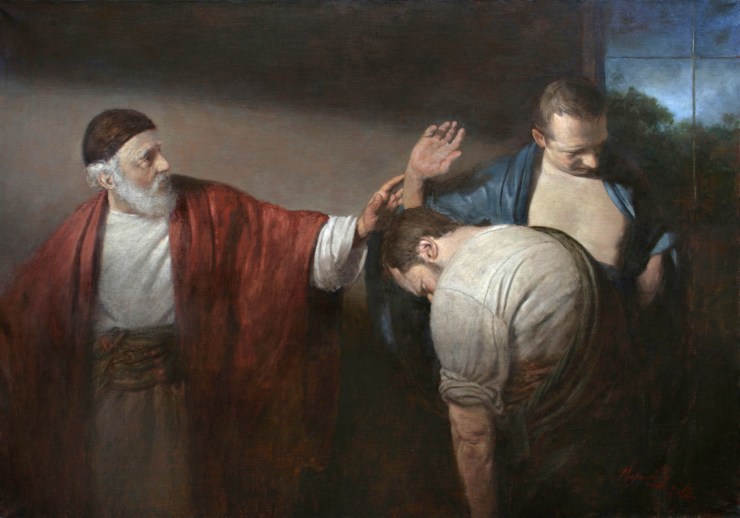
In classic Jesus fashion, He answers their question with a question, “Where did the baptism of John come from? From Heaven or from man?” But the elders and chief priests recognised the trap in Jesus’ question. They knew that if they answered, “from Heaven,” they would admit to John being sent from God. But they didn’t believe that. On the other hand, if they say, “from man,” they feared what the crowd’s response would be because they all believed John was sent from God—a prophet. So, Jesus answers the question for them in another classic Jesus fashion: a parable we usually call the Parable of the Two Sons. The first son refused to obey his father, but later he obeyed and went to do as his father said—to work in the vineyard. The second son immediately said he would obey his father, but in his great hypocrisy he did nothing. Now, who do these two sons represent?
For Jesus, the prostitutes and tax collectors are the first son who repented after hearing John’s preaching and received his baptism of repentance—they are the true believers. But the chief priests and elders of the temple did not believe John’s message, so Jesus does not consider them true believers because by rejecting John’s message—the one who came to prepare the way of the Messiah—they reject Jesus’ message. They are the second son who always immediately say they obey God the Father, but they do not. If they truly were obedient to God, then they would have believed John’s message, and they would therefore believe Jesus’ message since He was sent from the Father [John 7:28-29]. Indeed, they looked down on these repentant sinners, but they are the true people of God.
Like the first son in the parable, at first, the prostitutes and tax collectors did not obey God the Father, but then they turned from their ways—they repented. By their repentance, they entered the vineyard, that is, the kingdom of Heaven. In our Old Testament reading, we didn’t hear a very important verse. In verse 23 of Ezekiel 18, God says, “Have I any pleasure in the death of the wicked, declares the Lord GOD, and not rather that he should turn from his way and live?” The word for “turn” here is the same word for “repent” in Hebrew; it works the same way in Greek. God desires that the wicked should repent—turn—from his way and live. If the chief priests were truly obeying God, they would’ve believed John’s message—and therefore Jesus’ message—and repented, but they do not even though they say they obey Him. The sinners who repent are the ones who truly obey God the Father and thus enter His kingdom. The path of unrepentance walks in the kingdom of the devil, which leads to destruction. The path of repentance turns from this wicked path and walks in the kingdom of Heaven, which is full of sweet life like a vineyard.
The first son “worked out [his] salvation with fear and trembling,” as we heard from Paul [Phil. 2:12]. “Repent” not only means “to turn” but also “to have a change of mind.” With reverence and awe for his father, the first son turned from his stubborn sin—he changed his mind, as the text says—and did as his father said. The second son was so big headed that it’s a shock he didn’t fall over with such swollen pride. A person who fears, loves, and trusts in the Lord repents because He trusts in God’s promise of mercy. A person who fears, loves, and trusts in themselves or some other false god refuses to repent, even while deluding themselves that they are obedient.
The aim of the Gospel is to make you and me the first son. Now, we speak of the Gospel in two senses. In its narrow sense, which is the way we usually speak of it and use it, the Gospels brings comfort and forgiveness of sins [FC Ep V, 7]. So, when you walk into either of your pastors’ offices, burdened by your sin and repentant of your sin, we will give you the Gospel for the forgiveness of your sins. The wide sense of the Gospel includes the proclamation of both repentance and the forgiveness of sins [Ap XII, 29], which you hear in every sermon. So, the aim of Jesus’ message—the Gospel—is to make us the first son. We hear the Word of God that calls us to repentance, and even though we might not like what God says at first, the Holy Spirit works to bring us to repentance—to turn from our wicked ways and live in God—to literally have a change of mind. But if we resist the Word and the Holy Spirit, we become the second son, big headed in our sin and self-righteousness.
The parable, then, brings us to ask two questions of ourselves. The first is: Who might you be in the parable? Are you the first son who, after being stubborn in your sin for a while, you nevertheless repent and turn from your wicked ways? Or are you the second son, Christian in name only, refusing to repent of your wicked ways and live in the Lord? How might the Lord be calling you to repentance today? Which of the Commandments are nagging your heart? Do you disagree with this soft voice of the Holy Spirit? Will you repent and live, or pretend you haven’t done anything, or that your sin isn’t really that bad?
The second question is: Are there any repentant sinners you might be looking down on? One of my friends is a pastor at Family of God in Christ Ministry in southwest Detroit. People usually refer to their ministry as “the homeless church” because most of their congregation is made up of homeless people and recovering addicts. They minister to people who’ve been prostitutes, people still wrestling with severe addiction issues, and people who can’t seem to get out of homelessness because of various factours that have nothing to do with laziness. Many people call them “the homeless church” or something else in a pejorative way, not out of kindness. But my friend and the other pastors take that as a compliment because these are repentant sinners—these people are the first son in the parable. Yes, they might have resisted the Father for a while, but then they walked into Family of God Ministry—the Father’s vineyard in southwest Detroit—and received the Lord’s fruits. Meanwhile, the second sons look down on these first sons—these repentant people who believe the Gospel of the Lord and receive His mercy.
What first sons might you look down on? Is it the homosexual who’s repented and taken a vow of celibacy? Is it the recovering addict who’s repented and will constantly battle with sobriety for the rest of his or her life? Is it the adulterer who has since repented and changed their ways? Like the Lord urged the chief priests and elders to change their minds—to repent—and believe John’s message about the Christ, so the Lord calls you to change your mind, repent, and believe the Gospel of the Lord so that you may have life. Rather than being arrogant second sons, let us look at the first sons among us with “affection and sympathy,” as we heard from Paul today [Phil. 2:1].
Again, the aim of the Gospel is to make you the first son, and the Lord has given us gifts—the Word and Sacraments—by which we can turn from our wicked ways and live in Him. Our services always begin with Confession and Absolution to do exactly that—to confess that we have sinned in thought, word, and deed and cannot free ourselves from our sinful condition. Therefore, we rely on the infinite mercy of God, our heavenly Father, to grant us forgiveness for the sake of Christ. If you’ve been reminded of any sin since then, you will have another opportunity at the Lord’s Supper. You will have a moment to confess your sins to Christ as you kneel before the altar just before He gives you His body and blood—the fruits of His vineyard in the bread and wine—for the forgiveness of sins, life, and salvation. But if you can’t remember any or you remember one later, don’t worry—it’s covered in the blood of Jesus.
We give you the Sacraments every Sunday for the sake of good order, but you don’t have to wait till Sunday in the case that a particular sin is burdening your conscience in the middle of the week. Again, you have two pastors who are available to give you private Confession and Absolution, or the Lord’s Supper privately. These Means of Grace are the Lord’s gifts to you for your pastors to use as often as you need it.
The Church, then, is filled with first sons—with people who were prostitutes, addicts, unbelievers, adulterers, liars, thieves, murderers, slanderers, and so on. Only a God full of love can take people like us and make us His sons—into a family, a family that takes care of one another because of the Father’s love. He is our Father who gives us not punishment when we repent, but a vineyard—abundant, sweet life through the blood of Christ our Lord, to whom belongs all the glory, now and forever. Amen.
Bibliography
Stetzer, Ed. Christians in the Age of Outrage: How to Bring Our Best When the World Is at Its Worst. Carol Stream, IL: Tyndale Momentum, 2018.
 The Lutheran Column