
Chapter 7: The Living Body
This chapter is much shorter than the rest, and it doesn’t necessarily provide any new information but rather serves as a comforting conclusion to Kleinig’s survey of Lutheran anthropology. It summarises the entirety of the book as follows:
All human life on earth shares the same common condition: it is lived in the body… Our spiritual life on earth is also life in the body. It is the life that we live with the triune God, Father, Son, and Holy Spirit. More correctly, it is the life of Jesus in us, our life of faith in him, his eternal life that he shares with us, as we live for a short while in our bodies here on earth.
p. 216
Kleinig does not shy away from the Gospel when he says that God sees the body He has given you at birth from three different viewpoints: who you once were apart from Jesus Christ His Son, who you are now in Christ, and who you will be with His Son, “but not in that order” (pp. 218-219). God first of all sees you as you will be when you see Him face-to-face with His Son, Jesus. He already regards you with your resurrected and glorified body. He regards you in that light because He sees you clothed in the righteousness and purity of Christ (which your pastor represents for you in the vestments he wears in the Divine Service, by the way). God does not overlook your sin, but your sins cannot stop God from re-imaging you in Christ Jesus His Son.

Kleinig ends the book with grounding our bodily identities in “three homes.” Drawing from his own vocations, our first home is with our parents and siblings. As he opened this final chapter with, “We were conceived with embryonic bodies in the body of our mother” (p. 216). Therefore, our first home is with our parents and siblings “because God has created me with my body through my father and mother” (p. 220). Even if you’ve lived in more than one place with your parents and/or siblings—and even if your parents are divorced—you have one home with your parents who love you. The same is true for those who are adopted. While your body may not have come from your adoptive parents, they nevertheless have grafted you into their parental home and made you a member of their family, just as God the Father makes us members of His family in Baptism.
Our second home, if one is married, is with our spouse and children. As Kleinig speaks of his wife, “I am now one flesh with her and at home with her. My body belongs to her, just as her body belongs to me… She is the fixed, unaltered physical point of orientation for me with my ever-changing body” (p. 221). In the same way, no matter how many places you live with your spouse and/or children, your home is with each other. When I was in the U.S. Army and single, I would always say, “Home is wherever I take my boots off.” Similarly, home is wherever your spouse and children embrace you.
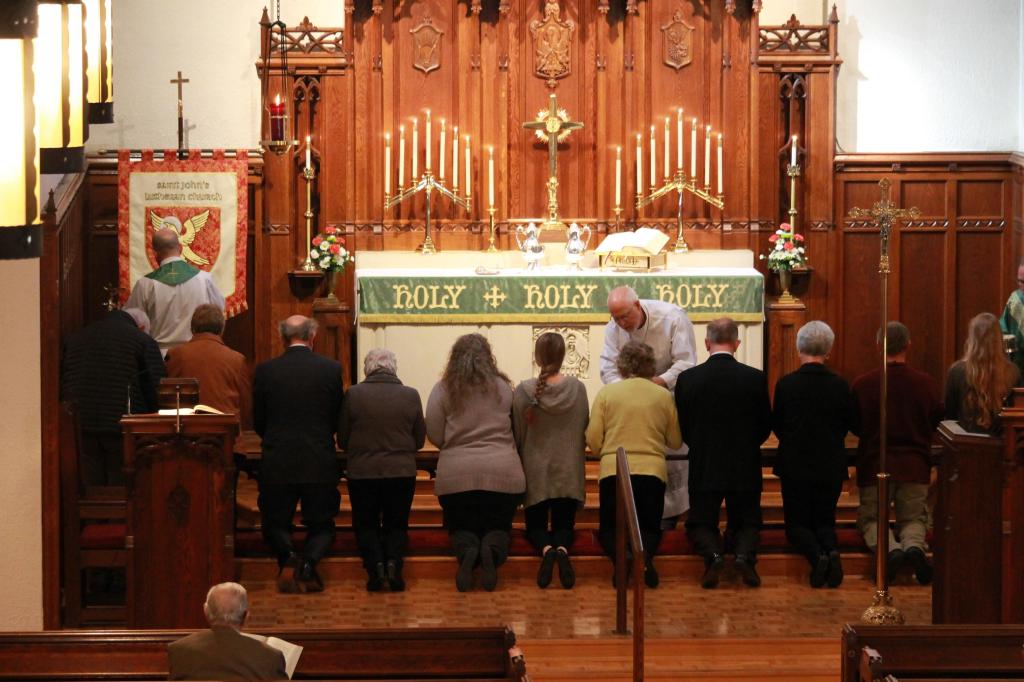
Lastly, whether single or married, our third home “is with Jesus and his Father. That home is the house of the heavenly Father, which belongs to Jesus as his Son (Luke 2:49); it is his home that he shares with us and all the saints (John 14:1); it is that place where Jesus is at home with us and where we are at home with him… His home became my spiritual home when I was baptized and has remained my spiritual home ever since. In the church, I live my life in the body together with Jesus” (p. 221).
Thus, by way of living by example rather than argument, we uphold the 4th Commandment in continuing to honour our father and mother no matter how old we get (see also Luther’s explanation in the Small Catechism in how we keep this commandment), we remain faithful to our spouse (see 6th Commandment explanation), and whether single or married we come to our home church to receive the Word and Sacraments that unite us to Christ’s body in the communion of saints (see 3rd Commandment explanation).
If you got this far in this long review essay, I sincerely thank you for your readership and I strongly encourage you pick up your own copy of the book and read it, especially as there are terrific insights from Kleinig I purposefully neglected to cover. Kleinig’s Wonderfully Made has not only benefited me intellectually concerning Lutheran anthropology, but it has also certainly enhanced my understanding of my own body and my relation to those around me according to my vocations as well as to Christ my Saviour. I pray that as you pick up this book and patiently read through it as it challenges today’s cultural thinking, that it does the same for you.
 The Lutheran Column