
Chapter 4: The Spiritual Body
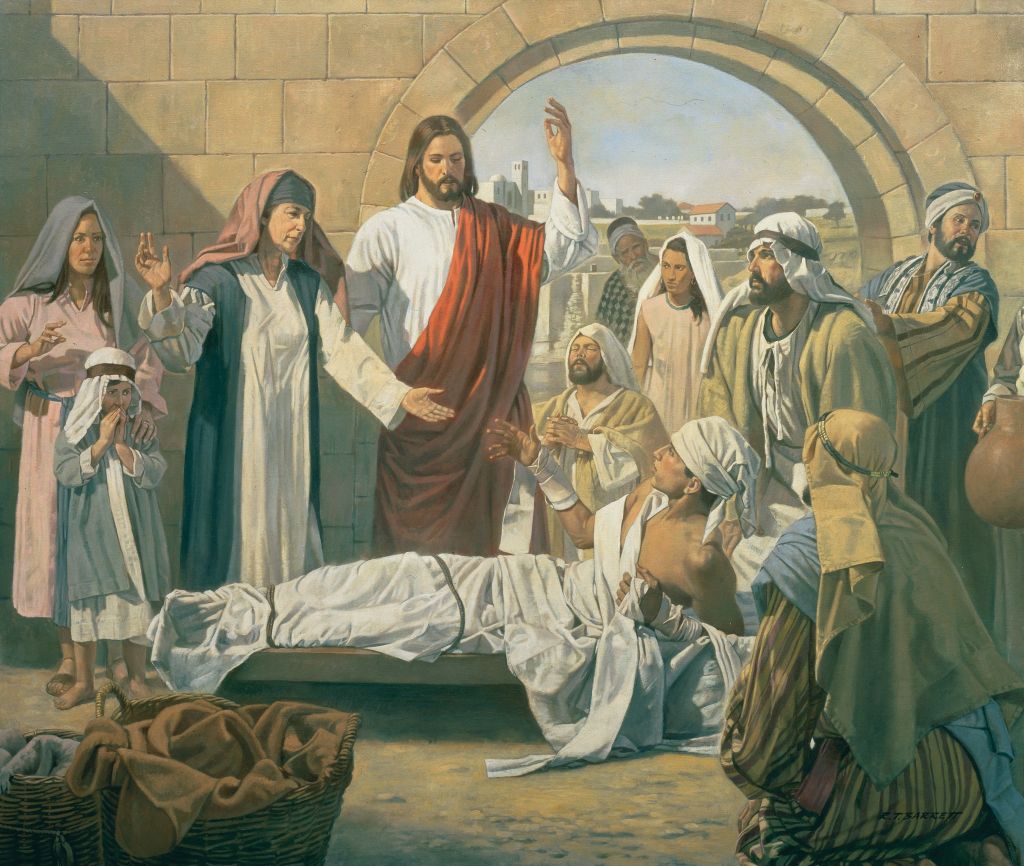
This chapter deals with the death of the body, particularly that our bodies in the bodily resurrection will be spiritual bodies. Kleinig begins this subject with Luke 7:11-17, the raising of the widow’s son in a town called Nain, as a framework for two possible ways of living: death apart from Jesus or death with Jesus.
With death apart from Jesus, the widow and those accompanying her in the funeral procession are dying people who are carrying “a dead man to be buried, before they, too, are carried by other people to the same place of death.” On the other hand, a death with Jesus is portrayed in Jesus’ approaching the funeral procession and the widow’s dead son. He “touches the unclean corpse of her son with his holy hands to remove its death with his own living body and give it life from his own body. Then, strangely, he addresses the corpse of the young man as if he were merely asleep, commands him to arise, and restores him to life… With that reunion the funeral procession is turned into a triumphal victory procession” (pp. 106-107).
Many choose the former death to die apart from Christ and make hopeless attempts to avoid it through diet and exercise. “We are just born to die,” they remark. Thus, they choose hopeless nihilism, believing in the meaninglessness of life since the moment we are born we are just preparing for death, while they also make the self-contradicting claim that “life is what you make of it.” If we are all just born to die and life is therefore meaningless, then “life is what you make of it” doesn’t matter.
Conversely, as Christians, “the death of a believer is not a period but a semicolon. With [Jesus] the course of an earthly life passes through the gate of death to eternal life with God the Father. And that happens already now as soon as we hear God’s word and believe in Jesus as God’s Son (John 3:16, 36; 5:25; 1 John 5:12)” (p. 108). The crux of this chapter, therefore, can be stated as follows:
So from faith’s point of view, the course of life in the body ends in life rather than death. In fact, our spiritual life began with death, for even though we were physically alive, we were born spiritually dead without any ability to fear, love, and trust in the living God, dead in our transgressions and sins (Eph 2:1, 5; Col 2:13). From the moment of our conception, we were all disconnected from the source of life, like a branch cut from a vine, and so not yet enlivened by the life-giving Holy Spirit. We were all spiritual zombies until the risen Lord Jesus gave us eternal life through a new birth by water and his life-giving Spirit (John 3:5; Col 3:11-13; Titus 3:4-7; 1 Pet 1:3). Thus, eternal life begins for us already now in our bodily existence, for by faith we now share in the divine life of Jesus.
pp. 108-109
In other words, because Christ’s life-giving Holy Spirit enlivens us by faith and Baptism, we begin life in our spiritual bodies now to be fully revealed in the life that is to come upon Christ’s Parousia, which Kleinig develops further later into the chapter.
For now, Kleinig teaches the reader to avoid the common Gnostic misunderstanding of death. Many people today, like the ancient Gnostics, believe that we are prisoners in our physical bodies. So, they think that when we die, our souls leave our bodies and we are finally free. They are not wrong that our souls leave our bodies, because that’s what makes death, well, death. But that’s not the full story. In death, “we don’t put [our bodies] off like dirty clothes in order to free our souls from our bodies, as if they were a burden or perhaps even a prison for our souls. Instead, we who trust in Jesus put off our bodies like worn out, shabby clothes in order to put on our best dress, a new, perfect body over us” (p. 111).

The Scriptures speak of this death as a threefold event. First, in Baptism, Christ “took off our old self, the old Adam, and dressed us up with a new self, a new Adam (Col 2:11-12; 3:9-10)” (p. 111). As Paul also says in Galatians 3:27, in Baptism we have “put on Christ.” And as he says in elsewhere, in Baptism we have “died to sin” and are now “alive to God in Christ Jesus” (Romans 6:1-11). Thus, right now, as a baptised Christian you have experienced death to sin and therefore experience new life in Christ on this earth.
Furthermore, there is an ongoing new life on this earth, which Paul calls “[walking] in newness of life” (Romans 6:4). As Kleinig says, “The transformation that began with the rite of Baptism continues for as long as we live here on earth.” This means, “The disciples of Jesus do not just reflect his character, his nature as God’s Son; they are also called to be like him in how they act and in what they do” (pp. 111-112). Baptism’s “newness” of life means a new way of living. This further means that we give up our former sinful ways of living and walk in the way of the Lord. What this looks like will become clearer at the end of the chapter.
The last event is, of course, our eschatological clothing. “We are not destined to become discarnate souls, naked wraiths, disembodied ghosts, when we die. Nothing could be worse than that!” Rather, we are “becoming even more fully embodied. That is what God has promised us and prepared for us by the incarnation of his Son” (p. 113)! As we live life anew as God’s baptised children, we therefore look toward life as spiritual bodies fully realised and glorified when Christ returns in all His glory.
Therefore, as Christians, we have a double comfort. (1) We don’t have to fear death anymore, and (2) we can welcome God’s coming judgement because we’re innocent. Kleinig describes this first comfort in a consoling way:
People in the ancient world commonly pictured death as a greedy monster that lived in the sea or the watery underworld. When they died, they fancied that they were swallowed up as by the waters of the sea; they were overwhelmed and engulfed by death… Death was envisaged as a hungry, flesh-eating monster with a large mouth and even larger belly. In an amazing reversal of that normal pattern, Jesus himself fulfills the prophecy of death’s death in Isaiah 25:7. By his death, Jesus not only swallows up death, that awful life-gobbler, but also promises to swallow up all that is mortal in us by his life. Our bodies will finally be overwhelmed and engulfed by life rather than death.
p. 114

As Christians, we no longer fear death because Christ’s death has swallowed up Death itself. To be sure, all of us will still experience earthly death, “For the wages of sin is death” (Romans 6:23). Christians will still face death, “but,” Paul continues, “the free gift of God is eternal life in Christ Jesus our Lord” (Romans 6:23). People try so arduously to ignore and avoid death with the best diet and exercise routines, with cosmetic surgery, and even science-fiction nonsense like the prospect of uploading our consciousness to a cloud server. We may try to ignore and avoid death, but Death will inevitably force us to confront it. But thanks be to God that through Christ we can look Death in the face and say, “O death, where is your victory? O death, where is your sting” (1 Corinthians 15:55)?
The author of Hebrews says that when we die, we come to judgement (Hebrews 9:27). As Christians, our second comfort is that we can actually welcome God’s judgement because His judgement has passed over us in Christ on the cross. We call this justification by faith, which Kleinig describes well:
Even though [Jesus] was without sin, God charged him with our sin and condemned him to death as a sin offering for us (Rom 8:3; 2 Cor 5:21); because he was without sin, God also raised him with his body, in order to give us his purity, righteousness, and innocence (Rom 4:24-25). So instead of being put to death, we receive forgiveness of sins through Jesus (Luke 24:47)… He does not just pardon the evil deeds that [sinners] have done but also frees them from the sinful state of mistrust of God and rebellion against him… That welcome word of pardon is God’s judgement which they hear already now, long before they stand before his tribunal at the end of the world…
That changes the prospect of judgment for us so completely that we need now no longer dread it but may welcome it instead.
pp. 115-116
In short, we welcome God’s judgement because it means we will hear the final declaration of our innocence—our justification—in Christ from God’s own mouth while our enemies face their doom under God’s wrath.
After rehashing our being “re-imaged” in Christ via Baptism, Kleinig finally gets to the crux of the chapter, which is that we will be spiritual bodies in the bodily resurrection. You should read what he says on your own, but another longer quote is worth sharing concerning the myth that we will be “spiritual,” as in ghostly, beings in the resurrection. Drawing mostly from Luke, Kleinig says:
Contrary to common belief, we will not be raised as disembodied souls… An existence as a ghost is no life at all, for ghosts are the living dead, diminished entities, homeless souls that haunt the realm of the living without enjoying life at all. We will also not be raised with exactly the same bodies that we have here on earth. That, too, would be [a] horrible prospect, for we would be stuck with our present damaged bodies and be burdened by all their infirmities and disabilities. Rather, we will be raised from the dead with splendid bodies that have been completely changed. Even our scars, if they remain with us, like the scars of Jesus (Luke 24:40; John 20:20, 27), will be transfigured and transformed.
p. 125
Kleinig looks at other Scripture passages worth reading on your own to support this accurate claim. For now, it should suffice to say, “Our resurrected bodies will differ from our natural bodies because they will be completely animated by God’s Spirit. They will be spiritual bodies” (p. 128). He discusses this for several pages, which is an exciting read, but I want us to return to the main premise of the book, that we are to live by example rather than by argument. At the end of this chapter, Kleinig offers seven ways to live as examples concerning the spiritual bodies we will have in the bodily resurrection.
The first has to do with what we confess about the resurrection, which has two parts to it. (A) The fundamental Christian doctrine of the resurrection “provides us with a sure, eternal foundation for our life in the body here on earth and governs what we do with our bodies” (p. 136). As Paul would say, “Glorify God in your bodies” (1 Corinthians 6:19). This means you take care of the body God has given you. Don’t smoke, don’t drink a lot, don’t eat a lot of junk food, don’t put yourself in unnecessary risky situations, get the common vaccinations (I’m not talking about COVID vaccines), don’t cover yourself in excessive tattoos and piercings, and so on. In short, live as if the body God gave you matters, because it does matter to Him, since He is going to raise it from the dead completely new and restored in His perfect image.
And (B) “with that sure and certain foundation [of the resurrection] we can be sure that no task that we undertake in his service, in the world, the church, our families, or our congregations, will be in vain, because we are not working for time but for eternity” (p. 136). In other words, we can take seriously the vocations God has given us on the earth, whether these vocations be in the world, our families, or our congregation. As Jesus said, “Do not lay up for yourselves treasures on earth, where moth and rust destroy and where thieves break in and steal, but lay up for yourselves treasures in heaven, where neither moth nor rust destroys and where thieves do not break in and steal. For where your treasure is, there your heart will be also” (Matthew 6:19-21).

To put this another way, we fulfil the vocations God has given us not in the vain attempt to raise up kingdoms on earth but because we know we are destined to God’s eternal kingdom. Instead of clinging to the promising utopias of politicians, we cling to the kingdom of God to come descending on the clouds. We do what He has given us to do not for our own glory but for His glory.
The second way we live by example is what Kleinig calls Easter jubilation:
[This life] calls for thanksgiving during the fifty days of rejoicing from Easter to Pentecost and on every Sunday. It calls for festive thanksgiving whenever we celebrate the death of death in Holy Communion. It calls for songs of praise and musical celebration that express what cannot be otherwise expressed. But, most of all, it calls for daily, lifelong jubilation, full-bodied, wholeheartedly rejoicing that anticipates and echoes the joy of eternal life with God in heaven.
p. 137
If you haven’t noticed by now, much of our living by example has to do with attending corporate worship. Regarding our Easter jubilation, we celebrate the foundational doctrine of the resurrection through Christ’s own resurrection not only on Easter Sunday, and not even every Sunday is enough, but also throughout each week. How? Through singing, whistling, and living with the joy of the resurrection. I myself often find myself whistling hymns in public, and I no longer live a gloomy life from Monday to Saturday because of the promise of the resurrection. Neither should you. This doesn’t mean you have to be a smiling idiot 24/7, but simply that you live each week with the joyful knowledge of the resurrection you will experience rather than the hopeless, fatalistic doom of our culture’s contemporary nihilism.
Third, if we are to physically live out the hope of the resurrection, this also means we proclaim it. Francis of Assisi is often attributed for saying, “Preach the Gospel at all times. Use words if necessary.” It’s debated whether or not he said this, but whether or not he did, the saying is ludicrous. The very word “Gospel” itself, which also means Good News, necessitates speech. We can live out the joy of the Gospel, certainly, but that won’t do much if we don’t speak about it. Indeed, how can we live in the joy of the Gospel if it is not first preached? As Kleinig says:
The resurrection of Jesus must be preached for us to participate in it and benefit from it… Preaching the gospel does not just tell us that Jesus has abolished death, but it actually brings his life and immortality to light in us (1 Tim 1:10)… Thus, the preaching of the resurrection does not just offer the hope of eternal life after death; it actually raises people from spiritual death here and now.
p. 137

This does not mean we don’t preach the Law, for the Law kills and the Gospel brings to life. One cannot be brought to life if they don’t first die. One cannot be freed from their sin if they don’t first die to it. When we go through our seminary training, there’s a simple phrase that’s ingrained into us throughout our homiletics classes: “The Gospel must predominate.” As a pastor myself, I have taken Paul’s confession as my own, “For I decided to know nothing among you except Jesus Christ and Him crucified” (1 Corinthians 2:2). Not just crucified, but crucified for you; and His crucifixion also assumes His resurrection for you.
This proclamation goes not only for pastors but also for laypeople. You can preach the Law all day long at people who are living in sin, but that won’t do any good if you neglect to give them the Gospel for the forgiveness of their sins.
Fourth, we live by example in our daily baptism/self-denial. “Jesus calls us as his disciples to deny ourselves and take up our cross daily as we follow him on the way that leads us through death to eternal life (Luke 9:23-24). Our old way of life is over because we now belong to Jesus in body, soul, and spirit. We walk with him in the land of the living (Ps 116:8-9)” (p. 138). In picking up our cross daily and following Jesus—in our daily self-denial—we deny the way we once lived before Christ met us with His all-availing death and life.
We can also think of this daily self-denial as our daily baptism since in Baptism we have died to sin and rise to new life in Christ. In Luther’s words, “So a truly Christian life is nothing other than a daily Baptism, once begun and ever to be continued… that we always keep purging away whatever belongs to the old Adam” (LC Part 4, 65). This daily baptism happens in nothing other than repentance—and all repentance ends in forgiveness—since Baptism itself begins with repentance and ends in forgiveness.

Kleinig suggests we put this daily baptism, or self-surrender, in practice through evening and morning prayer. “On the one hand, we undergo a little death every night by the practice of daily repentance… Each night before we go to sleep, God urges us to confess our sins and seek his pardon” (p. 139). You could do this with the service of Evening Prayer in the hymnal you have at home, or the short evening prayer Luther wrote in the Small Catechism by making the sign of the holy cross and saying:
In the name of the Father and of the † Son and of the Holy Spirit. Amen. I thank You, my heavenly Father, through Jesus Christ, Your dear Son, that You have graciously kept me this day; and I pray that You would forgive me all my sins where I have done wrong, and graciously keep me this night. For into Your hands I commend myself, my body and soul, and all things. Let Your holy angel be with me, that the evil foe may have no power over me. Amen.
Daily Prayers, Luther’s Small Catechism
And, “On the other hand, we also undergo daily renewal by the Holy Spirit each morning when we get up from our beds. Our waking from sleep each morning prefigures the resurrection of our bodies” (p. 139). Thus, you can also do this with the service of Morning Prayer in your hymnal at home or the short morning prayer by making the sign of the holy cross and saying:
In the name of the Father and of the † Son and of the Holy Spirit. Amen. I thank You, my heavenly Father, through Jesus Christ, Your dear Son, that You have kept me this night from all harm and danger; and I pray that You would keep me this day also from sin and every evil, that all my doings and life may please You. For into Your hands I commend myself, my body and soul, and all things. Let Your holy angel be with me, that the evil foe may have no power over me. Amen.
Daily Prayers, Luther’s Small Catechism

The fifth way we live by example concerning our spiritual bodies in the coming resurrection is the way we do our funerals. Trying to ignore the tragedy of death, people will turn funerals into “celebrations of life” or, staying true to our contemporary Gnosticism, will have balloons or doves being released to symbolise the deceased’s spirit leaving their body and thus being “free” from their so-called bodily prison. As Christians, the way we do our funerals must be vastly different than the rest of the world. The church, after all, is holy—or set apart—which means we fundamentally look, speak, and act differently than the rest of the world. Kleinig makes a good suggestion:
The church must not embrace any kind of discarnate spirituality. Instead, congregations should, if at all possible, continue to hold funerals for their members in their sanctuaries rather than in a secular funeral parlor or at a crematorium; funerals with coffins next to the baptismal font, if at all possible, to acknowledge that the wages of sin is death and to celebrate the free gift of eternal life through the Lord Jesus; funerals that do not offer fake hope to the grief-stricken but the sure and certain hope of the resurrection of the body. Even though the Bible does not forbid cremation, the church would do well, in our present context, to encourage the burial of the body on hallowed ground as a powerful, countercultural witness to the resurrection of the body, like our ancestors and Christians in the early church… While we may rightly grieve the loss of those who have died, we must also rejoice with the hymns of praise that celebrate the resurrection of our bodies.
pp. 140-141
As I preached at one funeral of a member who died, only Christians can genuinely smile at a funeral. So that you will better understand what I mean, I would like to share a short segment from that sermon I preached on John 14:1-6. I have changed the names to protect their identities:
Phyllis, you told me a story about Martha and the Lord’s Supper that I’ll never forget. The last time I visited Martha was two days just before she had passed, and at the time I didn’t know I had given her her last Communion. Physically, Martha was very weak, and I didn’t truly know how strong her spirit was until you had told me that after I ran into you and Laura on my way out, you told her you guys talked to me and she looked up at you, smiled, and said, “Communion.” She smiled because one of the last things she consumed in this world was Christ—the Way, the Truth, and the Life.
This smile of hers reminded me of another one of her smiles during my visits. Every time we read through Psalm 23 together, whenever we got to the part that says, “Even though I walk through the valley of the shadow of death, I will fear no evil, for You are with me,” she would smile. She never frowned in this valley of death, but rather she smiled because she knew the Light of the world walked beside her in this dark valley to be with Him on the other side.
Unlike the Gnostics around us, we don’t celebrate the life of the dead person but the eternal life of Jesus Christ given to him or her. Therefore, we don’t preach eulogies praising the dead person’s good works but rather the pastor preaches a sermon of the perfect works of Christ who died and rose again for this person sleeping in his or her coffin until they rise again when Christ returns in glory.

The sixth way we live by example is how we commemorate these saints who have passed. Many will utilise harmless means like tattoos and shrines to honour their departed loved ones. Others will utilise much more harmful means by consulting demons through mediums, psychics, and ouija boards. Rather than these pagan and demonic means, as Christians “we can stay in touch with them physically and personally in Holy Communion, for Christ’s body is the only link between the living and the dead” (p. 141). We have a special day for this as well, called All Saints’ Day.
What Kleinig is talking about is what we call the communion of the saints, which we confess in the Apostles’ Creed (“I believe in the Holy Spirit, the holy Christian Church, the communion of saints,” etc.). Simply put, the communion of saints are the people of God—past, present, future, dead, alive—who believe in Jesus Christ their Lord and thus united to one another under His headship in the Body of Christ, the church (1 Corinthians 12:12-26). Thus, as those who have fallen asleep in the Lord are now communing with Christ in His physical ascension, we commune with Christ and with our departed saints in the holy Sacrament of the Altar where His saints on earth commune with His body in the Holy Supper. Through the mystery of this sacrament, we are still communing with our loved ones who are now with Christ our Lord.
Lastly, we live by example in modest dress. Kleinig is worth quoting in full here:
Despite the modern cult of nudity, our contemporaries are obsessed with dress and impressed by how people dress… It seems to me that, in addition to the desire to attract attention and admiration, our obsession with fashion assumes that our bodies look best when they are best dressed—dressed in a way that covers up our least attractive features and enhances our most attractive features, dressed in a way that shows our shape in the best light and focuses attention on our uncovered faces…
Our desire to be well-dressed may unconsciously prefigure the resurrection of the body, for when our bodies are raised from the dead, they will not be naked; we will be clothed with incorruptible purity and immortal holiness… St. John sees the saints dressed in white linen like the priests at the temple (Rev 3:4-5; 4:4; 6:11; 19:9; cf. 3:18). Christ himself provides them with these bridal vestments (Rev 19:8)…
So for us, our dress does not just display our social status, identity, and self-regard; it discloses our spiritual status, identity, and honor as citizens of heaven.
pp. 142-143
To avoid any confusion, dressing modestly is not the same as dressing up. We all too often equate the two. The purpose of “dressing up,” as Kleinig said, is to cover your least attractive features and to accentuate your most positive features. The purpose of dressing modestly, on the other hand, is to disclose our identity as citizens of God’s kingdom and therefore honour own bodies. You should dress like the child of God you are, not like the child of disobedience you once were. This goes for both men and women. Leave your short skirts, short shorts, and muscle t-shirts at home. In fact, you should leave them out of your wardrobe entirely, for you are still a child of God when you’re not at church and should act and dress like it.
As a pastor, people will often ask me how they should dress for church. What I tell them is that there is no Scriptural or ecclesiastical requirement to “wear your Sunday best,” as we often put it. This is because (A) Jesus approached lepers and prostitutes in ragged clothing, so He doesn’t care what you look like; and (B) by “dressing your best for Jesus,” you’re not fooling Him! You’re only fooling yourself, and perhaps trying to fool others. Jesus still sees what you’re trying to cover up, but He doesn’t care because He still invites you to approach Him at the altar for the forgiveness of your sins.
Do you have to dress up in a dress, or shirt and tie, or a suit every Sunday? Of course not. Can you? Sure, if that’s your preference. On the other hand, can you come to church in pyjamas? Sure, you can. Should you? Probably not, because you’re in public for crying out loud. Either way, modest dress is the standard, not your best dress or dressing like a slob. Such modest dress prefigures the modest dress we will have in the new creation.
This last example of modesty sets the stage for the next chapter on our sexual bodies.
 The Lutheran Column